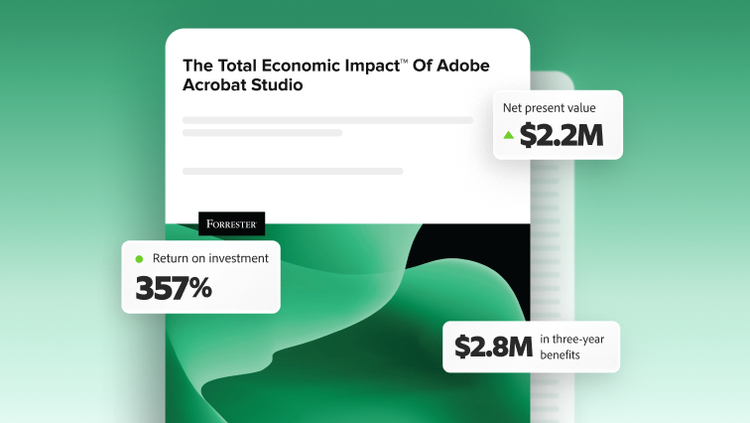
Forrester’s TEI study unpacks the 357% ROI achieved with Adobe Acrobat Studio.
09-10-2026
Every business carries a hidden productivity tax, showing up in the time and effort spent turning scattered information into action. Teams work across a growing volume of documents, spending hours searching PDFs, extracting insights from presentations, tracking updates and distilling thousands of pages into a clear, leadership-ready perspective. As documents multiply, so does friction across the workflow, creating delays and slowing execution. This is the challenge examined in Forrester Consulting's study, commissioned by Adobe, The Total Economic Impact™ Of Adobe Acrobat Studio.
The study quantifies the business impact of reducing this friction through the AI-powered capabilities of Adobe Acrobat Studio, including Acrobat Pro, PDF Spaces, Acrobat AI Assistant and Adobe Express. By helping teams accelerate information retrieval, document review and content creation, all while collaborating more effectively, the document productivity platform delivered 357% ROI over three years. The findings demonstrate what becomes possible when AI-driven workflows cut through information overload and turn static documents into action.
The numbers behind the opportunity.
Modern enterprises constantly navigate layers of information spread across contracts, invoices, product documentation, compliance files and countless stakeholder interactions. Finding the right insight at the right moment can be challenging, with complexity compounding as work progresses through teams and decision points. Forrester’s study highlights how Acrobat Studio simplifies the process of finding, sharing and acting on information by closing the gaps between documents, workflows and people.
The benefits found in the study were significant:
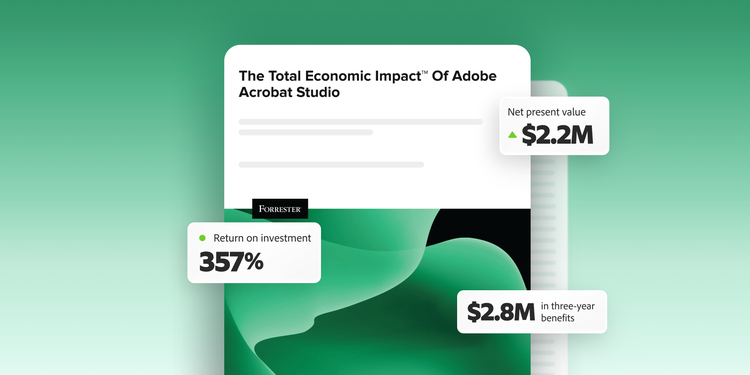
- 357% ROI over three years.
- $2.8 million in three-year benefits.
- $2.2 million Net Present Value (NPV).
- Payback in less than six months.
The study aggregated the experiences of business decisionmakers at seven organisations and 316 survey respondents across industries into a composite global organisation representing businesses that rely heavily on documents representing businesses that manage large volumes of documents.
Where the AI promise collides with real-world workflows.
Enterprises have already added AI to their workflows. So, why do routine document tasks continue to consume so much time? The study reveals that AI adoption alone is not enough.
Teams handle an overwhelming volume of information every day and many still struggle to automate document management. 66% of respondents report grappling with manual, time-intensive processes, while 58% cite slow review and approval cycles as a persistent drag on productivity.
Moreover, many business tools now have built-in intelligence, but not the trust needed to rely on them. When an AI-generated summary cannot clearly trace its conclusions back to their sources, users are left wondering whether the output is grounded in fact or simply a confident-sounding hallucination. Instead of acting on the insights, users first have to verify them. The promised shortcut becomes another checkpoint.
Collaboration also remains fragmented, with files moving across inboxes and chats rather than shared workspaces. And when visual content is needed, non-designers often find themselves waiting in line for creative support.
Technology is only part of the equation. The real breakthrough comes from connecting information, context and collaboration in ways people can trust.
The quantified impact of Acrobat Studio across the document lifecycle.
The study traces a clear line from operational challenges to business outcomes, demonstrating that the impact of Acrobat Studio isn't merely anecdotal. It shows how rewiring the flow of information across the business led to the following three-year, risk-adjusted benefits:
- Faster insight generation: Forrester found a 35% increase in the speed of document review and insight generation with Acrobat AI Assistant and PDF Spaces — resulting in a three-year present value (PV) benefit of $1.1 million. Instead of spending hours locating and synthesising information across lengthy documents, teams used a shared workspace that enabled faster analysis, decision-making and creative thinking.
- Accelerated content production: PDF Spaces and Adobe Acrobat Express helped teams plan and create professional content up to 40% faster, with efficiencies varying across use cases, generating a three-year PV benefit of $810,000. By equipping non-designers with branded templates and intuitive creation tools, routine content updates no longer had to wait for the creative team’s support.
- Shorter review cycles: The study found an 80% acceleration in content review turnaround time with Acrobat Studio and Adobe Express — delivering a three-year PV benefit of $164,000. Standardised templates and built-in governance helped teams move faster while maintaining consistency, compliance and integrity in brand content.
- Greater revenue impact: Easier access to information, quicker approvals and faster content updates contributed to 2% incremental revenue growth — resulting in a three-year PV benefit of $533,000. When teams focused more on the market instead of the process, stronger business relationships and measurable gains followed.
- Reduced operating costs: By consolidating document workflows and licences, Acrobat Studio reduced content management and creation costs by approximately $100 per user — resulting in hundreds of thousands of dollars in savings and a three-year PV benefit of $193,000. It also helped teams kerb software sprawl by simplifying the technology stack.
These findings tell a broader story. By removing friction across the entire document lifecycle, enterprises unlocked benefits that compounded at every stage.
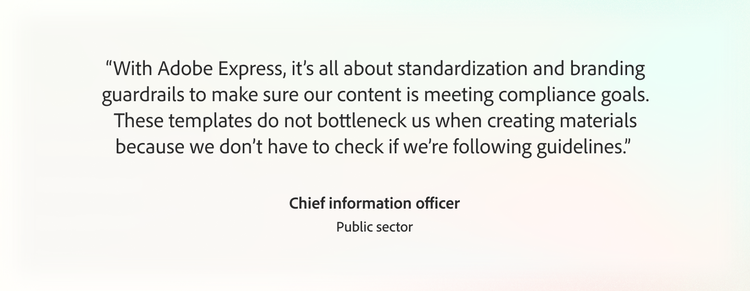
"With Adobe Express, it's all about standardisation and branding guardrails to make sure our content is meeting compliance goals. These templates do not bottleneck us when creating materials because we don't have to check if we're following guidelines."
Chief information officer, Public sector
The human dividend: Trust, security and collaboration.
The true advantage of AI-powered insight generation lies in the confidence to act on it without hesitation. Forrester found that 64% of Acrobat Studio’s AI Assistant users trusted its insights, compared to just 8% who did not. At the heart of this trust is transparency. Instead of asking users to accept an answer at face value, AI-generated insights from Acrobat Studio are tied back to source documents, making verification part of the experience rather than a separate task.
Trust, however, is only valuable when it's paired with security. Acrobat Studio helps safeguard sensitive information with enterprise-grade security features such as application sandboxing, document encryption, permissions and policies controls and single sign-on. In addition, its approach to AI gives enterprises greater control over their data, which is never used for model training. Together, these capabilities enable them to operate with confidence and peace of mind.
Just as importantly, collaboration becomes simpler. Rather than passing files across endless email threads and managing multiple versions, teams can work from a shared space and move directly into reviewing, refining and acting on outputs.
The study points to something bigger than efficiency gains. It underscores the power of a more trusted, secure and collaborative approach to work.
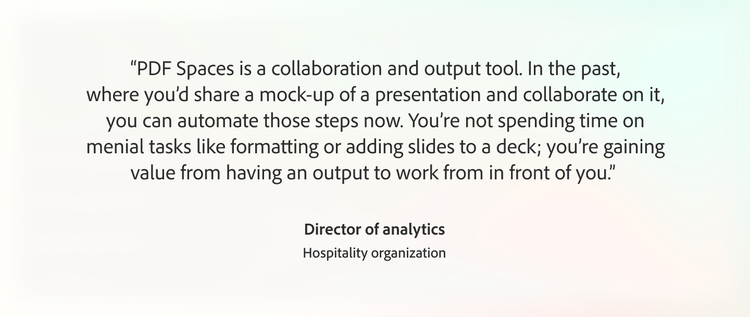
"PDF Spaces is a collaboration and output tool. In the past, where you'd share a mock-up of a presentation and collaborate on it, you can automate those steps now. You aren't spending time on menial tasks like formatting or adding slides to a deck; you're gaining value from having an output to work from in front of you."
Director of analytics, Hospitality organisation
The economics of intelligent document management.
A 357% ROI naturally raises a simple question: Where does the value come from?
According to the study, the gains are driven by two levers — productivity recapture and revenue generation. Every hour reclaimed from searching for information, reviewing documents, formatting content and waiting on creative or approval cycles can be redirected toward customers, decisions and innovation. The impact also shows up on the top line, with 62% of users reporting improved content quality directly contributing to revenue growth.
The economics are straightforward. Forrester calculated $2.8 million in three-year PV benefits against a total investment of $607,000, comprising:
- $351,000 in subscription costs.
- $69,000 for deployment and implementation.
- $186,000 for training.
The benefits translated into an NPV of $2.2 million and an ROI of 357%.
The composite organisation was already using Acrobat Pro, which meant the move to Acrobat Studio required relatively limited change management and training investment. This helped reduce roll-out complexity and accelerate time-to-value.
Maximising the value of enterprise information.
What if the stack of PDFs on your laptop could become a secure workspace for asking questions, uncovering insights and collaborating seamlessly with stakeholders to produce on-brand output? What if document-heavy work stopped being a bottleneck and started becoming a competitive advantage? This is the idea behind Acrobat Studio - a unified platform for document management, AI-powered insights and content creation that helps you to turn data into action.
Beyond quantifying substantial business value, the study also reveals the platform’s broader potential, including AI-powered translation and localisation, e-signatures and audio narration capabilities. For enterprises looking to do more with their information assets, Acrobat Studio helps bridge the gap between static documents and smarter decision-making.
Read the full study to explore how these findings translate into new opportunities for sustainable growth.
Recommended for you
https://business.adobe.com/fragments/resources/cards/thank-you-collections/acrobat