How to choose the best LMS for BFSI: Scale training without increasing compliance risk.
10-12-2026
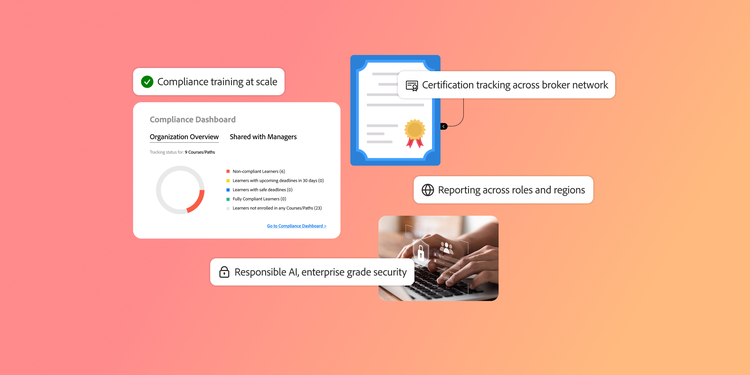
Managing compliance training in financial services means you're always one regulatory update away from having to redo work you thought was done. That's just the nature of the role and most L&D leaders in BFSI have made peace with it.
What's harder to manage is everything outside your direct control. The brokers, agents and distribution partners representing your organisation need to stay certified too and you often have limited visibility into where they stand until something goes wrong.
Partners have also shifted what they expect from training. A bancassurance partner preparing for a client meeting doesn't want to sit through a generic compliance module. They want a partner training programme that maps to what they sell, delivered in a way that fits into their day.
The most effective personalised learning platforms for BFSI are designed with that full scope in mind. They keep compliance training on track across internal teams and partner networks, automate the certification lifecycle and give your L&D team visibility across every audience you're responsible for, without adding to the administrative load your team is already carrying.
This guide breaks down what to look for in a finance-ready LMS and how to evaluate the best LMS for BFSI using a practical decision matrix designed for regulated environments.
The biggest training challenges in financial services and how a specialised LMS solves them.
The best LMS for BFSI was designed around that complexity, not retrofitted to handle it. Here is where most organisations start to feel it:
Why compliance training is an ongoing challenge for L&D leaders in BFSI.
Compliance training rarely gets to be anyone's only priority. It sits alongside content updates, stakeholder requests and new hire onboarding, all competing for the same team bandwidth. The best LMS for corporate training is one that handles enough of that weight automatically, so your team can focus on building better learning programmes rather than managing administrative overhead. Here is where that support matters most:
1. Keeping training current
When FINRA (Financial Industry Regulatory Authority) updates its registration requirements or the SEC (U.S. Securities and Exchange Commission) issues new conduct standards, every affected compliance training module needs to be reviewed and redeployed before your learners encounter the outdated version. In a large financial institution, such a process touches hundreds of learners across multiple business units, with deadlines that regulators don't negotiate on. Managing that cycle manually is where most compliance training programmes start to break down. The best LMS for BFSI handles content versioning and redeployment automatically, so your team isn't scrambling every time a regulation shifts.
2. Tracking across a distributed workforce
In financial services, manually tracking FINRA registrations, AML (Anti-money laundering) certifications and state-level licences across multiple geographies creates compliance risk that most teams don't catch until an auditor does. Spreadsheets don't flag expiring credentials and by the time a gap surfaces, your team is already managing a remediation conversation. For L&D leaders in BFSI, the best LMS for corporate training gives you real-time visibility into certification status across every role and region, before a gap becomes an audit finding.
3. Role-based compliance complexity
Compliance training is not uniform across job functions and most personalised learning platforms are not built to handle those differences at the role and licensing level that BFSI requires. A Series 7 licensed broker has different continuing education requirements under FINRA than a state-licensed insurance agent. A compliance officer responsible for GDPR (General Data Protection Regulation) data handling has different obligations than a BSA (Bank Secrecy Act) officer overseeing AML reporting thresholds. And when someone on your team holds more than one of these roles or operates across jurisdictions, the complexity compounds quickly.
https://video.tv.adobe.com/v/3477580?hidetitle=true
The problem compounds when someone on your team holds multiple licences or operates across jurisdictions. A wealth advisor who is both FINRA-registered and holds a state insurance licence needs to satisfy two separate continuing education tracks on different renewal cycles. Managing that manually across hundreds of advisors creates compliance risk that grows quietly until an audit surfaces it.
An AI-powered learning platform that maps training requirements to individual licence profiles and tracks renewal cycles independently gives L&D leaders in BFSI the infrastructure to stay ahead of those gaps before they become audit findings.
The hidden complexity of partner training programmes in financial services.
When your partners are selling regulated products across multiple regions and channels, training them is a different challenge from training your internal workforce. Here is where that tends to get complicated:
1. Visibility outside the organisation
When your partners operate independently, your visibility into their compliance training status is limited by default. You don't always know who is due for renewal, which regions are falling behind or whether your partner training programme is being delivered consistently across every tier and channel. That gap is difficult to detect without a centralised partner training platform and it usually only becomes visible when someone flags it, by which point the risk has already materialised. For partner enablement leaders managing large, distributed networks, that lack of visibility is one of the more persistent operational challenges in BFSI.
2. Certification tracking at scale
When a partner's FINRA registration lapses or an AML certification expires in your network, that partner may still be actively selling. Your organisation is carrying the regulatory exposure without knowing it. Fines, mis-selling penalties and revoked selling privileges are the consequences that tend to surface later, usually during an audit. The best partner training LMS automates certification renewals and maintains a full audit trail, so your compliance team has the evidence they need before a regulator asks for it.
Why financial services organisations can't afford to overlook customer education.
Customer education has a compliance dimension in financial services that many organisations underestimate. MiFID II (Markets in Financial Instruments Directive II) in Europe requires firms to assess whether retail clients understand the risks of a complex financial product before a transaction can proceed. In India, SEBI (Securities and Exchange Board of India) mandates that asset management companies fund and run investor awareness programmes as a regulatory obligation.
If your organisation operates across these markets, customer education is already part of your compliance obligations. A customer training platform that tracks completion and scales across segments gives your compliance and relationship teams the evidence they need when regulators ask for it.
What capabilities to look for in the best LMS for BFSI.
In finance and insurance, selecting an LMS is a compliance decision as much as a learning one. The best LMS for BFSI combines the capabilities of personalised learning platforms with the regulatory rigour and enterprise scalability that financial institutions require. For L&D leaders, partner enablement teams and customer education programmes, the best learning management system for BFSI delivers a single, connected learning foundation that scales across every audience without creating compliance blind spots.
Here’s what to look for when evaluating an LMS for regulated financial environments:
1. Automated certification and licence renewal tracking
Across your internal workforce and partner network, certification deadlines don't usually line up, licensing bodies have different requirements and renewal cycles vary by role and jurisdiction.
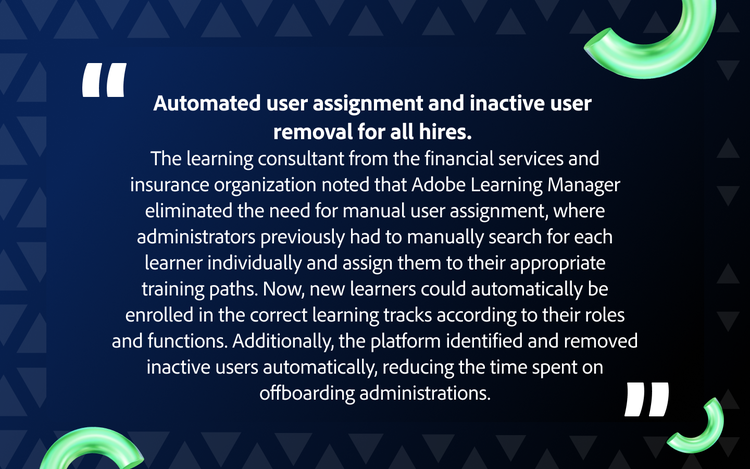
So the question is whether the platform you choose handles that automatically or leaves your team managing it manually. Adobe Learning Manager ensures certifications are issued only when learners meet the necessary success criteria and automatically reassigns programmes when they expire. Learning plans enrol or unenroll learners based on certification status, course completions or organisational triggers like new hires.
Push notifications and targeted alerts surface renewal reminders before deadlines are missed and compliance reports with ready-made learner transcript views give your team the audit trail regulators ask for. For your L&D leaders and partner enablement teams overseeing your broker networks, certification lifecycle management runs in the background rather than sitting on someone's to-do list.
2. AI-powered personalised learning for complex role structures
Financial institutions are under more pressure than most to adopt AI responsibly and that scrutiny extends to the learning platforms they use. When your legal and compliance teams are asking hard questions about how AI makes decisions in your LMS, here is what the platform should be able to answer:
- Responsible AI built for regulated environments: In financial services, every AI system your organisation adopts goes through legal, compliance and risk review. What they're looking for is transparency, accountability and explainability across every AI feature, not just recommendations.
Adobe's responsible AI framework covers the full lifecycle, from how models are trained on ethically sourced data, to rigorous testing for harmful bias, to an AI Ethics Review Board that reviews high-impact features before deployment. Your learner data stays within your own environment and is never used to train models outside it, with GDPR, SOC 2 and ISO 27001 compliance protecting every interaction. For L&D leaders evaluating an AI-powered learning platform in a regulated environment, that's the standard worth asking other vendors to match. - AI-powered personalisation that understands role and context: The wrong content reaching the wrong learner in a regulated environment creates compliance risk your team may not catch until an auditor does. Look for an AI LMS that recommends learning based on role, product portfolio and skill level, with semantic search that understands learner intent rather than matching keywords.
https://video.tv.adobe.com/v/3477580?hidetitle=true
- AI Assistant for Learners that reduces dependency on administrators: When a compliance question comes up mid-workflow, your learners need an answer in seconds. Look for a platform that surfaces instant, cited responses from verified course content, with relevant course recommendations and call script generation on-demand.
https://video.tv.adobe.com/v/3477581?hidetitle=true
- AI Assistant for Admins that cuts administrative overhead: The administrative burden of managing compliance training in financial services compounds quickly across roles, regions and partner networks. And when something in the platform isn't working the way it should, every minute spent troubleshooting is a minute your certification workflows, compliance reports and partner enrolments are sitting still. Look for an AI LMS where administrators get instant, accurate answers through a conversational interface trained on verified platform documentation.
https://video.tv.adobe.com/v/3477861?hidetitle=true
- AI Virtual Coach for high-stakes practice scenarios: Completing a compliance module doesn't mean your partners and advisors are ready to handle a difficult client conversation or a product objection in the field. Look for an AI-powered learning platform that lets authors build configurable role play scenarios with defined proficiency parameters, gives learners a live AI avatar to practise with, and delivers an analytical report rating their tactical knowledge and soft skills so they know exactly where they stand before a real conversation.
https://video.tv.adobe.com/v/3497303?hidetitle=true
- Personalised learning paths built around each learner: Learning in financial services covers a wide spectrum, from product knowledge to regulatory compliance to soft skills and no two learners are starting from the same place. Look for a platform where learners can have a conversation about what they need and receive a path built from your internal content and integrated external sources, calibrated to their individual profile and proficiency level.
https://video.tv.adobe.com/v/3497634?hidetitle=true
- Conversational reporting for learning managers: Compliance reporting in financial services generates more data than most managers have time to analyse and the reports that matter most are often the hardest to pull together quickly. Look for an AI LMS where managers can ask a question and get an immediate, accurate answer from their learning data through a conversational interface, rather than piecing together information from multiple reports to find what they need.
https://video.tv.adobe.com/v/3497499?hidetitle=true
- Generative Learning Experience Design for faster content creation: Every regulatory update in financial services means your compliance training content needs to be reviewed, revised and redeployed before your learners encounter the outdated version and that cycle never really stops. Look for an AI-powered learning platform that lets any team member build instructionally sound courses from simple text prompts, so your compliance training stays current without your team starting from scratch every time a regulation shifts.
https://video.tv.adobe.com/v/3497281?hidetitle=true
3. Integrations that embed learning into the flow of financial work
Your compliance training is only effective if your people complete it. When it requires them to leave the platforms they're already working in, it gets pushed to later and later often means a missed deadline.
The best LMS for BFSI meets your people where they work and helps them learn in the flow of work. Your compliance officers complete required modules directly within Microsoft Teams without switching applications. Your relationship managers find product training with their daily tasks in Salesforce. Your bancassurance partners and field advisors complete certification modules on mobile between client visits, with progress synced automatically when connectivity resumes.
For your L&D leaders and partner enablement teams, that means every completion is recorded automatically and audit-ready without anyone having to follow up.
4. Audit-ready reporting and compliance
When a regulator asks for proof that every relationship manager completed a product suitability module before a specific date or that every AML-certified compliance officer renewed their certification on time, your answer has to be immediate and timestamped. A spreadsheet export from a generic LMS rarely satisfies that requirement.
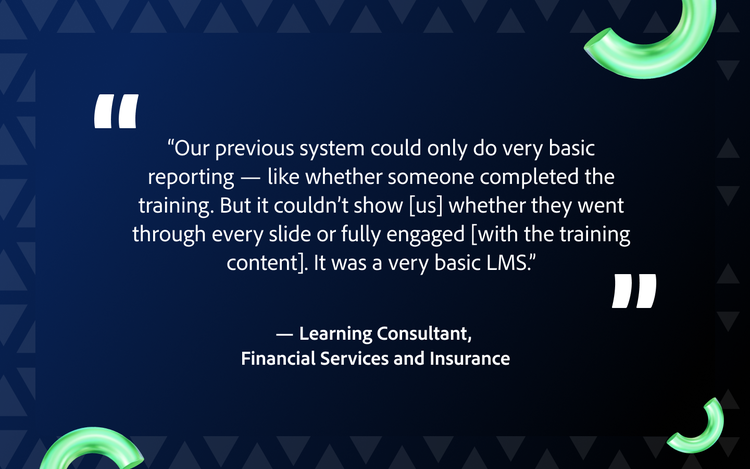
Excerpt from Forrester’s report on The Total Economic Impact™ Of Adobe Learning Manager
The best LMS for BFSI organises that evidence automatically. Role-based compliance reports surface your team's completion status by job function and region. Learner transcripts maintain a full record of every compliance training module completed, assessment passed and certification earned, with timestamps that auditors and regulators can rely on.
For your L&D leaders managing large, distributed workforces in BFSI, that reporting infrastructure means compliance is reviewable on-demand.
5. Blended learning for compliance and product training
When a regulatory update is significant enough to change how your partners sell, an email and a self-paced module often aren't enough. Your partners need a live session where they can ask questions and get answers before they're in front of a client.
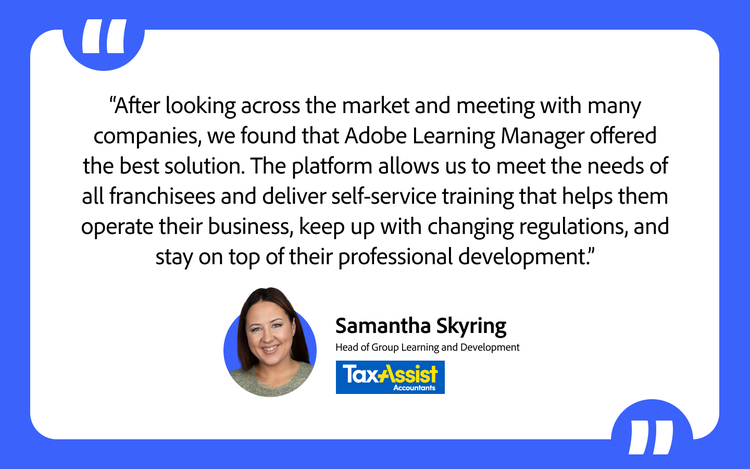
Excerpt from case study on how TaxAssist used Adobe Learning Manager
The best LMS for BFSI gives your L&D team the flexibility to combine self-paced compliance training with instructor-led and virtual instructor-led sessions, all managed from a single platform. Your learners can choose sessions that fit their schedules through a self-service calendar. Attendance is tracked automatically. Instructor utilisation is reported alongside learner progress, giving your team a complete picture of how your blended learning programme is performing across every role and region.
For your partner enablement teams, blended learning means a bancassurance partner can complete a self-paced product module before joining a live session with a product specialist, without your administrators having to manage two separate systems.
For partners learning on the go, content needs to be accessible across every device and format without friction. Adobe Learning Manager's Fluidic Player supports this natively, handling everything from SCORM modules and videos to PDFs, without requiring plugins or downloads. It's the kind of seamless delivery experience that most LMS platforms can't match out of the box.
6. Enterprise-grade scale for complex financial organisations
As your organisation grows, your training infrastructure needs to grow with it. Adding new business units, expanding into new regions or onboarding a new wave of distribution partners shouldn't require rebuilding your learning architecture from scratch.
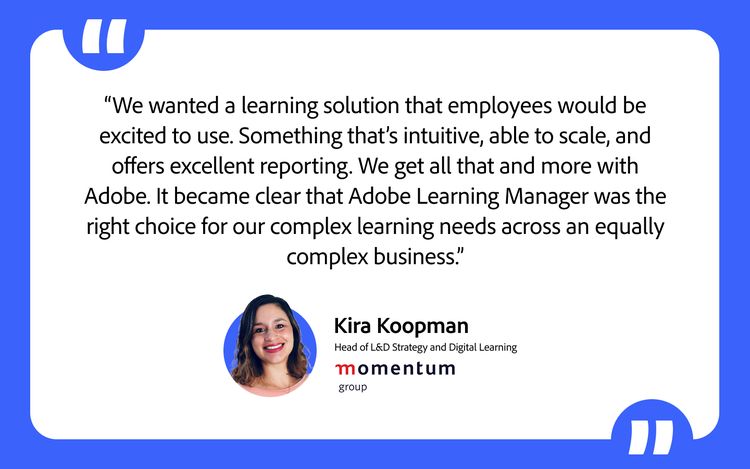
Learn how Momentum Metropolitan Holdings drove learner engagement while keeping up with compliance requirements
The best LMS for BFSI supports that kind of scale through multi-tenet architecture, giving separate business units, partner networks or regional teams their own dedicated learning environments with separate branding, administration and configurations, all governed from a single platform. Your compliance training standards stay consistent across every instance and your reporting stays centralised.
For organisations operating across multiple geographies, an enterprise cloud infrastructure with geo-collocated data centres and CDN-optimised content delivery means your learners in Singapore get the same experience as your learners in London or Mumbai.
For your L&D leaders, that means the platform supporting 500 learners today is the same one that supports 50,000 tomorrow, without compromising on compliance tracking, certification management or audit readiness.
LMS evaluation matrix for learning leaders in financial services.
Choosing the best LMS for BFSI goes beyond feature checklists and vendor demos. Use this matrix to ask the questions that surface how a platform actually performs in a regulated environment, across compliance, certification management, security and partner enablement.
Adobe Learning Manager: the AI LMS for regulated financial environments.
There's a point in every LMS evaluation where the conversation shifts from features to fit and in financial services, what fit means is quite specific. The platform needs to understand that compliance training for your employees and partners, certification tracking across distributed networks and audit readiness aren't separate workstreams that need separate solutions. They're the same operational problem and the most effective organisations manage them from a single place.
Embed youtube link for BFSI Video
Adobe Learning Manager gives your L&D and partner enablement teams the infrastructure to stay ahead of what regulated environments demand, without the administrative overhead that usually comes with it.
Your L&D leaders get AI-powered recommendations drawing on over 50 million course data points, surfacing the right content for each learner based on their role, product portfolio and certification status. Your partner enablement leaders get visibility into where your broker and advisor networks stand at any point in time and your data stays protected throughout with GDPR, SOC 2 and ISO 27001 compliance.
Book a demo to see how Adobe Learning Manager handles the compliance and training demands of your organisation.
Recommended for you
https://business.adobe.com/fragments/resources/cards/thank-you-collections/learning-manager