Enterprise marketing is challenging — whether that’s about handling fragmented data, the demand for personalisation, efficiency pressures, or ROI in long-cycle sales strategies. Your team may be exceptional, but success requires more as the customer journey evolves beyond linear pathways, and the introduction of artificial intelligence can help.
By integrating AI, you can break down silos, boost efficiency, align strategies, drive collaboration, and ultimately, improve campaign performance.
With expert insight from Michael Benjamin, Senior Director of Marketing for UKI, the Middle East, and Africa at Adobe, we’ll examine the benefits of AI as an orchestrator for enterprise marketing strategies. From predictive analytics and bridging silos to workflow automation, discover how AI can work for your enterprise marketing teams.
“AI tools are transformative for marketers, and I don’t think they’re understood in terms of the impact they bring.”
Michael Benjamin
Senior Director of Marketing for UKI, the Middle East, and Africa, Adobe
Breaking down silos with AI-powered unified customer profiles.
Marketing silos, often a byproduct of delegating marketing strategy elements in a 'divide and conquer' approach, pose a significant challenge for enterprises. While such organisational structures might initially appear to simplify complex workloads, they frequently result in an inconsistent customer experience, stagnant workflows, and cross-team miscommunication. However, what often seems an entrenched reality can be rectified by advanced AI marketing platforms. Platforms such as Adobe Experience Platform (AEP) and Real-time Customer Data Platform (RTCDP) are specifically designed to ingest, reconcile, and unify disparate customer data sets, creating a singular, authoritative source of truth for marketers.
By doing so, these platforms effectively eliminate departmental data silos across your enterprise, providing a true 360-degree view of each customer. This enables impactful, personalised experiences across all customer touchpoints and significantly reduces the risk of outdated or mis-targeted communications. Few things disrupt a customer's experience more than receiving marketing for an action they've already completed or a product they've already purchased. This unification, in turn, fosters better customer sentiment, minimises wasted effort, and drives marketing efficiency that is both accurate and timely. As Michael emphasises, "You can imagine the issues if you don’t have the most relevant and up-to-date information on the customer, and you’re not able to get personalised communication.”
Building a unified customer profile, however, is a never-ending journey, involving continuous data identification, cleaning, formatting, and integration. It is precisely here that AI plays a crucial role in streamlining these complex processes. All that disparate customer data — from ERP to web, mobile, social, transactional, and even customer support suddenly finds a single, comprehensive, real-time home. As Michael advises, "AI isn’t plug-and-play… it’s an ongoing journey. It’s never done." AI-powered unified customer profiles represent a constant process, continuously updating with every change and refining marketing strategies with each new piece of customer information.
By incorporating robust AI infrastructure and solutions into enterprise marketing, exceptional teams are empowered to focus on more impactful, strategic tasks, eliminating the risk of duplicated communications. Furthermore, teams gain immediate access to the precise data points needed to make informed decisions and deliver personalised content with ease and impact at scale.
“It’s a long journey. You have to identify where all your data is and make sure it’s clean data, formatted correctly. AI can help with a lot of that.”
Michael Benjamin
Senior Director of Marketing for UKI, the Middle East, and Africa, Adobe
AI-driven workflow automation and resource optimisation across marketing functions.
By automating complex, repetitive tasks and optimising resource allocation across the entire enterprise marketing ecosystem, AI reduces the burden on teams. Michael explains that “reducing the day-to-day, low cognitive tasks by putting them into AI, means that your team can work on the more important things such as strategy, processes, creative innovation, or stakeholder engagement.” The core idea is that you’re now free to “do what AI can’t do.” Suddenly, you’re finding time for more impactful tasks, rather than cramming in innovative human thinking around routine daily deliverables.
AI streamlines workflows from campaign planning and content deployment to budget allocation and channel selection. It does this through intelligent task routing, automated asset tagging, and AI-assisted campaign setup within Adobe’s integrated solutions. High-effort, low-complexity manual jobs can now be automated. Goodbye to formatting images or writing multiple variations of the same content brief.
The outcome of this is simple. Through the use of AI infrastructure and solutions, your campaigns benefit from a faster time-to-market, with a better application of human capital at scale across the marketing ecosystem.
“AI-driven workflow automation allows you to do what AI can’t do, which is engage stakeholders and build relationships with key individuals across the business to drive great outcomes.”
Michael Benjamin
Senior Director of Marketing for UKI, the Middle East, and Africa, Adobe
Predictive analytics and prescriptive insights for strategic marketing decisions.
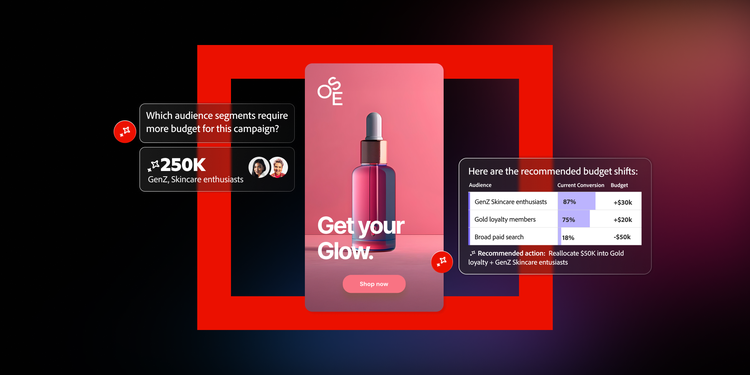
Predictive analytics and prescriptive insights transform enterprise marketing from reactive to proactive. AI excels at analysing marketing metrics for historical and real-time performance data, processing thousands of data points on demographics, behaviours, and content interactions. Applying AI marketing fundamentals to your existing workflows allows you the capability to predict future campaign outcomes, identify emerging trends, and prescribe the "next best action."
Michael notes how, “Every single minute, AI is looking at advertising campaigns and at thousands upon thousands of data points. It can then make recommendations on how you can get a better return on investment.” He continues, “not only is it able to ingest and analyse more data — it’s faster, always on, which a human can’t do. It’s able to pull forward productive data during recommendations and calculate the benefits.”
Functionally, this means that, through predictive analytics and prescriptive insights, AI platforms can use those marketing metrics to provide “suggestions” of the “best performing audience, the best performing message, and proactive recommendations on the best performing content to run” which in turn allows enterprise marketing leaders to make more informed, data-driven decisions on budget allocation, strategic investments, and campaign design.
AI’s power, exemplified in platforms like Adobe Experience Platform (AEP) and Marketo, extends beyond simple “idea creation.” It offers “robust analysis that only AIs can do at that scale, often with a forecast on the impact.” This means that, with proper implementation, AI can prescribe optimal channel mixes for specific customer segments (e.g., paid media across Google Ads, LinkedIn, Meta) and guide content and messaging strategies.
Such AI-driven approaches inherently make content delivery and campaigns less reactive, reduce the risks associated with uninformed decision-making, and improve average marketing ROI across complex portfolios. Furthermore, AI can identify subtle patterns and signals that human analysis might miss, leading to new business cases for content creation, product enhancements, or enhanced customer experiences.
“Because AI is not human and it’s looking at thousands of data points, it can look for things you didn’t even think to look at.”
Michael Benjamin
Senior Director of Marketing for UKI, the Middle East, and Africa, Adobe
Real-time cross-channel journey orchestration and dynamic optimisation.
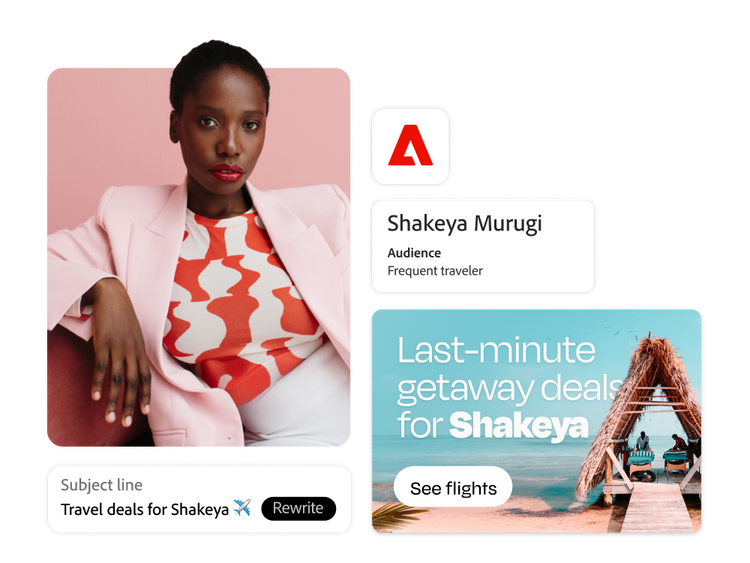
Specialised AI marketing platforms create a consistent and connected experience for customer journeys across channels. Simply put, from e-mail to web, mobile to social, advertising, and even offline interactions, your AI marketing platform can dynamically adjust messaging, offers, and content based on your customer’s behaviour in real-time. This leads to highly engaging and personalised customer journeys that can result in improved conversion rates, increased customer satisfaction, and stronger brand loyalty – without overburdening your team.
Real-time cross-channel journey orchestration ensures experience remains consistent, even during complex campaigns or along multi-channel sales pipelines. Multi-touch journeys go from unwieldy to easy, and multiple inbound experiences become consistent. But it goes beyond simple outreach.
The customer experience is everything, and Michael advises that “you want to be proactive and pre-emptive in driving for an important customer success score,” describing how, with AI, “you actually get ahead of that service ticket or delays to a response. You get those UI features before the customer has a bad experience.” AI gets you ahead of your customers’ needs, so that your services are never lacking. By anticipating churn or product friction points, you’re able to improve your NPS or CSAT score and reduce support tickets before issues escalate to needing human interaction.
AI-driven dynamic journey optimisation is crucial for managing the complexity of modern, multi-touch customer journeys on an enterprise scale. Even as experts, it allows your team to focus on those more delicate or cognitive issues and lets you exceed your customers' expectations at every interaction.
Michael Benjamin also highlights that anticipating challenges before they escalate allows teams to dedicate more time to complex customer needs.
Measuring and attributing enterprise marketing impact with AI-powered analytics.
While many long-established marketing models place value on last-click methods, assigning credit for conversion only to the last marketing touchpoint, AI marketing metrics look beyond this simplistic approach. Instead, AI-driven attribution analyses the true, incremental value of each marketing touchpoint and channel in driving business outcomes. It’s not just about the conversion itself, but everything that led to that moment. This offers unparalleled transparency into marketing spend and helps you to optimise future investments.
AI-powered analytics correlate marketing activities directly with revenue and growth metrics, and address attribution challenges like cookie deprecation and iOS tracking limitations, as well as adblockers. As these changes happen, AI modelling is increasingly the only way to close these measurement gaps by using data, historical patterns, and customer behaviour to create a fuller picture for accurate measurement. Michael sums it up succinctly, “As trackability is going away, the only option is AI modelling.” AI builds on those marketing fundamentals that would take too much time for humans to otherwise analyse and act on.
Additionally, AI-powered analytics allow for the granular analysis of various scenarios, such as what creative types work for you, e.g., static vs. video, short vs. long form, human vs. product focus. You can even model “What if?” scenarios, for example, “What if we removed TV?” Michael explains, “It’s the idea of looking at a scenario and planning to see if something were to happen, if something were removed or changed, what would be the impact of that?” Suddenly, you have a technology that can function as a simulation of contingencies, so you can more appropriately plan your marketing activities around these ‘what if’ events, ensuring your enterprise is never caught off guard.
Models may even go further than that, “you have more complex nested models,” Michael explains, “that can look at the impact of specific creative types: did it have a human in it? Did it not? Did it have products? Which are a lot more complex.” By implementing AI infrastructure and solutions, your ability to assess your marketing efforts skyrockets, and previously unanswerable questions come within reach.
Future of AI-orchestrated marketing.
The future of marketing for enterprises is defined by AI orchestrating seamless operations across five key areas: breaking silos, delivering predictive insights, optimising journey orchestration, boosting efficiency, and enabling precise attribution. Implementing robust AI infrastructure and solutions establishes new marketing fundamentals, future-proofing strategies against a rapidly evolving digital landscape, including shifts in search behaviour and tracking limitations.
This isn't a one-time fix, but a continuous strategic journey. AI marketing platforms like Adobe Marketing Cloud provide the agility to scale efforts, understand impact, and align teams. Embracing AI empowers leaders to confidently navigate complexity, drive measurable growth, and enhance customer interactions. Explore Adobe's innovative AI-powered solutions to advance your enterprise marketing journey today.