Advanced prompt engineering for AI agents: Building reliable workflows.

Adobe for Business Team

07-10-2026

AI capabilities have evolved quickly in recent years, dramatically changing the way we work with machines. In the early days of ChatGPT-like models, prompting was simple. You asked a question and the chatbot responded, creating a linear, reactive conversation. Today, we are designing AI agents for complete enterprise workflow management. As a result, the question “what is prompt engineering?” has taken on a new meaning — it’s about how effectively you structure instructions for AI agents.

AI agents can break down problems, co-ordinate actions, use tools and execute multi-step workflows. Therefore, the focus is no longer on single AI prompts. Instead, we need to design complete agent workflows that guide how an AI agent reasons, decides and executes across tasks. This is known as advanced prompt engineering.

Prompt engineering for AI agents is the practice of designing goals, instructions, constraints, context and decision logic that guide agents through multi-step tasks and workflows. Unlike traditional prompts that generate a single response, agent prompts help co-ordinate planning, tool usage, reasoning and execution across an entire process.

Gartner predicts that by the end of 2026, 40% of enterprise applications will feature task-specific AI agents. However, as these agents increasingly take on heavy lifting, enterprise teams feel less in control. This is because agents can often drift from desired outcomes and generate unreliable outputs.

This shift demands sophisticated prompt engineering techniques to design systems where humans don’t micromanage every step, yet still shape the direction, boundaries and logic of how work gets done.

Let’s take a deeper look at how to structure effective prompts for AI agents, beyond improved phrasing. To make this easier to navigate, we’ll break it down into key concepts:

Key takeaways:

Why traditional prompts fail complex AI agent workflows.

Enterprise workflows are rarely simple and involve a web of interconnected tasks. Take a common example: a marketing team asks an AI agent, “Create a social media campaign for launching a new fitness app targeting urban millennials.” This sounds straightforward, but it involves multiple steps like research, audience segmentation, message positioning, brand alignment and approvals. When a single, traditional prompt is expected to handle everything, the workflow starts to unravel because there is:

One error early on can compound through every step that follows. The outcome is inconsistent results, bypassed safety controls, hallucinations from missing context and a lack of governance.

This is why controlling the output of AI agents is important, especially in regulated or brand-sensitive settings. For enterprise-level content supply chain transformation, the fix is not a better-worded prompt, but orchestrating a structured, governed process to generate reliable output.

How prompt engineering works in AI agent workflows.

In the agentic world, prompt engineering is the process of designing the guidance, context and guardrails that help an AI agent reach a desired outcome across complex tasks. This means explicitly defining the agent’s scope of work through structured instructions such as:

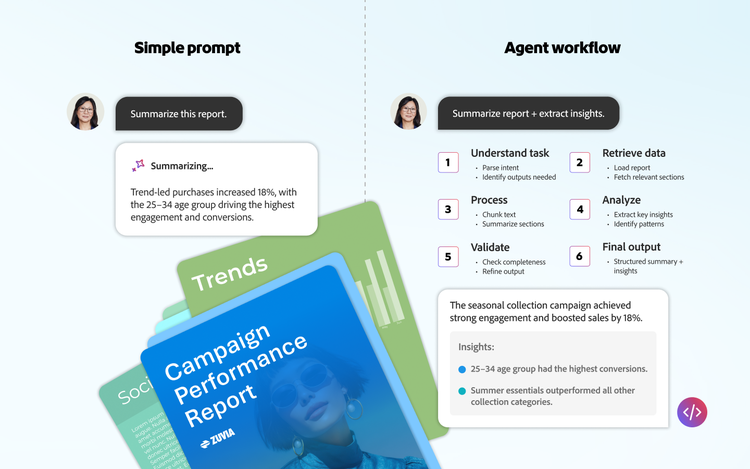
For AI agents, a prompt often functions as a workflow specification. It shapes an entire chain of decisions.

In enterprise environments, these workflows increasingly span content creation, approvals, campaign execution, personalisation, analytics and governance. Prompt engineering helps orchestrate these connected processes while maintaining consistency and control across systems.

Comparison visual showing a simple prompt producing one output and an agent workflow using multi-step prompts for richer results.

How AI agents use tools and make decisions.

Think of an AI agent like a focused professional who knows its role, uses the right tools and follows a disciplined process to deliver results — all set in motion by the right prompt. It moves with intent and should be grounded in:

This helps the agent make informed decisions and execute tasks with precision. Prompt engineering also requires balancing over-specification and under-specification. Too much detail can make the agent rigid and unable to perform effectively when faced with variation. Too little detail leaves gaps in context, which can lead the agent to make assumptions or generate AI hallucinations.

How agents maintain context across workflows.

Context keeps an agent moving in the right direction. While prompts define the context provided at the start of a task, enterprise agents rely on memory and retrieval systems to maintain context across multi-step workflows.

The quality of agent outputs is heavily influenced by the relevance and freshness of the context provided. A capable model with a well-designed prompt can still provide confident but incorrect answers if the context it's working from is incomplete or stale. However, to get the context right when designing prompts, it is important to remember that agents also have constraints, such as:

Context is also essential for reducing AI hallucinations. A strong prompt helps the agent remember what matters, retrieve what’s needed and use context as a deliberate tool to drive better outcomes.

Core principles of advanced prompt engineering.

Effective agent prompting mirrors how real-world work gets done — sequentially, anchored in context and with clear checkpoints along the way. A well-designed prompt helps AI agents become more reliable, useful and scalable over time. The core principles behind an effective prompt include:

Defining multi-step goals based on business outcomes.

Start by clearly defining the goal rather than sharing a broad idea. AI prompts for goal setting help break the task into smaller steps, making the path visible and achievable. For instance, a multi-step prompting for a digital marketing campaign may include instructions like:

Each step should clearly define the input, action and expected output for the given task.

Setting constraints and guardrails for predictable outputs.

Constraints are the rules that shape the result. If you don’t set clear guardrails, outputs can become inconsistent. Constraints take different forms depending on the task. For a marketing team, it can look like:

A detailed instruction like “generate output in bullet format with no more than 5 points, aligned to brand tone” removes guesswork and sharpens focus. It reduces variation by fixing the structure, lowers risk by preventing off-brand or incorrect messaging and minimises rework by clearly defining expectations.

Providing a rich context to improve relevance and accuracy.

Context determines whether the output is generic or genuinely useful. The more relevant background you provide, the sharper, more actionable is the result. Context typically falls under three categories:

Too little context leads to vague, generic outputs, while too much irrelevant information introduces noise, dilution and misalignment. Prioritising first-party data and real-time signals ensures relevance and accuracy.

Designing for failure and uncertainty.

Actual workflows aren’t perfect and your prompts shouldn’t assume they are.

Strong prompts prepare for what might go wrong and include clear fallback instructions such as:

This can make your system more resilient in dealing with non-ideal scenarios and handling conflicting inputs. Without this, agents can over-trust low-quality information or execute irrelevant actions.

When your prompt is built on these core principles, you can orchestrate truly intelligent and effective workflows. This is often the key difference between a basic prompt and one that’s ready for production.

How to write an advanced AI prompt for agents.

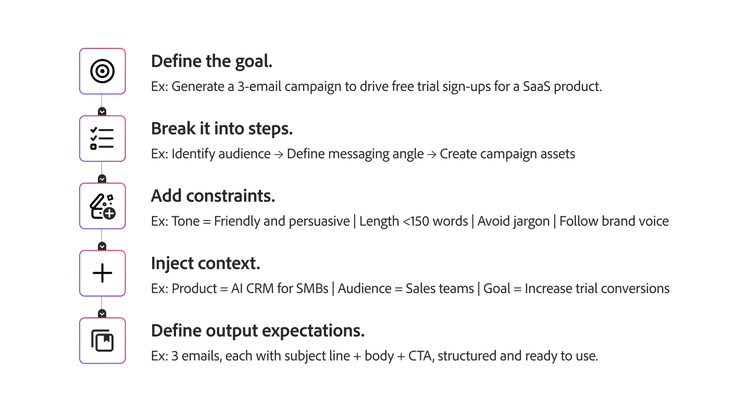
An AI agent performs best when it has clear direction. The quality of its output is closely tied to how well you brief it. A strong prompt turns the agent into a reliable executor. With the core principles in place, this can evolve into a repeatable, scalable framework. Advanced prompt engineering is about directing agents.

Flow diagram showing an advanced AI prompt for agents, with examples at each step.

However, there are a few nuanced mistakes to avoid while designing an agentic prompt:

  1. Vagueness: Clarity is the key. Prompting “write something engaging” leaves too much room for interpretation. The agent fills in the gaps, but not always the way you intend.
  2. Overloading instructions: Packing everything into the context window creates noise and can hurt performance.Loading only task-specific data and using just-in-time retrieval helps keep prompts direct and relevant to the task.
  3. Missing output definitions: When expectations are poorly defined, the output accuracy suffers. Including examples of the desired final output helps produce more reliable results.
  4. Providing too many tools: A well-audited, focused toolset is crucial. More tools don’t necessarily increase capability. In fact, they often introduce confusion into the agent’s decision-making process.

Techniques to improve AI agent reasoning and performance.

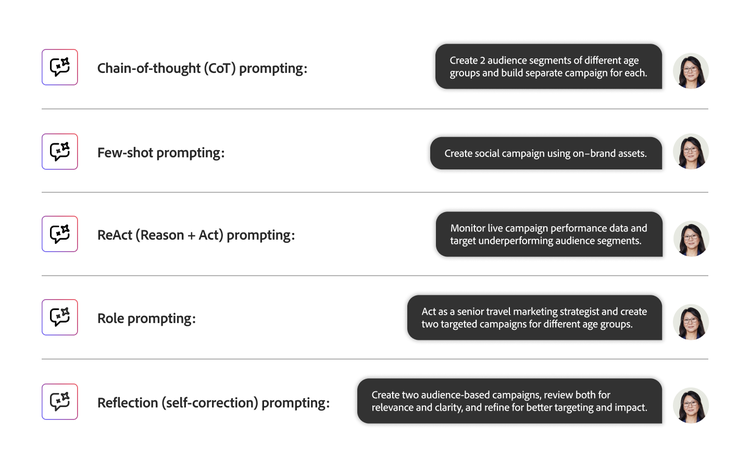
Once a structured prompt is in place, additional techniques can improve how agents reason, use tools and validate outputs — especially in complex workflows. A few methods to help improve reasoning and execution are:

Visual examples of advanced prompting techniques that improve AI agent reasoning, accuracy and performance.

While these advanced prompt engineering techniques are valuable, the key is knowing which ones to apply in different scenarios. In practice, the best prompts combine these techniques thoughtfully.

Applying prompt engineering to enterprise workflows.

In enterprises, AI workflow automation has become a key focus area. It enables organisations to move beyond isolated tasks and smoothly connect ideas, people and decisions across end-to-end processes. Prompt engineering plays a critical role in making possible this, moving workflows forward.

Here’s how it plays out in everyday business work:

Marketing operations example

A marketing operations team might prompt an AI agent to optimise campaign performance through the following workflow:

Agent orchestration, powered by strong prompts, enables enterprises to drive speed while maintaining visibility, consistency and control. Discover how campaign execution and connected workflow management can be further streamlined with Adobe Workfront.

Testing and optimising prompts for agents at scale.

Efficient AI agents aren’t built on a single perfect prompt. As enterprise data, goals and constraints evolve with the business, prompts must adapt too. That’s why prompt engineering is an ongoing process.

Let’s explore which approaches improve the effectiveness of prompts:

  1. Define success for agent outputs: Success in agent-driven workflows is measured by real-world outcomes, not just output quality. For campaigns, that means assets ready to launch with minimal edits. For compliance, it means outputs that meet required brand standards, reduce risk and support accurate review. Teams should tie prompt performance to business outcomes, with a focus on effectiveness in context, not perfection in isolation.
  2. Use structured evaluation metrics: Teams must rely on clear scoring systems to evaluate outputs. This removes subjectivity and creates a common quality benchmark, making it easier to assess relevance, completeness, consistency and overall task success.
  3. A/B test prompt variations: Teams should refine prompts through testing, not assumptions. Experimenting with different structures, constraints and measuring results against defined metrics helps teams quickly identify what performs best.
  4. Build feedback loops into workflows: Evaluation must be embedded directly into workflows. Human feedback, through reviews, edits and approvals, leads to continuous improvement. This helps refine prompts and standardise high-performing ones into reusable templates.

AI prompt improvement comes from continuously measuring what works, enabling agents to become more reliable, scalable and effective in dynamic environments. Effective testing and optimisation also help enterprises reduce manual effort, streamline complex workflows and keep human oversight focused where it adds the most value.

Scaling and governing AI agent outputs.

As agents take on end-to-end workflows, the focus shifts from “can they complete the task?” to “can they do it reliably, at scale, every time?” Auditability and version control are critical for teams to track prompt changes, trace outputs and ensure every update is traceable and reviewable.

As a result, prompts are evolving into managed assets, governed and maintained much like software code. This is pushing organisations toward:

To support this, enterprise AI governance must be embedded into the agentic workflows by design. Additionally, with strong data integrity and real-time context, agents can act on accurate, up to date information.

From prompts to orchestrated workflows — building smarter AI agents.

The conversation has moved beyond writing better prompts. According to IBM, 72% of executives expect agentic AI to enable new technology capabilities that can transform business models and industry structures. But that transformation won’t come from experimentation alone.

AI agents are becoming digital teammates, taking ownership of workflows while staying aligned with business goals. Their real value lies in how effectively intelligence is operationalised through the right structure, context and constraints — and in doing so, how well they connect enterprise processes, data and outcomes. In the years to come, this will be the key differentiator for organisations that want to accelerate growth.

Explore how Adobe Experience Platform can help you scale AI-driven workflows with real-time data and orchestration, leading to governed execution and scalable impact.

https://business.adobe.com/fragments/resources/cards/thank-you-collections/generative-ai