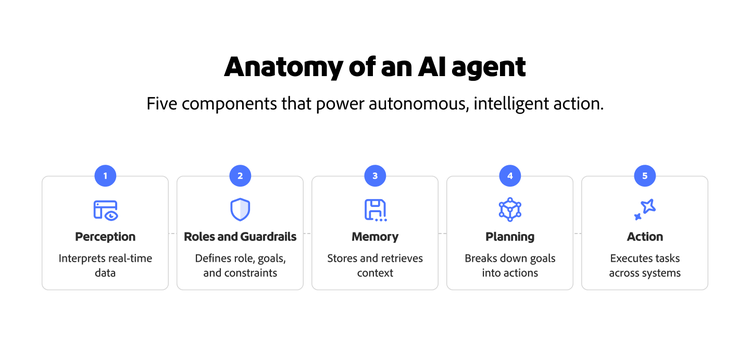
An enterprise AI agent can interpret goals, use context, plan steps, use tools, and operate within defined business and governance boundaries. Understanding AI agent components can help enterprises evaluate and use AI agents effectively. Each component serves a distinct function while relying on the other components to deliver impactful outcomes.
Perception
Perception is how an AI agent receives and interprets signals from its current environment. In enterprise software, this typically includes user input, application state, system events, APIs, metadata, and approved data sources. Perception can help the agent understand what is happening now, what the user is asking for, and which conditions or constraints may affect the task.
This component gives the agent situational awareness at the start of execution. It turns incoming signals into usable context that can inform reasoning, planning, and action. For example, perception may help an agent recognize the current page a user is on, the status of a workflow, the data objects involved, the permissions in effect, or whether a required field or dependency is missing.
Roles and guardrails
Roles and guardrails define an AI agent's role, objectives, and operational constraints within your enterprise. This component defines what the agent is for, what kind of tasks it should handle, what systems it may access, what policies or guidelines it must obey, and when it should defer to a human. Roles and guardrails define the boundaries for what the agent should and should not do, helping ensure goal-oriented AI agents remain aligned with enterprise priorities. Examples of tasks include identifying the task scope, permissions, brand rules, escalation rules, and approval requirements.
Memory
Memory provides the necessary context for an AI agent to execute tasks accurately within a specific session. To maintain precision, it is important to distinguish active memory from static knowledge retrieval. Memory typically operates through two distinct layers:
- Short‑term memory for immediate conversational context and active task details
- Long‑term memory for reusable knowledge, past interactions, patterns, or stored preferences
While knowledge retrieval involves pulling information from a broad, external database (like a product catalog or documentation), memory functions as the agent’s specific record of past engagement. This component does not imply unrestricted, autonomous learning. It allows the agent to provide consistent experiences when context is intentionally stored and governed. By accessing these historical touchpoints, an agent can align its responses with established customer preferences and previous workflows without requiring the user to repeat basic instructions.
Planning
Planning is the component that helps the agent interpret goals, sequence tasks, and choose among approved actions. This component analyzes high-level objectives and breaks complex tasks into a logical sequence of actionable steps. Rather than following a rigid script, this component evaluates available options and selects the most efficient path to reach the desired goal.
This capability can provide the strategic thinking needed to navigate unexpected obstacles, much like a project manager. It allows the system to make informed decisions based on real-time context and adapt its strategy as circumstances change. This flexibility distinguishes agentic systems from rigid rule-based automation. Planning components enable agents to stay aligned with broader business goals even when encountering situations they weren't explicitly programmed to handle.
Action
Action translates decisions into specific tasks performed within enterprise systems. This component connects the agent's intelligence to real-world capabilities, such as updating records, triggering workflows, sending communications, or interfacing with external services. Strategic thinking delivers little value without the ability to act. The action component connects reasoning and planning to operational tools such as APIs, applications, and workflows.