The world of AI is constantly abuzz with the chatter of change, excitement, and rapid advancement. While a niche tool only a few years ago, generative AI solutions like ChatGPT have become household names — with adoption, recognition, and implementation across public and professional life. In fact, research shows that over one billion people use AI platforms each month, for common tasks including summarising and generating text, and answering questions.
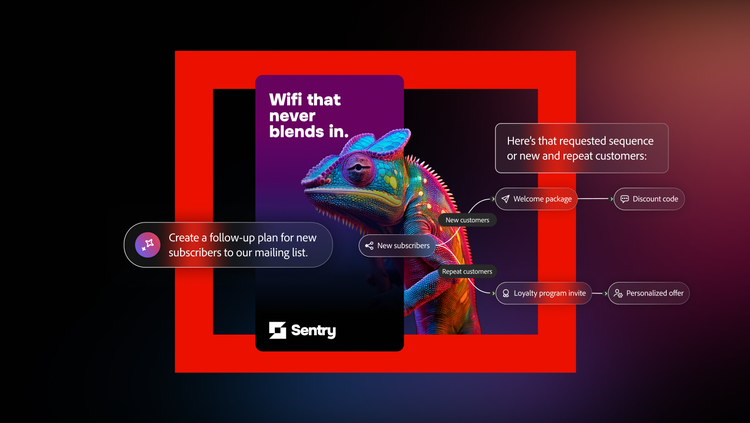
We’ve come a long way, but we’re barely off the start line. Agentic AI is the next evolutionary step in AI, distinguishing itself from generative AI with its ability to orchestrate multiple AI systems and tasks at once for complex, end-to-end AI agent workflows. Adobe Content Supply Chain Solutions Consultant, Koen Van Eeghem puts it best: “The idea is that agentic AI is going to connect multiple individual systems so that they can do more smart things together.”
While agentic AI presents immense potential for efficiency and innovation, its successful implementation relies on businesses and enterprises meeting a number of key prerequisites and understanding the fundamentals of building AI agents — most importantly, the data foundation that agentic AI requires to do its best work.
To get the most out of agentic AI, enterprises can’t insert AI agents into inefficient processes, poor data practices, or unclear ownership. To successfully adopt this innovative system, users must first address several critical prerequisites.
Poor data practices, such as inconsistent entry, siloed information, and outdated records, along with broken processes like manual hand-offs and individualised knowledge reliance, significantly undermine the effectiveness of AI agents.
To ensure AI success, organisations must address these foundational issues through robust data governance, including data quality management, stewardship, and lifecycle management, alongside process optimisation to eliminate inefficiencies and standardise data flow.
Furthermore, successful AI adoption requires organisational readiness — encompassing a data-driven culture, clear communication, comprehensive training, proactive resistance management, and strong leadership buy-in, all of which are essential for agentic AI to thrive and deliver maximum value.
In this article, which draws on the insight of Adobe Content Supply Chain Solutions Consultant Koen Van Eeghem, we’ll look at the necessity of robust data, strategic application, human oversight, and organisational readiness in relation to agentic AI — and how, by fixing what’s broken, agentic AI can be transformative.
Understanding agentic AI: Beyond the generative hype.
Though it was by no means the first form or iteration of mass-market AI, generative AI was a breakthrough, moving from simply analysing data to creating content and handling processes in the blink of an eye. It has bolstered productivity gains and transformed industries through problem-solving and human-machine methodologies. Agentic AI builds upon these successes to create more sophisticated, multi-step processes.
Defining agentic AI and its evolution.
Just like its generative cousin, agentic AI's definition is in its name. The term agentic refers to something that possesses the ability to achieve outcomes independently or autonomously — or with agency, in other words.
So, an AI agent can work independently. However, Koen builds on that definition, describing agentic AI as multiple AI systems working together efficiently and smartly to complete work quicker and more efficiently.
Agentic AI builds on generative AI, and those original developments, built on AI foundation models, were the turnkey factor that closed the loop for agentic AI, by enabling it to understand and generate content. With these developments, agentic AI can now perform end-to-end tasks. Koen uses the analogy of agentic AI being the “AI variant” of a content supply chain, where multiple people and processes collaborate. Here, it’s the AI that fulfils much of the legwork — not the human.
AI as a copilot, not a replacement.
Current AI tools thrive in a space where they aid human roles, rather than replace them. They are designed as smart assistants or copilots, created to help users complete tasks effectively, rather than replace human roles. For example, instead of handling an entire marketing campaign, an AI tool can automate data entry for marketing campaigns. While it may not be 100% accurate, it still saves human time that would otherwise be spent on menial tasks.
There’s a desire to utilise AI in every aspect of work — and increasingly in our home and personal lives. However, to maximise AI, you should only use it where it adds value. Koen cites arbitrary uses that don’t add value such asTVs with AI, or your fridge with AI, explaining that AI is effective when working with large datasets, complex challenges, or tasks that require detailed analysis. That is where its true value lies.
When it comes to an AI-enabled camera to scan your fridge to tell you how much milk you have left, the benefits are seemingly less clear.
When utilising AI, you should remember that the “human factor” is essential for creativity, fine-tuning, and strategic alignment. Koen describes AI as a predictive model that can only provide what it has been trained on and that limits creativity. The human factor is one of those AI agent fundamentals that can take your usage to the next level.
AI agent fundamentals: Clean data and robust infrastructure.
Strong foundations are key for almost every project, and this is as true for creating an agentic AI system as it is for generative AI. Without a solid foundation, agentic AI cannot set goals, reason, plan, or execute tasks. It’s in this area that many businesses fail, trying to bolt on or plug-in-and-play, without establishing a robust infrastructure for AI agents first.
Without executing the fundamentals of AI agents as the foundation, everything crumbles.
The master system of record.
Creating a unified master system of record, where all enterprise data resides, is essential for a responsible AI foundation. Without a single, central source of truth, your AI won’t have access to accurate and trustworthy data set. Metadata should also be accurate, with clean and well-tagged data. Koen advises that an AI system is only as strong as the data on which it is trained.
Remember, data is a broad term that encompasses content, analytics, marketing requests, and visual assets for foundation training models.
Standardising interoperability with industry protocols.
By now, there are industry standards for AI system communications, which determine how an AI agent allows an AI to connect with external systems (or vice versa).
While there are several standards, two of the most important ones are:
- Model Context Protocol (MCP): This is a protocol that allows an AI model to securely connect with external systems, tools, applications, and data. MCP enables AI to access real-time information, files, search engines, and more. You can think of it as an API, but designed for AI use.
- Agent-to-Agent (A2A): A2A is an open communication protocol standard that allows AI systems to connect with each other, even across providers if desired. Think of it as a translator, helping autonomous AI agents share information to break down silos.
Koen explains that by following these protocols, you get a LEGO-like brick box, where you can just piece together services and AI into one integrated system. However, to maximise this, or even handle it, an orchestrator is essential.
The orchestration layer for unified AI agent workflows.
There is a need for operational teams to do the maintenance on the construction of these models, which should be then reviewed both technically and ethically. This can be a difficult thing to build, so many enterprises may turn to an ‘orchestration layer’, which can coordinate and manage multiple systems, applications, and AI agents, streamlining the entire AI agent workflow. An example of an orchestration layer is Adobe Experience Platform Agent Orchestration, which unifies and standardises data and AI processes, acting as a comprehensive AI agent solution.
These systems connect disparate components into a cohesive system, enabling greater speed, scale, and precision, while relieving you of the taxing job of uniting those components. Just as AI unifies and standardises data, you need to apply those principles to your AI processes as well.
Strategic deployment: Where automation delivers real value.
An agentic AI solution has many practical applications. Its deployment should be strategic and value-driven for the best results.
Agentic AI for scaled content and hyper-personalisation.
In recent years, demand for content production has skyrocketed, with 72% of marketers expecting content demand to increase 5x or more. To remain competitive and scale effectively, personalisation, language and translation, as well as cross-channel content, have become necessary. Gone are the days of basic translations or a one-size-fits-all service. To connect with your customers, you must meet them where they are.
Agentic AI helps manage scaling content production by automating repetitive tasks, such as generating mock-ups or translations, freeing your creatives for higher-value work. Koen puts things into perspective, stating, in his own experience that the amount of content he needs to create is skyrocketing. He explains that agentic AI helps marketers to become more efficient, automating repetitive tasks such as replacing background images across thousands of Photoshop files, rather than relying on junior creatives to handle them manually. With agentic AI, users can quickly generate mock-ups for numerous ideas, allowing your team to explore more ideas in less time that might otherwise get overlooked. Koen explains that AI can help teams to quickly get mock-ups for a wide range of ideas. Often, one of the ideas that might not have been expected to land well can become the most successful campaign, but the team would have never known.
Guiding customers with agentic solutions.
Agentic AI can transform your digital channels into personalised, conversational experiences for customers. Agentic AI solutions like Adobe Brand Concierge can help users navigate websites, enabling them to find information quickly. By leveraging all available data on the webpage, agentic AI can offer personalised recommendations and support, build trust, and take users from discovery to decision.
Defining autonomy and human oversight.
AI is a new technology, and with it comes the critical, ethical, and practical question of where to draw the line on AI autonomy.
AI isn’t like a toaster — it’s a technology with profound potential that can alter the way you think and work. With technology like this, there’s a critical question. Where do you draw the line? — both ethically and practically. While everyone may have a different answer, Koen shared his “Business Impact” rule with us, advising that you should ask yourself: If this task was assigned to a team member, would you review this before pushing it out or would you trust them to deliver what is necessary?
Many tasks require human oversight, perspective, and creative thinking. Koen explains that AI really shines autonomously in areas such as data crunching, summarising, and other absolute things. Conversely, he explains that some areas require human oversight, particularly subjective things involving feelings or biases.
Navigating the evolving digital landscape: SEO in the age of LLMs.
The digital landscape is rapidly evolving, and SEO is changing with it. Yet many are under the misconception that Large Language Models (LLMs) may render traditional SEO and websites obsolete.
SEO is very much alive, albeit with a few upgrades.
The evolving discovery funnel.
LLMs are having an impact on the world of SEO, with Koen noting that 60% of the people in the first step are using LLMs to do discovery. However, outside of this discovery phase, users still click through to the site through those citations on your website for deeper engagement or purchase decisions. Additionally, LLMs tend to draw upon those high-authority, organised sources, which are ranked and found by traditional SEO.
The internet and websites are not over; the funnel has simply expanded, and a hybrid approach is the way to go.
Optimising for generative and answer engines (GEO/AEO).
In many ways, SEO is more relevant than ever. AI engines often rely on traditional search engines, such as Google and Bing to find answers when their training data is insufficient. If content isn’t optimised for SEO, then LLMs won’t be able to find it.
There are changes, though. Brands should manage their presence on third-party platforms such as Reddit and Wikipedia, in addition to their own sites. LLMs use these third parties as sources. Koen’s advice skews the same way suggesting that brands should have a presence on Reddit and invest in updating their Wikipedia page to stay in control of their brand narrative. If LLMs use these third parties as sources, they could influence the brand’s image as data is pulled from there. He also recommends scouring the internet for anything that looks or feels like your brand.
In the age of LLMs, brands must control their narrative across all channels, not just their owned properties, as LLMs will utilise that content, whether it’s an official source or not.
The future of agentic AI development: Focused value, not just buzz.
Successful agentic AI implementation is built on a foundation of clean data, strategic application, human oversight, and a prepared organisation. Implementing AI must be more than plug-and-play, and companies must shift from the mentality of AI hype to a pursuit of tangible value and thoughtful implementation. Koen suggests that in five years, the hype of it all will have faded down, and the teams and companies where agentic AI can really make a difference will be able to work on it in a more focused way.
On implementation, Koen advises that 95% of the AI pilots fail or do not return on the investments due to a lack of clear goals and problem-solving focus, rather than an issue with AI's inherent capabilities.
For successful implementation, Koen suggesting asking yourself: Did it make sense to start with? Where were the goals? What were the KPIs? What were the problems that we were trying to solve? Or were we trying to include AI because it’s the buzzword of the year?
While the pace of adoption varies, the ultimate success of agentic AI lies in a pragmatic approach that prioritises clear business objectives, a responsible AI foundation, and readiness. This ensures that automation genuinely works, driving innovation and competitive advantage.
Learn more about Adobe AI for business.