
A new marketing operating model is emerging — one where AI doesn't just assist but acts, connecting data, content and decisioning in real time so brands can show up with relevance for every customer, across every interaction, at a scale that wasn't possible before.
Competitive advantage in this era won't go to the organisations with the most AI capabilities. It will go to those who've figured out how to make their capabilities work together with AI integrated across workflows, moving from a collection of disconnected tools to a system of co-ordinated execution.
That's the promise of customer experience orchestration. In this series, I've explored why agents are becoming a new audience marketers must reach, what it means that agentic AI has moved from possibility to practise and how the three modes of engagement — human-to-human, human-to-agent and agent-to-agent — are reshaping the ways brands connect with customers. In this final instalment, I want to dive deeper into what it takes to make all three modes work: the agentic capabilities, the data foundation and the orchestration layer that ties it together.
My conversations at major industry events like VivaTech, Cannes Lions and Fanatics Fest and in customer meetings keep returning to the same question: what does the orchestration layer actually look like when it's working? The answer is a system that unites disconnected workflows, siloed data and fragmented execution — not another tool, but a genuine operational teammate.
That's what Adobe CX Enterprise Coworker is built to be: the connective tissue of the agentic enterprise, an intelligent marketing and creative collaborator that orchestrates customer experience workflows across marketing systems. It works with your team to operationalise and manage complex, cross-functional work, turning insight into action and ideas into exceptional customer experiences. Humans define the goals and direct the strategy. CX Enterprise Coworker handles the execution, automating end-to-end marketing operations, building insight-driven campaign orchestration and driving always-on intelligence. It keeps the system running, adapting and improving across every customer touchpoint.
“Adobe CX Enterprise Coworker gives enterprise marketing teams the ability to operate with greater speed and clarity that simply wasn't possible before. It does this not by replacing the people behind the work, but by removing everything that was getting in their way.”
Anjul Bhambhri
SVP Engineering, Customer Experience Orchestration, Adobe
The gap between AI ambition and agentic execution — and the barriers to closing it.
The appetite for AI-powered customer experience is real and growing. According to Adobe's 2026 AI and Digital Trends research, 80% of organisations expect breakthrough customer experiences to be highly personalised and anticipatory in real time. As I mentioned in my last blog, the Agentic Marketing Garage, a hands-on experience we launched at Adobe Summit and are bringing around the world, showed us that marketers are ready to use agentic AI as a tool and teammate. The most remarkable moments were when marketers pushed back, redirected agents and discovered they could move faster than they ever imagined.
But readiness and execution are two different things. The same Adobe research tells a more complicated story of value realisation: 75% of organisations cite data integration and quality as the biggest barrier to implementing agentic AI solutions, ahead of talent gaps and unclear ROI. Only 39% have a shared customer data platform capable of supporting agentic AI and 52% say their data unification and structure actively limits the advancement of their AI initiatives. The ambition is there; the foundation often isn’t.
Picture a perfectly built campaign email landing in the inbox of a customer who churned six months ago, while your highest-intent prospects never see it at all. As CMOs, we gravitate toward the campaign and the creative. But none of that matters if it doesn’t reach the right customer at the right moment.
I believe agentic marketing efforts will continue to fall short of their potential until organisations align on data ownership and decision-making. A recent IDC report on CMO-CIO alignment for AI success puts it plainly: For IT and marketing, data is both a shared priority and a shared blocker.
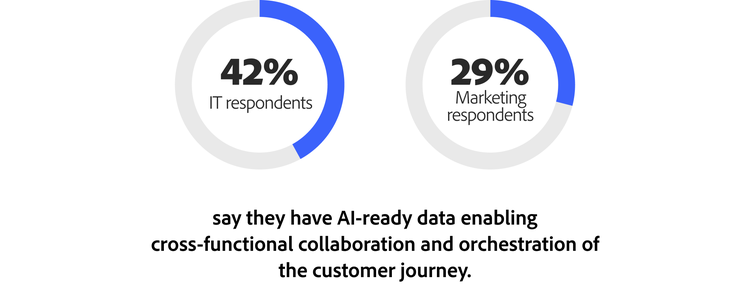
Addressing this tension is not solely an IT concern. How a brand structures, unifies and activates its customer data directly determines the quality of every experience it delivers. That’s why it’s never been more important for marketing leaders to partner with IT on a strong data strategy — because building a connected, agentic-powered CXO model depends on getting that foundation right together.
Tool and teammate: how agents become the operational layer for customer experience orchestration.
AI can now operate software, which frees people to do work that is more valuable: define the goals, direct the strategy, govern the system and bring the creative insights, empathy and nuance that only human experience can teach. But as AI scales, a new challenge emerges. The question is no longer simply how to deploy AI capabilities — it's how to manage the operational complexity that arises when intelligence, workflows, governance, creativity and customer experience all need to work together.
That's the shift CX Enterprise Coworker is built for. We've arrived at the moment when intelligent orchestration empowers marketers to go from producing content to co-creating with AI. This means scaling ideas into standout experiences that continuously adapt and optimise across every touchpoint. CX Enterprise Coworker is the orchestration layer that amplifies creativity — semi-autonomous when you set the guardrails, fully autonomous when you're ready to let it run.
What makes that level of autonomy possible and trustworthy, comes down to three capabilities:
- Organisational memory that compounds over time. The system retains and reuses business context across sessions, agents and team members — enriched continuously by campaign performance, customer interaction history and business outcomes. Every decision builds on what the organisation already knows, rather than starting from scratch with each new brief or campaign cycle.
- A shared workspace where humans and AI operate as coworkers. Approvals, handoffs and creative decisions happen in one conversational environment that your team can access from the tools they already use. The work doesn’t stop moving because someone is waiting on an email chain or a meeting that hasn’t happened yet.
- Human-defined autonomy that scales with confidence. Teams set the goals, the guardrails and the level of autonomy in plain language — no technical configuration required. Whether the workflow is fixed or dynamic, the system reasons and adapts until the outcome is reached. This is what semi-autonomous looks like in practice: CX Enterprise Coworker operates within the bounds you define and earns more autonomy as trust is established over time.
Unified customer data is the foundational prerequisite for agentic CXO.
Each of those capabilities runs on data. Without a strong, real-time data foundation, even the most sophisticated agentic system is making decisions in the dark — acting on incomplete signals instead of the full context of who a customer is, what they need and why they're engaging in this moment.
Unified customer data enables the move from signals to meaning, democratising intelligence across the organisation so that real-time profiles, behavioural context and the reasoning behind each interaction are accessible and actionable at every touchpoint. It's what allows brands to understand not just what customers did, but what they asked, what they needed and how the experience evolved. And it's what truly operationalises agentic-powered customer engagement — orchestrating data, insights, journeys, content and delivery from acquisition through loyalty, in the moment, for every audience. This is the infrastructure that turns "treat every customer like they're your only customer" from a marketing aspiration into something a brand can really achieve.
Take something as simple as an end-of-quarter promo. The same offer reaches a loyal customer as recognition, a lapsed one as a reason to return and a new prospect as a first invitation. The marketer sets the goal and the coworker handles the execution, adapting each version intelligently within the brand's guardrails.
As agents take on more autonomous action across more touchpoints, the stakes of getting this right only grow. The brands that earn customer trust at scale are the ones that have built accountability into how their systems run — not as an afterthought, but as the foundation. That's a responsibility that belongs to marketing leadership as much as IT.
Three CXO decisions only marketing leaders can make.
The infrastructure is ready. The capabilities exist. What determines whether an organisation realises the full potential of customer experience orchestration is a set of decisions in front of marketing leaders. Here's where to focus:
1. Treat governance as the foundation of scale, not a constraint on it.
Brands that embed guardrails from the start both protect against risk and build confidence to let agents do more over time. Governance is how agents earn autonomy. The goal is not to limit what the system can do. It's to demonstrate that it performs, adapts and upholds the brand's standards consistently, so that trust compounds with every interaction.
2. Make the shift from campaign thinking to continuous experiences and engagement.
True orchestration happens when marketing leadership commits to embedding intelligence into every phase — planning, activation and optimisation — rather than treating each cycle as a fresh start. The organisations that will lead are the ones building systems that sustain real-time, adaptive engagement without starting again every time.
3. Own data unification as a brand decision.
How a brand structures and activates its customer data determines the quality of every experience it delivers. This isn't a technical project to delegate or defer. It's a strategic decision that marketing leaders need to drive because the quality of every agent decision, every personalised moment and every customer interaction flows directly from the quality of the data underneath it.
Marketing leaders are orchestrating what's next.
This series started with a simple observation: AI agents are becoming an audience marketers must reach, not just a tool they use. From there, we explored how agentic AI is making customer experience orchestration operationally real, how brands must show up across three distinct modes of engagement and now — what it actually takes to make all of it work.
The foundation is data. The engine is orchestration. And CX Enterprise Coworker brings it together, a good teammate that plays well with other tools, built to turn fragmented efforts into co-ordinated execution and agentic-powered customer experience. When those pieces are in place, customer experience orchestration delivers what marketing has always promised: relevance, for every customer, in every moment, at enterprise scale.
That's what's possible. And the decision to pursue it — to treat data infrastructure as a marketing essential, to embrace agents as both tools and teammates, to move from campaign thinking to continuous engagement — starts with marketing leadership. Get this operational foundation right, understand your use cases and how AI integrates with them and lean into the high-judgement decisions that ensure every customer experience reflects the best of your brand. Do this and your teams can finally build the kind of experiences your customers expect when they need it most.
Learn more about Adobe CX Enterprise Coworker.
Recommended for you
https://business.adobe.com/fragments/resources/cards/thank-you-collections/thought-leadership