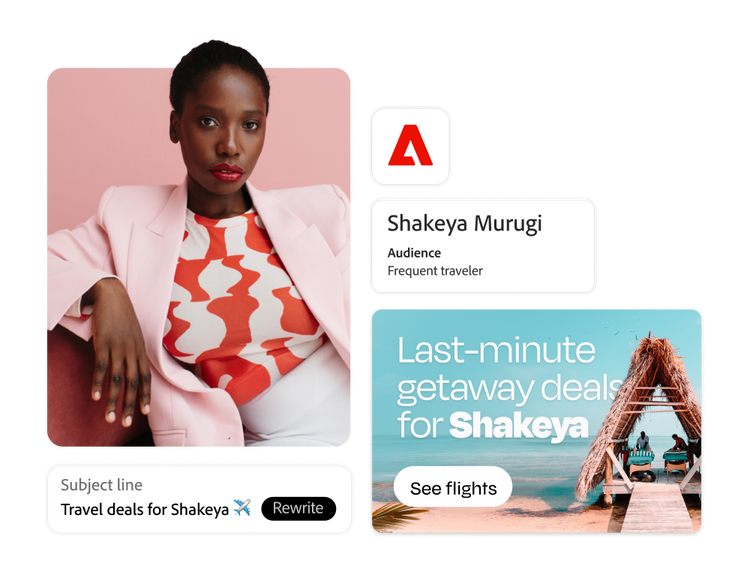
We’re at a critical juncture in customer experience. AI has long supported personalization behind the scenes. But at Adobe Summit 2026 in Las Vegas this April, we saw it step into the center of the action. It’s helping marketers design, build, and launch experiences in real time. And then adapt them based on how customers respond, determining what they see, how they decide, and how interactions unfold.
We’ve entered a new era of engagement, and it’s playing out across many different fronts: humans interacting with humans, humans collaborating with AI agents, and AI agents acting on behalf of customers. AI brings speed and scale, but it also means fewer moments of direct control.
Discovery, evaluation, and engagement now happen through AI‑driven channels, like ChatGPT, Claude, and Gemini. In a zero‑click world, disconnected marketing can’t keep up. And while CMOs and marketing leaders are still responsible for attracting and engaging customers in meaningful moments, those moments are increasingly shaped, accelerated, and delivered by AI.
This is where customer experience orchestration (CXO) comes in. CXO brings content, data, decisioning, and trust signals together across journeys so brands can show up with clarity and confidence for both humans and AI agents. And agentic AI is expanding the scale of orchestration, changing how experiences are personalized and how work gets done across the customer lifecycle.
In my last blog, I explored how AI agents are beginning to act on behalf of customers, transforming the rules of engagement. Here, I want to focus on what this momentum means for marketers, as agentic AI moves from possibility to practice.
Introducing Adobe CX Enterprise.
I've been coming to Adobe Summit for years, but this year marked a turning point. AI and agentic technologies are changing how work gets done, how marketing teams amplify their efforts across content, channels, and audiences, and how humans and AI work together to improve every customer touchpoint and interaction.
At Adobe Summit we unveiled Adobe CX Enterprise, an end-to-end agentic AI system designed to orchestrate the entire customer lifecycle, from first interaction to lasting loyalty. It empowers teams to create content, engage customers, and show up consistently as a brand, without fragmentation or manual workarounds. Just intelligent orchestration built for how modern marketing operates.
We also introduced CX Enterprise Coworker — an AI agent that fits into your existing workflow and acts on its own when needed — and Adobe Brand Intelligence, which turns static brand guidelines into a living system that keeps your brand consistent as AI-powered content scales.
CX Enterprise Coworker enables organizations to move beyond experimentation and into real, repeatable execution. Teams can set up AI Coworkers with clear roles, permissions, and guardrails, configuring them to assist specific workflows or to run in the background to deliver trusted, on-brand experiences in real time.
And Adobe Brand Intelligence helps maintain brand integrity as more AI, teams, agencies, and regions get involved. It’s an always-on shared source of truth for how your brand should show up, keeping humans and AI aligned as work moves faster. The system trains itself on approved content, brand guidelines, and past decisions, and then applies that intelligence across every experience. The result is less need for manual reviews, less brand drift, and more confidence that everything in market reflects your brand as intended.
The new rules of brand visibility.
Marketers are used to the rules of engagement changing — but this time, they’ve been torn up, tossed aside, and totally rewritten. What matters now to AI-driven discovery is accuracy, trust, and representation, because brands are no longer always speaking directly to customers. AI agents now decide what information customers see by selecting, summarizing, and explaining content on the brand’s behalf. Readiness for AI‑led discovery is now a core brand responsibility.
At Adobe Summit, we got an inside look at how Adobe Brand Visibility, formerly Adobe LLM Optimizer, helps marketers understand how their content appears in AI-powered experiences, and how that visibility stacks up against competitors. Teams can identify where their content is falling short, detect inaccuracies that could harm brand trust, and make targeted improvements to optimize performance.