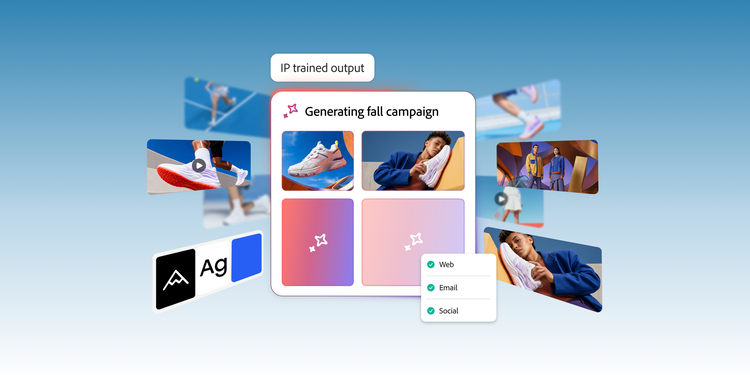
Enterprise teams face growing pressure to produce more content without adding unnecessary time to production and approval. Traditional workflows can slow that process when teams work across separate formats and repeatedly rebuild campaign content.
While generative AI can accelerate initial creative production, first-draft speed alone does not determine campaign velocity. The real value comes from creating assets that reflect brand and campaign requirements from the start, reducing the revisions required before they are ready to be used.
IP-trained AI can help shorten the path from generation to approval by grounding creative output in the brand’s own intellectual property. Adobe Firefly Foundry, an Adobe-managed enterprise offering, enables organizations to work with Adobe experts to build proprietary, deeply tuned generative AI models. These models support high-fidelity creation across image, video, audio, vector, and 3D, helping teams preserve the products, characters, visual styles, and creative relationships that distinguish their brand.
Explore how Firefly Foundry can help improve campaign velocity across production and execution:
Campaign speed is an executive priority.
When campaigns take too long to develop, approve, and activate, the opportunity may have already passed. According to Adobe's 2026 AI and Digital Trends Consumer Report, 69% of customers say brands today have five seconds or less to capture their attention in a promotional email, ad, or social media post.
These strained campaign workflows cost organizations time-sensitive marketing opportunities. Adobe’s 2026 State of Marketing in an AI-Driven World report found that 84% of organizations missed at least one marketing opportunity in the previous quarter because their workflows could not respond in time, while 29% missed six or more opportunities. Meeting this expectation depends in part on how fast teams can create and adapt campaigns across channels, regions, audiences, and formats while the opportunity is still available.
As customer attention windows decrease, campaign speed has become a business priority. Brands need assets that align with campaign requirements from the outset and move efficiently through review and approval. Multimodal AI can help teams retain campaign context across asset types, keeping campaign execution fast and cohesive.
How multimodal AI changes campaign velocity.
Multimodal AI helps teams apply shared creative context across asset types. However, multimodality does not establish brand knowledge, persistent campaign state, or workflow coordination alone.
Consider a product launch. A single campaign may require display ads, product imagery, social content, videos, audio, and market-specific variations. Although these assets serve different purposes, they all must reflect the same campaign concept and brand standards. Multimodal AI can help teams keep these assets connected within the same creative system.
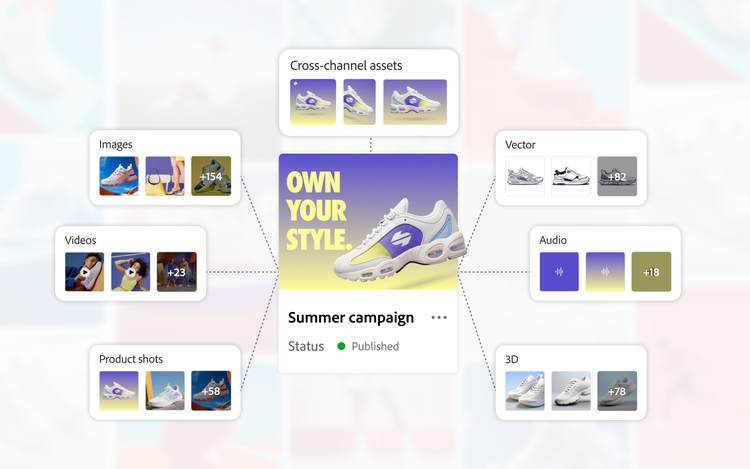
Adobe Firefly Foundry provides a brand-trained model foundation that teams can use during concept development, asset creation, review, and adaptation. Its contribution is a more brand-faithful generation within those workflows, rather than automatic management of every production stage.
Concept development.
Concept development turns a creative brief into an initial campaign direction. Teams establish the visual language, product presentation, messaging, and other creative elements that will shape the campaign. Starting with generic references or stock images can prolong research and exploration and produce concepts that feel disconnected from the brand.
How Adobe Firefly Foundry helps.
Firefly Foundry models are trained on a company’s IP, visual systems, and approved assets, giving teams a starting point grounded in the brand’s own visual language. This can help teams reach stronger campaign directions faster and reduce the amount of rework needed during concept development.
Asset development.
Once a concept is approved, teams need to translate it into usable assets for different channels and formats.
As production expands, each asset must continue to reflect the approved creative direction.
How Adobe Firefly Foundry helps.
Firefly Foundry can support high-fidelity content creation across campaign formats, including images, video, audio, vector assets, and 3D product visualizations. Its semantic understanding helps preserve character traits, visual styles, product details, and relationships between creative elements. Teams can develop different campaign components using the same proprietary model, so an approved concept carries into every format.
Review and revision.
Creative assets typically pass through brand, product, editorial, legal, and regional reviews before release. If teams identify inaccurate product details, inconsistent branding, or other fundamental issues late in the process, assets may require extensive revisions or a complete rebuild. This rework can delay approvals and campaign activation.
How Adobe Firefly Foundry helps.
Firefly Foundry models help teams produce assets that are closer to established brand and product requirements, giving stakeholders a more consistent baseline to evaluate. Review cycles can then shift from correcting fundamental issues to refining campaign-specific elements. This helps reduce the risk of rebuilding assets that miss basic production requirements.
Versioning and adaptation.
Once a campaign is approved, teams still need to adapt it for different markets, audiences, and channels. Each variation may introduce specific requirements, such as a different product configuration, cultural setting, visual emphasis, or channel format, while preserving the original creative direction. Producing these versions manually can turn adaptation into a second production cycle that can slow content velocity.
How Adobe Firefly Foundry helps.
Firefly Foundry models give creative teams a consistent foundation for localization and other adaptations without having to create assets from scratch for each variation. The result is less repetitive production work and more time for higher-value creative and strategic tasks.
Evaluating campaign velocity by assessing creative assets.
Campaign velocity depends in part on how efficiently generated assets become approved, usable creative, usable creative. Generic AI models may produce assets and variations quickly, but outputs that are off-brand, inaccurate, or difficult to edit can add corrective work and delay execution. Asset quality is therefore one contributor to velocity, alongside the production, review, and activation processes around it.
Teams can evaluate campaign velocity by assessing whether AI-generated assets are accurate, consistent, editable, repeatable, and easy to review:
How to evaluate model generation.
These criteria can help teams distinguish between AI that increases output and AI that shortens the path to approved creative, enabling faster responses to marketing opportunities.
Where velocity creates a competitive advantage.
Marketing opportunities can emerge and fade quickly. Organizations that reduce time to market are better positioned to respond while customer interest is still high.
Adobe Firefly Foundry can help enterprises build more responsive creative operations by reducing corrective work, repeated context rebuilding, and fragmentation across campaign formats. By helping teams act on opportunities sooner while maintaining creative consistency, Firefly Foundry can help turn campaign velocity into a competitive advantage. Some of the key business outcomes include:
- Faster responses to launch priorities, seasonal demand, and market opportunities.
- Lower costs from corrective work, rejected assets, and repeated production.
- Greater creative capacity for innovation and differentiated storytelling.
- More consistent brand execution across markets, channels, and formats.
As campaigns expand across more channels, formats, and markets, teams must produce more assets without losing what makes their brand distinctive. Adobe Firefly Foundry grounds content generation in proprietary IP, helping teams preserve their products, characters, visual styles, and creative relationships from concept through adaptation.
Explore how Adobe Firefly Foundry can help enterprise teams turn proprietary IP into faster, more consistent, on-brand campaign production.
Recommended for you
https://business.adobe.com/fragments/resources/cards/thank-you-collections/firefly
caas:content-type/blog, caas:products/firefly,
caas/blog-author/adobe-for-business-team