Over the past few years, Adobe and Workday have built a partnership focused on modernizing content creation and helping Workday deliver more seamless, personalized, data-driven customer experiences.
Today, that work is taking shape through an AI-powered marketing engine built on Adobe technology. The foundation is Adobe Experience Platform applications. Workday launched its revamped Adobe Real-Time Customer Data Platform last year, providing a unified data foundation built for scale and more relevant, AI-supported customer engagement. Adobe GenStudio solutions — including Adobe Experience Manager, Adobe Workfront, Adobe Express, and Adobe Firefly — unite the creative and content operations of Workday. This connected system allows Workday teams to create, manage, and scale AI-powered content with speed and brand consistency.
The partnership is rooted in co-innovation, and it is especially meaningful from an engineering perspective — translating complex data, platform, and AI work into real, measurable impact for the global brand. Workday collaborates closely with Adobe’s product and engineering teams to shape product direction, bringing real-world B2B requirements directly into development, while pushing capabilities — from data infrastructure to agentic workflows — into production.
Workday Chief Information Officer Rani Johnson emphasized that this isn’t just a modernization effort — it’s a true business transformation. She noted that marketing, IT, and security teams all have to move in lockstep for the company to scale safely and confidently.
Faster, brand-safe content creation.
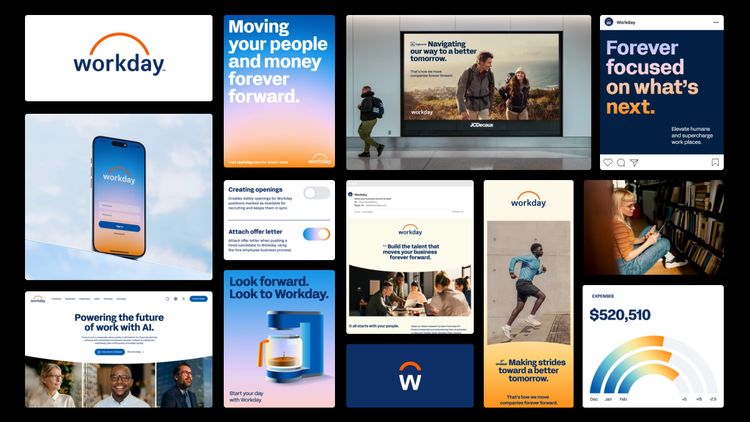
As Workday expands globally, content demand surges across marketing, product, sales, and internal communications. This means more assets needed for more audiences, formats, and channels than existing workflows could support. For Johnson and Chief Marketing Officer Emma Chalwin, the mandate has been clear from the start: empower more creators while rigorously protecting brand integrity. This requires building governance, transparency, and safety into every AI-driven workflow. What began as a bandwidth challenge evolved into a shared opportunity to modernize Workday’s entire content supply chain and create a connected, scalable, cross-functional model for the future.
Cross-functional leadership powering change.
Rather than tackling the challenge in silos, Chalwin and Johnson moved together — modeling the kind of cross-functional leadership required to scale AI responsibly. They jointly sponsor new technology implementations and co-govern AI usage, intentionally redesigning how teams adopt new tools and workflows.
“We’re embedding AI across the business, and that requires a different kind of partnership,” said Johnson. “We’re collaborating earlier and deeper than ever.”
This collaborative leadership resulted in unified programs that integrate AI and Adobe tools directly into daily work:
Everyday AI — a company-wide initiative giving every employee access to AI productivity tools and fostering an AI-first mindset.
AI Pods — putting Everyday AI into practice by establishing cross-functional teams of business experts paired with UX and engineering teams to rapidly develop AI-powered workflows.
Shared governance frameworks — ensuring brand safety, transparency, and responsible AI use across both marketing and IT.
The new pace of creative work.
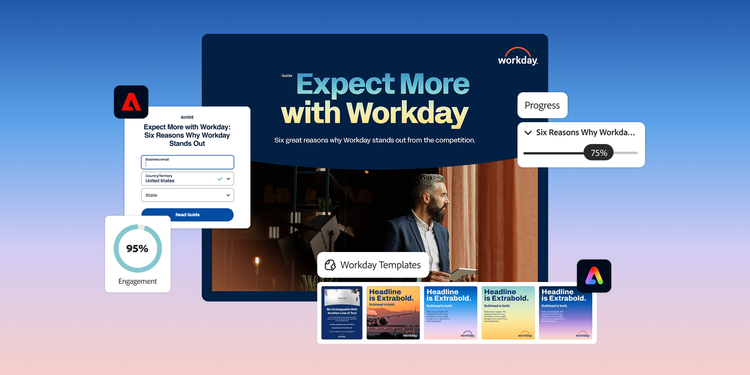
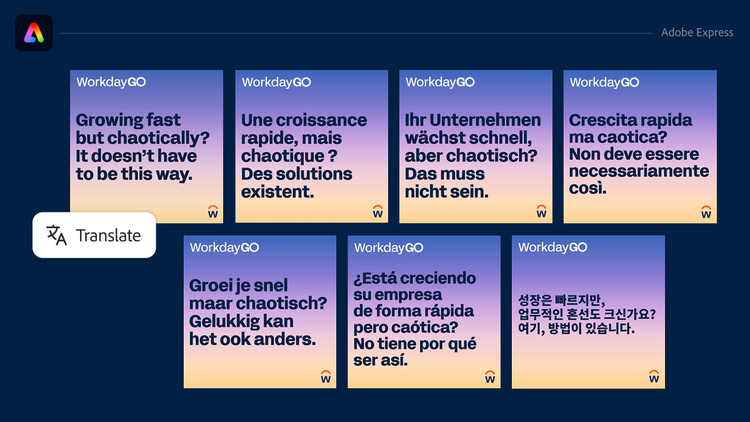
The impact of this partnership shows up most clearly in everyday creative work. Adobe Express has become Workday’s all-access creative tool, with more than 90% of marketers licensed. Teams now use it to produce everything from social assets and employee communications to field marketing materials and quick-turn product content.
Adobe Firefly generative AI helps accelerate early ideation, enabling teams to explore visual direction, generate variations, and refine compositions within brand guidelines. In this process, we take AI from experimentation into governed, repeatable creative workflows.
Adobe Express and Firefly help Chalwin’s teams move faster with more confidence, she said. They remove friction so people can focus on the work that really matters — the strategic, human-centered work only people can do.
“Adobe Express and Firefly help our teams move faster and with more confidence. They remove friction so our people can focus on the work that really matters – the strategic, human-centered work people can do.”
Emma Chalwin
Chief Marketing Officer, Workday
By scaling Adobe Express, Workday is reimagining how creative work gets done. The technology is moving AI from a transactional request model to an empowerment engine, enabling marketers to launch designs independently using a robust, brand-curated template library. The creative team has reclaimed critical bandwidth from this shift and reduced costs by at least 50%, allowing designers to focus on higher impact, high-concept brand initiatives.
A connected backbone for coordinated marketing.
To handle the acceleration of content needs, Workday requires a connected operational backbone — one designed with the same rigor, observability, and governance expected of enterprise-grade systems. Adobe Workfront now structures intake, planning, production, and approvals, giving marketing and IT shared visibility and enabling teams to scale confidently.
Workfront helps bring structure and governance to the creative flow so teams can move quickly without compromising trust, Johnson said.
As Workday modernizes how content moves from idea to execution, the organization is also investing in the data and journey infrastructure needed to support its next phase of personalization. With its revamped customer data platform, Workday has established a centralized marketing data foundation, enabling audience activation across platforms such as Adobe Marketo Engage and LinkedIn. They’re using automated controls for data retention and anomaly detection to keep data clean and compliant, reducing the need for manual data hygiene processes.
Building on its long-standing data foundation, Adobe Journey Optimizer B2B Edition will scale personalization through AI-driven segmentation and optimize campaign workflows for measurable impact.
Together, this foundation allows Workday to move faster from intake to interaction — delivering personalized experiences that feel purposeful, consistent, and customer‑first.
An agentic-ready marketing engine.
Looking ahead, Workday is beginning to leverage generative and agentic capabilities — moving agent-driven workflows from proof of concept into production.
Workday is exploring the agentic AI capabilities in Adobe Agent Orchestrator, a technology we introduced mainstage at Summit 2025 in Las Vegas. It has been performing key jobs like intent-based identification and prioritization, detecting key buying groups, and streamlining practitioner workflows while creating agentic journeys, thus accelerating decision-making and delivering personalized customer engagement. In general, from a product and engineering standpoint, this is where the work becomes especially exciting — moving beyond dashboards and rules into systems that can understand, reason, prioritize, and act with intent while remaining transparent and controllable by humans.
With a shared Adobe AI platform, shared governance, and shared visibility, the Workday marketing and IT teams are building a future where creativity, data, and AI work in concert — a future where thoughtfully engineered platforms empower people to do their best work.
As Senior Vice President of Adobe Experience Cloud, Anjul leads an Experience Cloud engineering organization focused on powering digital businesses across B2B and B2C.
With three decades of experience in enterprise software development, focusing on data, databases, analytics and SaaS, she has launched technology ventures within mature companies and grown ideas into global organizations with significant revenue streams.
Anjul joined Adobe in 2016, spearheading product strategy and engineering for Adobe Experience Platform (AEP), the industry’s first purpose-built customer experience management platform, delivering personalized customer experiences in real-time at scale. Included in this body of innovation are solutions like Real-time Customer Data Platform (RT-CDP) for B2B and B2C, Journey Optimizer and Customer Journey Analytics. Anjul also leads other critical parts of the Adobe Customer Experience product portfolio, such as Adobe Analytics, Adobe Marketo, Adobe Campaign and Adobe Target, empowering brands to deliver personalized experiences across surfaces.
She spent 14 years at IBM, most recently leading product strategy, engineering and technology adoption as Vice President of Engineering for the Big Data and Analytics Platform.
Anjul holds a Bachelor’s in Electrical Engineering from the University of Delhi.