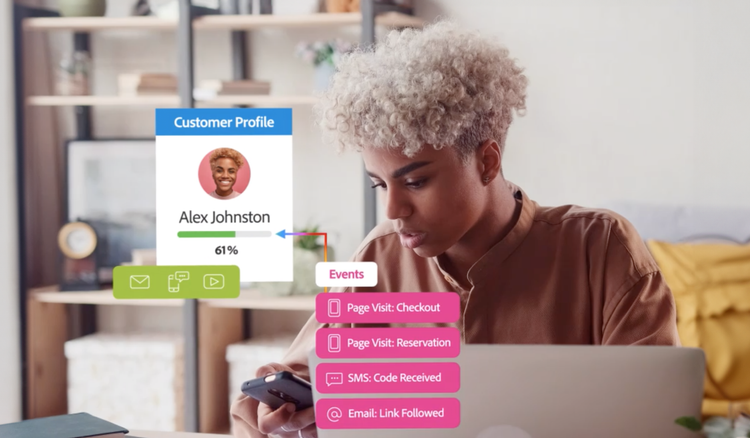
ADOBE REAL-TIME CDP
Harness customer experience data for intelligent activation.
Unify and harmonize data from every source to create AI-powered profiles and audiences for personalized, in-the-moment engagement across the full customer journey — all while respecting customer preferences.
Watch overview | Watch overview about Adobe Real-Time CDP Book a demo | Book demo adobe real time cdp
Explore the features and capabilities of Real-Time CDP.
Built on Adobe Experience Platform, Real-Time CDP lets you create high-value audience segments with intelligence for real-time B2C and B2B use cases across the entire marketing funnel, without relying on third-party cookies.
- Flexible connectivity
- Harmonized data access
- Intelligent audience management
- Data governance
- Full funnel activation
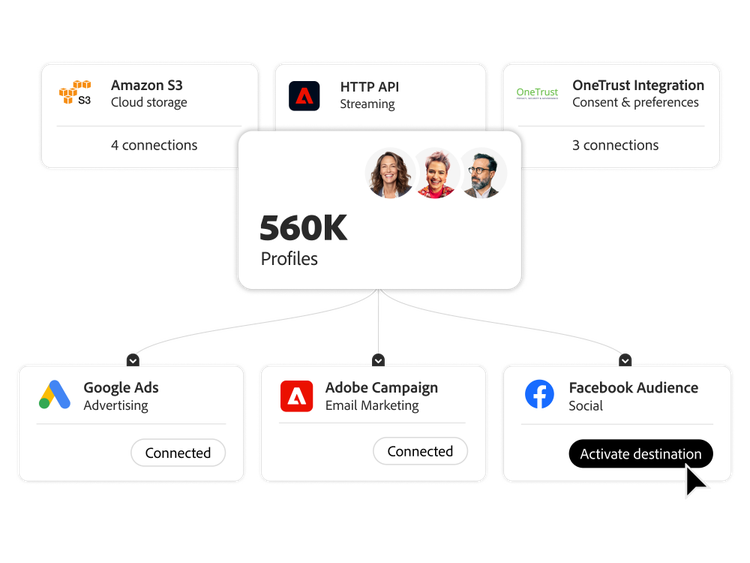
Connect to data from one flexible environment — no matter the source.
Take full advantage of your data warehouse investments and easily enrich first-party data to empower enterprise teams to activate valuable data and drive more personalized customer experiences.
- Maximize the value and minimize the movement of your data with a flexible architecture. Activate customer data directly from your existing warehouse for real-time, personalized experiences without the need to move or copy underlying datasets.
- Build powerful, federated audiences. Create and enrich high-value audiences directly from your data warehouse and combine them with continuously ingested internal and external data sources.
- Unify comprehensive data sources. Securely ingest and unify zero-, first-, and cookieless third-party data, including insights from trusted second-party sources for in-the-moment engagement and personalization.
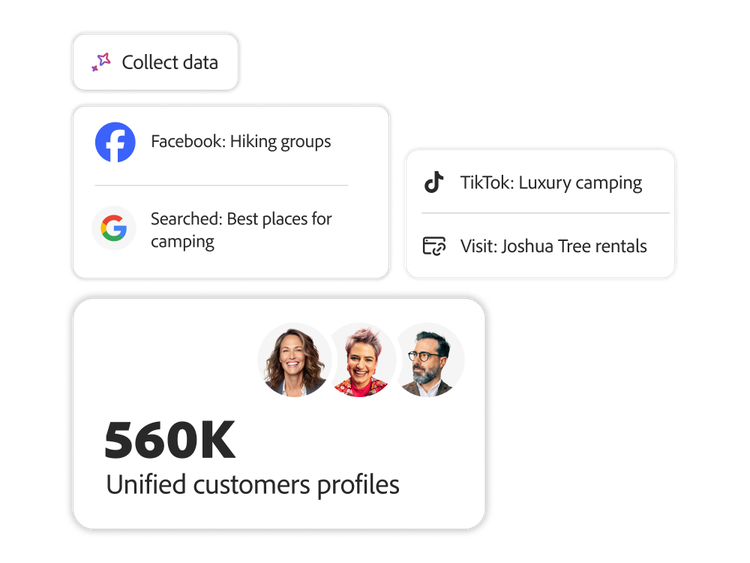
Connect data to form.
With Real-Time CDP, you can connect and normalize online, offline, and pseudonymous customer data to create unified B2B and B2C profiles and audiences in one platform. From this foundation, Real-Time CDP automatically denormalizes and materializes data optimized for real-time decisioning, personalization engagement with customers and prospects.
- Standardize, clean, and monitor data. Ensure data is consistently structured, clean, and traceable, enabling accurate insights and trusted customer experiences.
- Harmonize and unify customer profiles. Empower teams across the organization to access and update a unified customer profile that ensures they’re working with consistent, current information.
- Get efficient self-serve templates and interactive tools. Help teams to act more quickly with resources that are marketer-friendly and agent-supported.
- Data Engineering Agent. Automate data onboarding, SQL preparation, data collection, and troubleshooting with Data Engineering Agent.

Build, activate, and optimize audiences at scale.
Stand up and optimize campaigns with tools to create and segment audience and customer profiles in real time — all enriched with diverse data sources and powered with AI insights.
- Create and manage audience insights from a centralized interface. Quickly create, manage, and optimize audiences using intuitive tools and natural-language prompts. This streamlines the process of building and refining audiences, reduces reliance on technical resources, and accelerates speed to market for campaigns.
- Get advanced audience insights for personalization. Gather deep, actionable insights into audience behavior and campaign performance, enabling more precise targeting and personalization.
- Enrich audiences with flexible input from all sources. Leverage data from multiple sources — including warehouse connections and second- and third-party partner data — to enrich and activate audiences across channels, while keeping management central and internal.
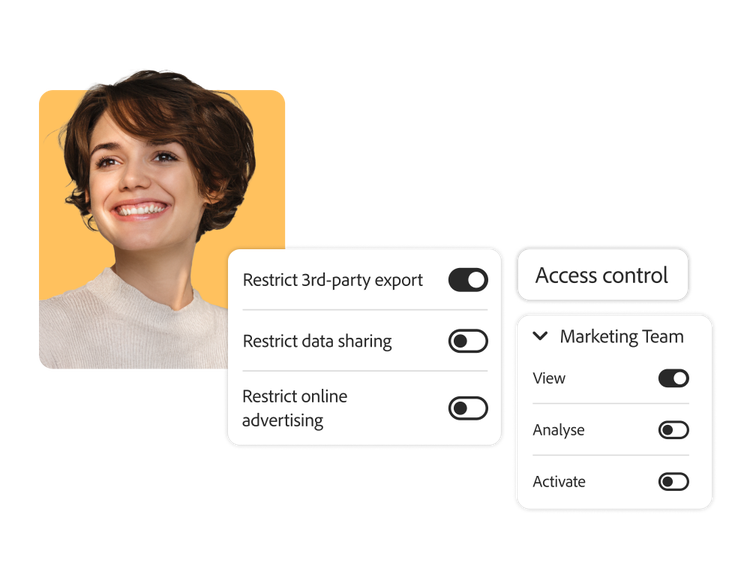
Confidently manage your data with enterprise governance tools.
Manage customer data across all lines of business from one centralized platform.
- Give teams enterprise data privacy and compliance. Create, manage, and enforce data usage policies across teams that help ensure sensitive data is only used in approved ways and aligns with privacy regulations.
- Use permissions to control data access and security. Determine which users and teams can access specific data types and actions, limiting the exposure of sensitive information and reducing the risk of unauthorized access.
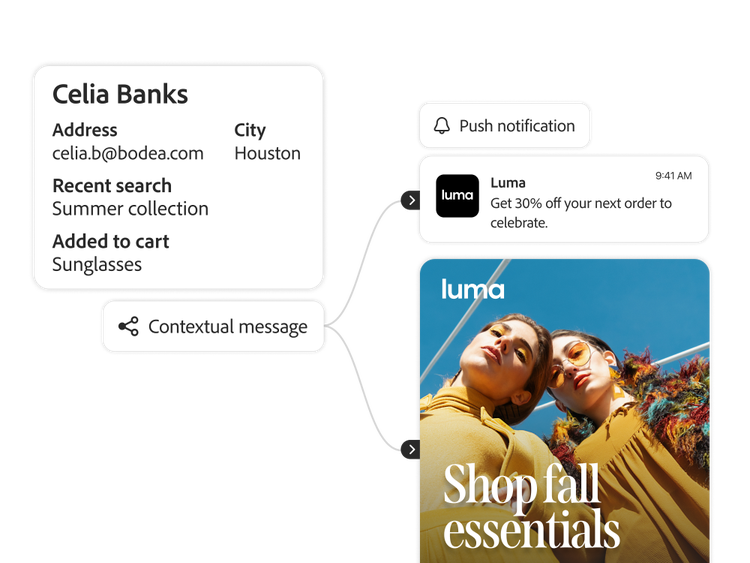
Deliver relevant, real-time customer experiences across every channel.
Reach new customers, personalize engagement, and optimize the entire funnel for measurable impact with real-time engagement.
- Deliver targeted customer experiences and in-the-moment personalization. Leverage real-time data ingestion and streaming delivery to activate personalized experiences for customers faster.
- Plan, orchestrate, and activate cross-channel journeys. Use prebuilt integrations and APIs to activate known and unknown data across channels to build destinations for customers along their journey. Plan journeys using a marketer-friendly, easy-to-use canvas to activate with even more speed.
Adobe Real-Time CDP use cases


Convert unknown prospects.
Recognize and remarket to unknown visitors with personalized experiences for better conversion.

Create customer profiles.
Build unified profiles that power more targeted and relevant omnichannel experiences.

Retain customers.
Connect data faster to enhance your customer profiles, unlock deeper insights, and retain customers.

Govern customer data
Earn and maintain customer trust through responsible data governance, management, and usage.

Additional Real-Time CDP offerings.

Adobe Real-Time CDP Collaboration
A purpose-built data collaboration application that lets you connect with brand partners, advertisers, and publishers — from connected TV to commerce media — to find high-value audiences in a user-friendly environment, all while prioritizing privacy.

Adobe Real-Time CDP Connections
Streamline how data is collected and distributed to Adobe Experience Platform and other systems and endpoints — such as Facebook and Google — while improving site performance. Adobe Real-Time CDP Connections uses server-side forwarding to enable you to instantly deliver powerful marketing experiences.
Learn more about Real-Time CDP.
Better together.
Connect Adobe products to create experiences that are right on time and just right for your customers.

Real-Time CDP + Adobe Journey Optimizer
Build unified profiles and actionable audiences while also creating and delivering personalized customer experiences.
Learn more | Learn more about Real-Time CDP plus Adobe Journey Optimizer

Real-Time CDP + Adobe Customer Journey Analytics
Supplement customer profiles with cross-channel behavioral insights for enhanced audience creation and activation.
Learn more | Learn more about Real-Time CDP plus Adobe Customer Journey Analytics

Personalization at scale
Adobe can help you make personalized experiences a part of every customer moment.
Questions? We have answers.
The main difference between a data management platform (DMP), a customer data platform (CDP), and a customer relationship management (CRM) platform is the primary purpose for which customer data is stored and organized. Between managing existing customers, marketing to potential customers, and integrating that information to create a unified customer profile, each platform uses data in different ways.
A customer data platform (CDP) builds a robust, varied picture of customers by collecting and harmonizing data from a wide array of sources. A CDP combines customer data from your website, customer service interactions, mobile app visits, physical visits to a store, and even your CRM or DMP.
The focus of a customer relationship management (CRM) platform is managing relationships with existing customers and leads. It helps organize data such as purchase history, customer contact information, and any communications that might have happened with a customer.
A data management platform (DMP) pulls user data from third parties to target audiences more efficiently and segment key attributes. It captures user data, anonymizes it, and then exchanges it with other companies for targeted advertising.
Real-time segmentation refers to the instant qualification, membership, and grouping of users based on in-the-moment data. This can include their current behavior, recent actions, or up-to-date attributes.
Unlike traditional segmentation, which relies on static or historical data, real-time segmentation responds to what users are doing in the moment. This allows marketers to adapt immediately.
By using real-time data, businesses can personalize content, experiences, or offers as users engage. This improves relevance and increases the chance of conversion.
Real-time segmentation helps marketers meet users’ needs and preferences as they happen. This leads to stronger engagement, faster decision-making, and higher campaign performance.
Let us show you the full power of Adobe Real-Time CDP.
