When work becomes invisible, stalled in inboxes, trapped in approval queues, or lost between departments, delivery predictability collapses. Kanban offers a structured, visual alternative that surfaces every task, its status, and its blockers without demanding that an organisation dismantle its existing processes.
What is Kanban and how does it transform workflow management?
What is Kanban and who benefits from it?
The governing principle of Kanban is simple: work that cannot be seen cannot be managed. Kanban is a visual method for managing workflow that makes every task, its current stage, and any impediments visible to the entire team. Originating in Toyota's manufacturing lines in the 1940s, where physical cards signalled production capacity, the method has since been adopted across knowledge-work domains including software delivery, financial services operations, and marketing production.
Kanban becomes relevant when teams experience invisible queues. Work items stall without anyone noticing, priorities shift mid-week, and managers rely on status meetings rather than real-time visibility. A professional services firm in London coordinating deliverables across legal, compliance, and client-facing teams, for instance, might adopt Kanban to replace email-based status tracking with a shared visual board that every stakeholder can read at a glance.
Unlike frameworks that require wholesale process change, Kanban begins with the organisation's existing workflow and evolves it incrementally. This makes it accessible to regulated industries or large enterprises, such as UK clearing banks or NHS trusts, where pausing operations for a methodology overhaul is neither practical nor politically viable.
How does a Kanban board differ from a Kanban card?
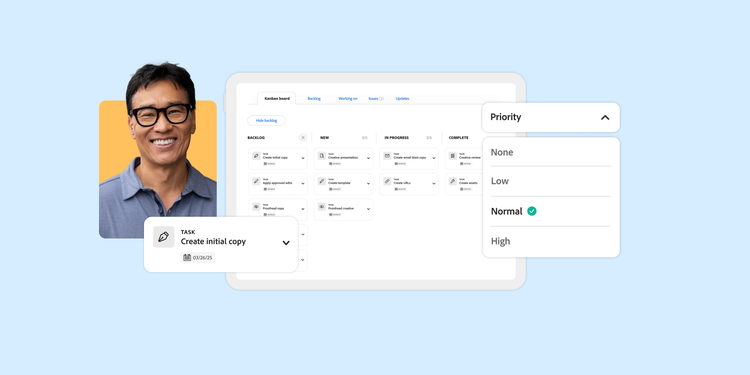
The distinction rests on scope: the board provides the macro view of all work across stages, while the card provides the micro view of a single item's detail.
A Kanban board represents workflow as a series of columns, each corresponding to a stage, 'Requested', 'In Progress', 'Under Review', 'Done'. Teams customise columns to mirror their actual process; a FinTech compliance team might include 'Regulatory Check' as a distinct stage between development and release.
A Kanban card is a single work item that moves across the board. It carries metadata: owner, deadline, priority level, dependencies, and blockers. Moving a card from one column to the next signals progress without requiring a meeting or a status email.
Dimension
Board
Card
Scope
All work across all stages
One specific task
Primary question answered
'Where is everything?'
'What does this task need next?'
Customisation
Add or reorder columns
Add fields, tags, attachments
Audience
Team leads and stakeholders
Individual contributors and reviewers
Work-in-progress (WIP) limits operate at the column level on the board. They cap how many cards can occupy a stage simultaneously. When a column reaches its limit, the team must resolve existing items before pulling new ones, this is the mechanism that surfaces bottlenecks rather than hiding them. Without WIP limits, a board degrades into a passive to-do list that no one acts upon.
Which principles and practices define the Kanban method?
Six core practices form the operational backbone of the method. Each addresses a specific business pain:
- Visualise the workflow, eliminates hidden work. Every task has a card; every stage has a column.
- Limit work in progress, prevents overload and context-switching. A 'Design' column capped at four forces the team to finish before starting.
- Manage flow, ensures stalled items are noticed. Regular board reviews identify cards that have not moved.
- Make policies explicit, removes ambiguity. A content production team, for example, defines that no asset moves to 'Ready for Publish' without sign-off from both legal and brand, eliminating the scenario where one editor approves based on unwritten assumptions another editor does not share.
- Implement feedback loops, creates regular cadences for review. Fortnightly service-delivery reviews examining cycle-time data allow teams to spot systemic delays.
- Improve collaboratively, uses data to evolve the process through team-driven experiments rather than top-down mandates.
Foundational principles underpin these practices: start with what you do now; agree to pursue incremental, evolutionary change; respect current roles and responsibilities; encourage leadership at every level. These principles mean Kanban does not require a reorganisation, critical for UK public-sector bodies or financial institutions with rigid governance structures where change-control boards must approve even minor process adjustments.
How does Kanban compare to Scrum and when does each approach fit?
The choice between Kanban and Scrum is not about quality, it is about the nature of work inflow and the degree of ceremony an organisation can sustain.
Dimension
Kanban
Scrum
Cadence
Continuous flow
Time-boxed sprints
Roles
No prescribed roles
Scrum Master, Product Owner
Change policy
New items enter any time
Sprint backlog locked
Planning overhead
Minimal
Sprint planning, review, retrospective
Measurement
Lead time, cycle time
Velocity
Best fit
Operations, support, reactive work
Product teams with defined backlogs
Scrum provides stronger accountability through sprint commitments but imposes ceremony overhead that frustrates teams handling reactive work. An IT service desk, for example, cannot lock its backlog for two weeks when incidents arrive unpredictably. Kanban offers flexibility but demands team discipline around WIP limits, without that discipline, it becomes an unmanaged list.
A hybrid option, sometimes called Scrumban, suits teams that want sprint cadence for planning but Kanban's visual flow for execution. UK digital agencies managing client deliverables alongside internal product work often adopt this pattern to balance external deadlines with internal capacity.
What benefits does Kanban deliver for enterprise teams?
- Reduced cycle time. WIP limits force focus. A software team pulling five items rather than fifteen through active development experiences fewer context switches and shorter code-review queues, translating to faster release cadence.
- Improved predictability. By tracking lead time and cycle time, managers forecast delivery dates with data rather than guesswork, valuable for teams reporting to executive sponsors who need reliable timelines for board-level updates.
- Greater transparency. Every stakeholder sees the board. A retail group coordinating store-level marketing across UK regions replaces weekly status calls with a shared Kanban view, reducing reporting overhead.
- Continuous improvement without disruption. Because Kanban does not mandate sprints or ceremonies, teams adopt it alongside existing processes, particularly relevant for organisations already running hybrid agile approaches or those in regulated sectors where process changes require change-control approval.
How should your organisation select and implement Kanban tooling?
The principle governing tool selection is fit-for-purpose: the tool must match the organisation's coordination complexity, not merely provide a board interface.
Decision framework. If your team is fewer than ten people with a single linear workflow, a lightweight board tool suffices. If your organisation coordinates cross-functional work across departments with audit, governance, and reporting requirements, enterprise work management with Kanban views, resource planning, and role-based permissions becomes necessary.
Evaluation criteria. Assess integration with existing tools (creative suites, CRM, data analysis and visualisation tools), role-based access controls for data governance compliance, audit trails for regulated industries, and the ability to visualise dependencies across multiple boards.
Adobe Workfront provides Kanban board views within a broader work management platform that manages the lifecycle of work in one place. For organisations already using Adobe Creative Cloud or Adobe Experience Manager, this integration removes handoff friction between creative teams and project managers.
Implementation guidance. Map your current workflow stages honestly before configuring columns. Start with one team, measure cycle time for four weeks, then expand. The most common failure mode is designing an aspirational board that does not reflect how work actually moves today, this causes immediate abandonment because team members cannot reconcile the board with reality.
Explore how Adobe Workfront brings Kanban boards, resource planning, and creative workflows together in one platform. Find out more.
Recommended for you
Title
What is Kanban and how does it transform workflow management?
CardDescription
Learn what Kanban is, how boards and cards visualise work, and how UK organisations use Kanban principles to reduce bottlenecks and improve delivery predictability.
cardDate
2026-09-09
cardImage

primaryTag
caas:content-type/blog
Tags
caas:content-type/blog, caas:products/workfront, caas:topic/work-management, caas:blog-author/adobe-for-business-team