What are OKRs? OKR processes and best practices explained

Adobe for Business Team

05-12-2025

Woman seated outside. Overlays show goal alignment updates including project progress status. A second overlay displays OKR objectives one and two.

During the 2010s, investor John Doerr popularised a new approach to goal-setting for organisations – OKRs (objectives and key results).

Beyond mapping the destination and the route to reach it, OKRs align individual and team efforts with overarching business objectives – keeping everyone focused on the same outcome: success.

When implemented correctly, OKRs help staff at every level of an organisation focus on the same key priorities, drive performance and results, and maintain transparency and accountability throughout.

In the sections below, we walk through how OKRs work in greater detail – and how to apply them effectively within your organisation.

In this guide:

What is OKR?

Objectives and key results (OKRs) offer a straightforward yet powerful goal-setting framework – one that can play a significant role in driving growth and high performance across organisations.

It helps organisations clarify what they want to achieve (objectives) and how they will measure success (key results). Applied correctly, it becomes an effective means of aligning and engaging everyone within the business around meaningful, measurable goals.

Designed to create clarity across an organisation and connect people at every level to your top business goals, OKRs centre on setting ambitious, collaborative aims with clearly definable outcomes.

As OKR pioneer John Doerr explained in an interview with the Harvard Business Review: ‘The objective is what I want to have accomplished. The key results are how I’m going to get it done. The objectives are typically longer lived. They’re bold and aspirational. The key results are aggressive, but always measurable, time-bound, and limited in number.’

Brief history of OKRs

The story of OKRs reads as a who’s who of American corporate history.

What are the benefits of OKRs?

As a management goal-setting system and methodology, OKRs focus everyone’s efforts on the priorities that matter most, connecting the work of employees to what genuinely matters within the organisation.

The widespread uptake of OKRs comes down to five key benefits, which John Doerr refers to as the F.A.C.T.S.

Icons representing focus, alignment, commitment, tracking, and stretching.

These break down as follows:

There is also an additional benefit in agility. Unlike many other goal-setting methodologies, OKRs are not set in stone. Their focus on short-term target windows and broad objectives means they can adapt more readily to the evolving needs of the business.

OKR formula – defining objectives and key results

To define the approach in simple terms:

John Doerr’s formula offers a useful starting point:

‘I will accomplish “X” (objective) as measured by “Y” (key result).’

Using this formula, objectives represent your company’s goals for a given quarter or year, measured through key results. These should be clear, ambitious, and motivating, so that employees at every level understand the organisation’s primary goals and can fully commit to them.

Once your objectives and key results are defined for a set period – annually, for instance – the next step is aligning them across your business. For larger organisations, this is an inherent challenge, as different teams bring different priorities and ways of working.

This is where ‘cascading OKRs’ come in – the process of breaking down company-wide key results into smaller, team-specific ones. In most cases, this follows a process along these lines:

To address concerns that the process may feel overly ‘top-down’ or prescriptive, Doerr recommends that employees at all levels draft their own key results. This ensures they have genuine input into the process and ownership of it.

Types of OKRs and their applications

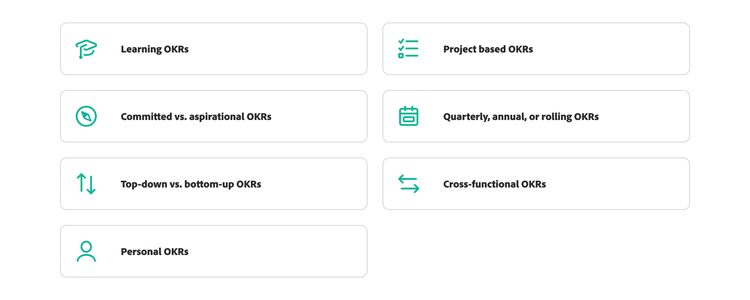
Broadly speaking, OKRs fall into three fundamental categories – learning, committed, and aspirational – as well as a number of different varieties that affect how you apply OKRs to a business structure.

Icons representing different types of OKRs and their applications.

Let’s break these down in more detail.

Learning OKRs

Learning OKRs prioritise acquiring new knowledge or skills, with a focus on experimentation and continuous improvement rather than pre-defined targets. They’re valuable for exploring new approaches, which can in turn inform future OKRs.

Committed vs. aspirational OKRs

Committed OKRs represent firm commitments, expected to be fully met by the cycle’s end against a pre-defined metric. Aspirational OKRs, sometimes called ‘stretch goals’ or ‘moonshots’, are ambitious targets that push boundaries, even when full attainment cannot be guaranteed.

Top-down vs. bottom-up OKRs

Top-down OKRs align teams around overarching organisational goals. By contrast, bottom-up OKRs emerge from teams and individuals at ground level, fostering creativity and ownership whilst remaining aligned with the company’s overall strategy.

Personal OKRs

The OKR framework isn’t confined to professional settings. Personal OKRs enable individuals to apply the same principles to their own goals, encouraging self-improvement and ensuring personal aspirations align with professional objectives.

Project based OKRs

Project-based OKRs align specific project goals with broader organisational objectives, ensuring that individual projects contribute to the company’s overall strategic direction.

Quarterly, annual, or rolling OKRs

The timeframe for OKRs is flexible, adapting to organisational needs. Quarterly OKRs provide short-term focus, annual OKRs establish long-term direction, and rolling OKRs offer continuous review and adaptation.

Cross-functional OKRs

Cross-functional OKRs bring multiple departments or teams together to work towards a shared objective, breaking down silos and fostering inter-departmental alignment and collaboration.

OKR examples

OKRs vary from business to business. Here are a few examples from different industries that may inspire your own OKR thinking:

Sales team objective: launch a new customer community

Key results:

Community management objective: make our community known by industry experts and thought leaders

Key results:

CEO objective: grow our business

Key results:

PR and analyst objective: build strong relationships

Key results:

Partner marketing objective: create a community of partners and resellers (MQLs)

Key results:

Top company objective: grow our corporate global business

Key results:

Demand gen objective: Optimise our customer acquisition

Key results:

Find out more about OKR templates.

What is the difference between OKR and KPI?

OKRs and KPIs (key performance indicators) are related concepts, yet there are important distinctions between them.

Crucially, KPIs are included within OKRs. By incorporating concrete, actionable metrics, KPIs fit naturally within key results.

Implement and manage OKRs effectively

Successfully implementing OKRs requires both a commitment to continuous improvement and a structured approach.

Let’s go through each stage step by step – from setting objectives and defining key results, to review, adjustment, and beyond.

Setting effective objectives

A clear, impactful objective forms the foundation of any effective OKR.

Objectives should be:

Three examples of well-written objectives

Defining measurable key results

Key results (KRs) are the measurable steps that demonstrate progress towards achieving an objective. Effective KRs often follow the SMART formula:

Examples of quantitative and qualitative key results

Clear ownership is essential for every KR. The designated owner is responsible for tracking progress, ensuring accountability, updating the KR’s status, and reporting on outcomes.

Establishing a cadence for OKR reviews

Maintaining momentum requires regular check-ins and progress reviews, alongside the flexibility to make timely adjustments. This involves:

Regular check-ins with your staff throughout the quarter are essential for tracking measurable progress. Defining your OKRs in line with your organisation’s top priorities ensures your efforts remain directed towards the right goals.

Visibility, alignment, and consistent progress on your OKRs are all critical to success. A system such as Adobe Workfront keeps your OKRs strategically aligned with ongoing work, accelerating delivery on goals and driving meaningful results.

OKRs vs. other goal-setting methodologies

If OKRs are not the right fit for your organisation, a range of alternative goal-setting frameworks is available.

OKRs vs. MBOs (Management by Objectives)

The principal distinction between OKRs and MBOs lies in scope. OKRs focus on challenging, aspirational goals with measurable outcomes that affect the business as a whole. MBOs, by contrast, are concerned with setting and managing more specific goals tied to individual performance.

MBOs are also less adaptable to changing circumstances, whereas OKRs lend themselves readily to revision. Much of this flexibility comes down to cadence – OKRs emphasise quarterly goals and regular check-ins, while MBOs are typically annual.

OKRs vs. SMART Goals

Both OKRs and SMART goals incorporate specific, measurable elements, yet their emphasis differs. OKRs prioritise aspirational, qualitative objectives supported by measurable key results, encouraging ambition and organisational alignment.

SMART goals, by contrast, centre on specific, attainable, and trackable targets, without adopting the same holistic perspective.

OKRs vs. KPIs (key performance indicators)

KPIs are metrics designed to track performance against pre-defined targets. Although some KPIs can serve as key results within an OKR framework, the two are not interchangeable.

KPIs are primarily concerned with measuring performance and operational efficiency. OKRs take a broader view, driving strategic change through ambitious outcomes.

OKRs vs. balanced scorecard

The balanced scorecard offers a broad strategic planning and performance management framework, encompassing financial, customer, internal process, and learning and growth perspectives. OKRs, whilst compatible with the balanced scorecard, provide a more focused and actionable approach to goal-setting and tracking within a defined timeframe.

Whilst the balanced scorecard offers a holistic view of organisational performance, OKRs concentrate on achieving specific, measurable objectives.

Common OKR mistakes and how to avoid them

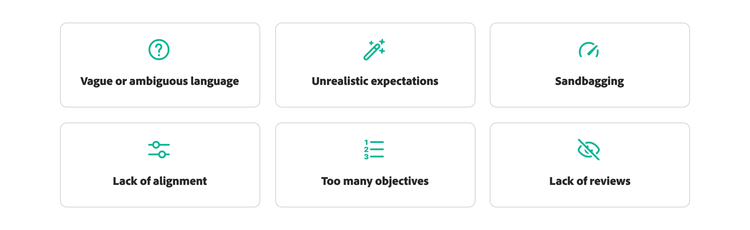
Here are a few common pitfalls to be aware of when implementing OKRs.

Chart with icons representing common mistakes with OKRs.

Getting started with OKRs

When used effectively, the OKR system enables more effective, efficient, and high-performance business operations – creating clarity and accountability for everyone across the organisation.

Adobe Workfront has all the tools and resources you need to create and track OKRs effectively. Find out more today and get started with your organisation.

https://business.adobe.com/fragments/resources/cards/thank-you-collections/workfront