Programmatic advertising accounts for the majority of UK digital display spend, yet many marketing teams still treat it as a black box delegated entirely to agencies. Understanding the mechanics, and knowing when automated buying genuinely outperforms manual methods, is the difference between controlled, measurable growth and opaque budget erosion.
Programmatic advertising made simple: a UK guide for marketing teams

What is programmatic advertising and why does it matter?
Programmatic advertising is the automated, algorithm-driven buying and selling of digital ad inventory. Rather than a media buyer negotiating placements individually with publishers through email or phone, exchanging insertion orders, awaiting confirmation over days, software executes the transaction in milliseconds against rules the advertiser defines.
Three groups encounter programmatic most frequently: marketing managers allocating display budgets across UK markets who need consistent reach without proportional headcount growth; digital leads tasked with scaling campaigns beyond two or three channels; and procurement teams benchmarking media-buying efficiency against agency costs to determine whether in-house capability delivers better value.
Programmatic becomes relevant once an organisation's manual process cannot keep pace with the volume and velocity of placements required. Consider a financial services firm running simultaneous campaigns across display, video, and connected TV to reach audiences in London, Manchester, and Edinburgh. Manual buying introduces scheduling delays, inconsistent pricing, and fragmented reporting that collectively erode campaign performance before the first optimisation cycle begins.
How does the programmatic auction cycle work?
The governing principle is straightforward: the speed and scale of digital inventory exceed human negotiation capacity. Automation resolves this by executing thousands of buying decisions per second against pre-set rules, ensuring every impression is evaluated against the advertiser's targeting criteria before a bid is placed.
The auction cycle completes in approximately 100 milliseconds:
- The advertiser defines targeting parameters, audience segments, geography, time of day, device type.
- A demand-side platform (DSP) submits a bid to an ad exchange when an eligible impression becomes available.
- A supply-side platform (SSP) on the publisher's side evaluates all competing bids.
- The winning ad is served to the user before the page finishes loading.
Component
Role
Typical internal owner
DSP (Demand-Side Platform)
Executes bids on behalf of advertisers based on targeting rules
Media buyers, campaign managers
SSP (Supply-Side Platform)
Manages publisher inventory and evaluates incoming bids
Publishers, ad operations
Ad Exchange
Marketplace connecting DSPs and SSPs in real time
Both sides (automated)
DMP / CDP (Data Management / Customer Data Platform)
Stores and segments audience data for targeting
Data analysts, marketing strategists
Each component represents a point where an organisation either retains or loses visibility over spend and targeting precision. Effective programmatic depends on normalising audience data before it enters the DMP or CDP, since inconsistent segment definitions across channels lead to duplicated bids and inflated costs.
How does programmatic differ from traditional display buying?
Dimension
Programmatic
Traditional Display
Buying method
Automated, auction-based
Manual negotiation, insertion orders
Targeting precision
Audience-level, layered signals
Publisher-level demographics
Speed of optimisation
Real-time, mid-flight adjustments
Post-campaign reporting, manual changes
Pricing transparency
Bid-level visibility
Bundled rates, limited breakdown
Scalability
Thousands of placements simultaneously
Limited by human negotiation capacity
The trade-off is genuine: programmatic offers speed and precision but requires data infrastructure and governance. Organisations activating first-party audience data are subject to UK GDPR obligations, particularly when segmenting customers using personal information collected through CRM or loyalty programs. Without a documented lawful basis for profiling, the ICO can and does intervene.
A practical scenario illustrates the difference. A UK retailer running a seasonal campaign across London, the Midlands, and Scotland can use programmatic to adjust bids by geography and time of day in real time, shifting budget toward regions where conversion rates spike as the promotion matures. Traditional display would have locked in placements and rates weeks ahead, with no mechanism to respond to live performance data. The retailer using manual methods discovers underperformance only in the post-campaign report, by which point the budget is spent.
What benefits and use cases drive adoption?
Efficiency gain. Automated bidding eliminates the manual workload of managing dozens of insertion orders. Media teams reclaim hours previously spent on administrative coordination, redirecting effort toward strategy and creative development. For lean UK marketing teams managing multi-channel budgets with limited headcount, this operational saving is often the primary justification for adoption.
Precision targeting. Layering first-party CRM data with contextual signals lets organisations reach high-value segments without wasted impressions. A professional services firm targeting CFOs researching compliance solutions, for instance, can serve relevant messaging across display and video inventory only to audiences exhibiting genuine research behaviour, reducing cost-per-qualified-lead materially compared with broad demographic targeting.
Real-time optimisation. Campaigns self-correct mid-flight, shifting budget toward placements that convert. This capability is critical for time-sensitive promotions such as open-enrolment periods or end-of-quarter pipeline pushes, where a two-week reporting lag renders optimisation meaningless.
Use case: cross-market scaling. A UK FinTech scaling customer acquisition across multiple European markets post-launch can use programmatic to test creative variants by region and reallocate spend within hours rather than weeks. The speed of iteration, testing three headline variants in Germany, France, and the Nordics simultaneously, compresses learning cycles that would otherwise span an entire quarter under manual buying.
What does a robust campaign setup process look like?
Effective programmatic campaigns are governed by a clear measurement framework before a single bid is placed. Without pre-defined KPIs, audience segments, and brand-safety controls, budget waste in the first month is common, and difficult to recover from once algorithms have optimised toward the wrong signals.
Step-by-step setup:
- Define campaign objective and success metric (e.g. cost-per-acquisition below £45, viewability above 70%).
- Build audience segments from first-party data, ensuring segment definitions are consistent across channels.
- Set frequency caps to prevent ad fatigue, protecting brand perception and reducing cost-per-acquisition.
- Configure brand-safety and contextual exclusions (category blocklists, keyword exclusions).
- Launch with a test budget, typically 10 to 15% of total allocation, to validate targeting assumptions.
- Optimise based on mid-flight data, adjusting bids, creative, and audience composition.
Use data analysis and visualisation tools to monitor pacing and attribution throughout the flight. Ensure data governance frameworks comply with UK GDPR before activating audience segments that include personal data, as the ICO expects documented lawful bases for any profiling activity, and enforcement notices carry significant reputational as well as financial cost.
Two best-practice callouts deserve emphasis. First, viewability thresholds ensure spend goes only to impressions a user actually sees, a CFO-friendly efficiency metric that directly reduces wasted media investment. Second, frequency capping is not merely a user-experience consideration; excessive exposure to the same creative correlates with rising cost-per-click and declining conversion rates, making it a measurable performance lever.
Which programmatic model fits your organisation?
The principle governing platform selection is operational fit: the right model matches an organisation's campaign complexity and data maturity, not vendor reputation alone.
Decision framework:
- If your organisation runs fewer than five campaigns per quarter and targets a single market, a managed-service DSP or agency-led model typically suffices. The agency absorbs platform complexity, and the cost of their margin is offset by reduced internal resource requirements.
- If you operate multi-channel, multi-market campaigns with first-party data at scale, an enterprise platform with integrated analytics and audience management is the better fit. The overhead of an agency intermediary, both in margin and in reporting latency, becomes a constraint rather than a convenience.
Evaluation criteria:
- Integration with existing martech stack, a platform that cannot ingest your CRM segments or export conversion data to your attribution model creates manual workarounds that negate automation benefits.
- Data governance compliance, UK GDPR readiness is non-negotiable; the platform must support consent-signal ingestion and segment suppression for opted-out users.
- Real-time reporting depth, surface-level dashboards delay optimisation; bid-level transparency enables mid-flight decisions.
- Cross-channel attribution support, programmatic rarely operates in isolation; the platform must contribute to a unified view of the customer journey.
- Total cost of ownership, platform fees, data costs, and agency margins combined; an enterprise platform with higher licence fees may still deliver lower total cost when agency margins are removed.
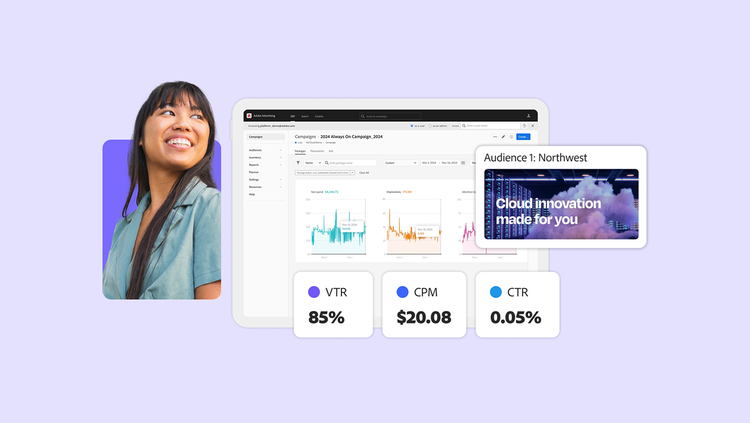
Adobe Advertising represents one enterprise-tier option in this category, a unified DSP with a native bi-directional integration into Adobe Analytics, enabling teams to incorporate ad performance data into more robust journey management and reporting without relying on separate tracking systems.
The key takeaway: choose based on campaign complexity and data maturity. An organisation running three domestic campaigns per quarter gains little from an enterprise platform's full capability set, and risks underutilising a significant investment. Conversely, a multi-market operation constrained by agency reporting cycles and fragmented data will find that the operational cost of not adopting an integrated platform compounds with every quarter of growth.
Explore how Adobe Advertising helps organisations integrate programmatic buying with analytics, enabling closer collaboration between web analysts and paid media teams. Learn more.
Recommended for you
Title
Programmatic advertising made simple: a UK guide for marketing teams
CardDescription
Programmatic advertising made simple, learn how automated ad buying works, when it outperforms manual methods, and how to set up your first campaign.
cardDate
2026-09-09
cardImage
primaryTag
caas:content-type/blog
Tags
caas:content-type/blog, caas:products/advertising, caas:topic/campaign-management, caas:blog-author/adobe-for-business-team