The customer journey is only as useful as the rigour applied to mapping and measuring it. Organisations that treat it as a workshop exercise produce artefacts that misrepresent reality; those that ground it in observed behaviour and continuous analytics turn it into a mechanism for revenue growth. This guide establishes the principles, stages, and measurement approaches that separate effective journey practice from decorative process documentation.
Customer Journey: From Governing Principles to Measurable Outcomes
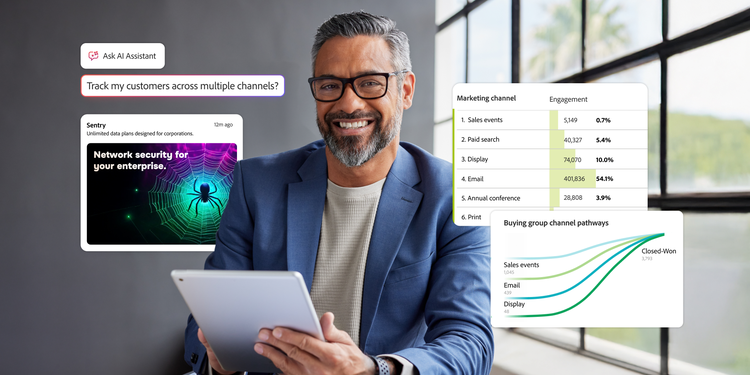
What is a customer journey and when does it become strategically relevant?
A customer journey is the full sequence of interactions a person has with a brand, from initial awareness through post-purchase advocacy, including touchpoints the organisation does not control: comparison sites, peer conversations, unlogged service interactions, and internal buying-committee discussions.
Three roles encounter this most directly. Marketers need visibility into which channels influence stage progression. CX leaders diagnose where prospects stall or abandon. Revenue operations teams connect journey signals to pipeline forecasts and renewal predictions.
The journey becomes strategically critical the moment an organisation operates more than one channel. A UK financial services firm with a branch network, mobile app, intermediary channel, and website finds that customers perceive a single relationship, internal silos are invisible to the buyer, and every disconnected handoff risks attrition. When a mortgage applicant begins an application on a mobile device, continues via a broker, and receives contradictory documentation from a branch, the organisation has a journey problem whether or not it has drawn a map.
A key distinction matters here: the journey describes what the customer does; the experience describes how the customer feels at each step. Conflating them produces process documentation that misses the emotional signals predicting churn or advocacy.
How do customer journey stages differ between B2B and B2C contexts?
Five stages form the standard model, though their duration and complexity vary dramatically by context:
Stage
Customer question
Typical UK touchpoint
Success metric
Awareness
'I have a problem'
Search, industry press, referral
Reach and recognition
Consideration
'What are my options?'
Content, webinars, analyst reports
Engagement depth
Decision
'Which option is right?'
Proposal, trial, procurement review
Conversion rate
Retention
'Am I getting value?'
Onboarding, support, account review
Renewal / repeat rate
Advocacy
'Should I recommend this?'
NPS, referral programme, peer forums
Referral volume
B2B journeys in UK enterprise, particularly in professional services, technology, and government procurement, extend the Decision stage dramatically. A London-based SaaS vendor selling to a central government department may navigate security accreditation (Cyber Essentials Plus or equivalent), architecture review, and commercial evaluation tracks simultaneously, with eight to twelve stakeholders involved over months. Effective audience targeting at the Consideration stage must account for each stakeholder's distinct information needs.
B2C journeys in UK retail compress Decision to minutes but expand Retention complexity: loyalty programmes, subscription models, and omnichannel returns create post-purchase touchpoints that determine lifetime value.
The most underinvested stage across UK organisations is Retention. Teams over-index on acquisition while post-purchase experience receives minimal orchestration, yet Retention is where the highest-value lifetime revenue is won or lost.
What principles govern effective customer journey mapping?
The governing principle is straightforward: a journey map must be built from observed behaviour, not assumed behaviour. Organisations that skip primary data collection, interviews, session replay, CRM event data, and behavioural analytics, end up mapping the journey they wish customers took and invest in fixing the wrong friction points.
Every actionable journey map must contain six elements:
- A defined actor (specific persona)
- A scenario (the goal the actor is trying to achieve)
- Journey stages
- Touchpoints per stage
- Emotional state indicators
- Ownership assignments
A UK professional services firm mapping its client onboarding journey might discover that a significant proportion of new clients experience a communication gap between the partner who closed the engagement and the delivery team who begins the work. Internal process diagrams show a clean transition; the client experiences silence. This friction point is invisible without mapping the handoff from the client's perspective.
The antidote to assumption-based mapping is triangulating qualitative interviews with quantitative behavioural data, what customers say they do versus what the data shows they do. Adobe Journey Optimizer supports this by enabling organisations to orchestrate journeys in real time and test content variations across channels, helping teams evaluate how different touchpoints perform within a journey. Without such triangulation, a map remains a workshop artefact that gathers dust.
How does journey analytics transform touchpoint data into revenue intelligence?
The principle: measurement must follow mapping, not precede it. Organisations that deploy analytics tooling before establishing a clear journey model generate dashboards without actionable insight, data without a framework to interpret it.
Organisations that cannot stitch the journey together default to last-touch attribution, which systematically undervalues upper-funnel and mid-funnel touchpoints. Budget flows toward channels that capture demand rather than create it, a misallocation that compounds over quarters.
Analytics transforms journey mapping from a periodic research exercise into a continuous measurement system. Instead of reporting that 'email has a 2% click rate', teams can identify that accounts exposed to a specific sequence, webinar then email then sales call, convert at materially higher rates than those receiving email alone.
Data feeding journey analytics must be clean, consented, and well-governed. For UK organisations handling personal data, UK GDPR and ICO guidance apply directly, data governance is not a compliance afterthought but a prerequisite for trustworthy insight. Organisations that skip this step find their journey intelligence is built on incomplete or non-compliant foundations. Journey data typically flows into a centralised data lake where cross-channel events can be unified into a single view of the account or individual.
The business implication is clear: organisations that measure journeys continuously can reallocate budget quarterly based on evidence rather than opinion. The gap between mapping journeys and measuring them is the gap between opinion-driven and evidence-driven investment decisions.
Which journey investment fits your organisation's current maturity?
The principle of sequenced investment applies: mapping before measurement, measurement before optimisation. Skipping a layer produces tools without the data foundation to make them useful.
If your organisation has fewer than three digital channels and a single buying persona: start with a manual journey map using interviews and CRM data. Invest in mapping methodology before analytics tooling.
If you operate across multiple divisions with complex buying committees and fragmented data systems: prioritise a unified analytics platform that can stitch account-level journeys across touchpoints without requiring a full data warehouse migration. Adobe Customer Journey Analytics supports this scenario by connecting cross-channel data and enabling comprehensive analysis of customer interactions across multiple touchpoints.
If you already have journey maps but cannot measure their accuracy or tie them to revenue outcomes: the gap is analytics, not mapping. Look for solutions that connect behavioural data to commercial outcomes in real time.
If your organisation handles personal data across the journey (most do): ensure data governance is in place before scaling analytics. UK GDPR compliance is not optional, and insights built on non-compliant data carry both legal and strategic risk. The ICO's enforcement actions demonstrate that personal data stitched across channels without lawful basis exposes organisations to material penalties.
The right investment depends on maturity. An organisation that leaps to enterprise analytics without first validating its journey model will generate sophisticated reports about the wrong questions.
Explore how Adobe Customer Journey Analytics connects data from various sources and supports omnichannel analysis for complex, multi-channel organisations. Find out more.
Recommended for you
Title
Customer Journey: Principles, Stages, and Measurement
CardDescription
Understand the customer journey — its stages, mapping principles, and how analytics connects fragmented touchpoints to revenue. A guide for UK B2B and B2C teams.
cardDate
2026-09-09
cardImage

primaryTag
caas:content-type/blog
Tags
caas:content-type/blog, caas:products/customer-journey-analytics-b2b-edition, caas:topic/data-&-analytics, caas:blog-author/adobe-for-business-team