Across industries, organisations are investing heavily in digital experiences, yet many are struggling to drive consistent performance from them. It’s no longer enough to launch beautiful, informative websites. Every experience needs to be discoverable, relevant and tied to measurable outcomes.
The challenge in delivering these experiences isn’t a lack of data. Most teams already rely on analytics platforms to track traffic and engagement, SEO tools to identify ranking issues and performance tools to measure page speeds. At its core, the problem is fragmentation and limited execution capacity. Insights live in silos, stakeholders lack alignment on priorities and even high-impact issues spanning SEO, Core Web Vitals and accessibility can take weeks or months to resolve.
As a result, common problems, from broken backlinks to slow page performance and missing alt text, often remain unresolved for weeks or months, despite the fact that they directly affect business metrics. To overcome these challenges, businesses must craft a new strategy that uses comprehensive insights and agentic AI to quickly address opportunities affecting traffic, engagement and conversion.
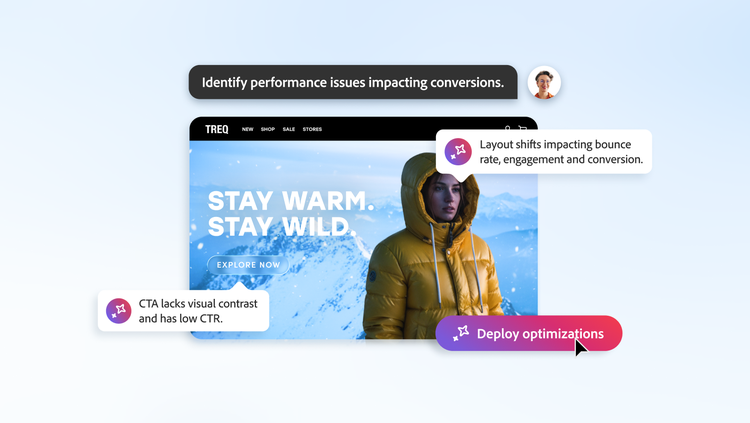
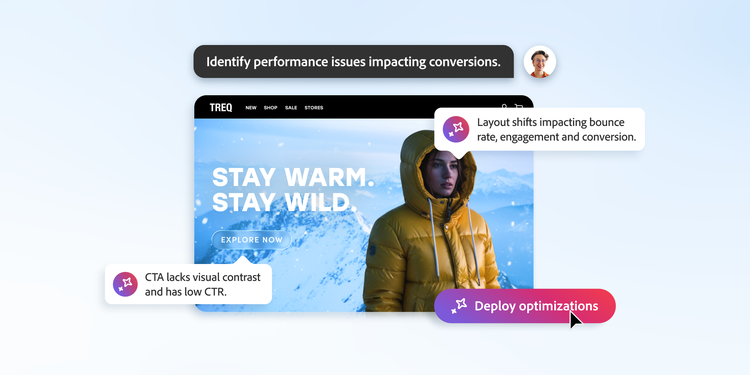
This year, at Adobe Summit, we’re introducing innovations for Adobe Experience Manager Sites Optimizer, an agentic application designed to help teams identify, prioritise and fix experience performance issues in minutes, not months.
Streamline processes to remove bottlenecks for marketers and web engineers.
One of the biggest barriers to optimisation has always been execution. Even when insights are clear, acting on them often requires co-ordination across multiple teams. Adobe Experience Manager Sites Optimizer removes that friction with a simple, streamlined framework:
- Automatic identification of performance issues and opportunities.
- AI-powered recommendations on how to improve engagement and traffic.
- Instant deployment of approved suggestions with one-click implementation.
This “identify, suggest and deploy” approach accelerates action on insights. Combined with one-click implementations and agentic support, it empowers web owners and martech professionals with greater controls — removing dependencies on engineering resources and long development queues.
Improve SEO and traffic by fixing high-impact issues at scale.
Many sites underperform in search not because of strategy, but due to unresolved technical and content issues across hundreds — or even thousands — of pages. These include:
- Missing or poorly written metadata.
- Broken backlinks and internal links.
- Pages that are not aligned with search intent.
- Slow load times affecting search rankings.
Experience Manager Sites Optimizer identifies these issues and ranks them based on their potential impact on traffic. For example, it can surface pages with high impressions but low click-through rates due to weak metadata or highlight broken backlinks that are limiting discoverability.
It also recommends specific fixes, such as improved titles and descriptions or backlink corrections. Teams can use bulk identification and remediation features to resolve systemic issues across sites, not just one page at a time. Agents can then help apply these updates directly within Adobe Experience Manager, across multiple pages, reducing the need for manual updates and co-ordination across teams.
Optimise Core Web Vitals and page performance without extensive technical analysis.
Page performance issues are one of the most common — and least resolved — barriers to both search ranking and user experience. Metrics like Core Web Vitals directly impact visibility and engagement, but identifying the root cause of issues — like layout shifts or slow load times — often requires deep technical analysis.
With Adobe Experience Manager Sites Optimizer, teams can find and address these issues at a page level by continuously monitoring metrics such as Largest Contentful Paint (LCP) for load performance, Cumulative Layout Shift (CLS) for visual stability and Interaction to Next Paint (INP) for responsiveness signals. These metrics, defined by Google, are crucial elements of user experience and organic visibility. Instead of reporting these scores, Experience Manager Sites Optimizer highlights the elements contributing to poor performance, such as large images, unoptimised components or late-loading content that causes layout shifts.
From there, Experience Manager Sites Optimizer provides clear recommendations, such as resizing or optimising media assets, adjusting component loading behaviour or fixing layout instability caused by dynamic content. Once teams review and approve these recommendations, they can deploy these suggestions via an agent.
Instead of deploying code changes directly into production, the agent creates a feature branch in a Git repository and opens a pull request with all recommended updates. As a result, developers can review, test and deploy with confidence to keep governance intact while accelerating execution.
By connecting performance issues directly to page elements and templates, Experience Manager Sites Optimizer helps teams move beyond monitoring scores to improving them without requiring every fix to go through a full engineering cycle.
Maintain accessibility and compliance standards at all times.
Driving traffic is only part of the equation — ensuring experiences are engaging, accessible and compliant is where real value is created. Websites need to meet accessibility standards and regulatory requirements, but sites continuously evolve and even small content changes can introduce issues related to usability or regulatory compliance. Most teams rely on periodic audits or disconnected tools, making it difficult to consistently identify and fix issues at scale.
Experience Manager Sites Optimizer embeds accessibility checks directly into the optimisation workflow, thereby enabling continuous auditing of pages against standards up to WCAG 2.2 Level A/AA/AAA. It identifies issues such as missing alt text, improper heading structures, low visual contrast and incomplete labels, ties them to specific page elements and prioritises them based on impact.
Instead of stopping at detection, Experience Manager Sites Optimizer enables teams to take immediate action. It provides clear, standards-based recommendations and, in many cases, allows teams to apply fixes directly within the authoring environment. Using intelligent automation, it can also identify patterns across pages — such as repeated accessibility gaps — and generate consistent fixes at scale.
By integrating auditing and remediation into everyday workflows, organisations can maintain compliance with timelines and other requirements, reduce risks and improve usability without relying on manual audits or separate processes.
Improve conversion with smarter touchpoints.
Conversion issues are often harder to diagnose because they involve multiple factors like content, layout and user journey. Adobe Experience Manager Sites Optimizer helps identify friction points in conversion paths, including:
- Forms with high drop-off rates.
- Pages where users disengage before completing key actions.
- Experiences that don’t effectively guide users to the next step.
Based on these insights, Experience Manager Sites Optimizer can recommend improvements such as simplifying or restructuring forms, adjusting content around calls to action and optimising page layouts to reduce friction. The latest innovations in form optimisation are aimed at helping teams identify issues that impact completion rates, refine form fields and structure and quickly test improvements.
By connecting engagement data with conversion outcomes, teams can make targeted improvements that directly affect business results.
Optimise what matters the most.
One thing is clear — the future of digital experience will be driven by the continuous AI-powered optimisation of strategies, approaches and more. The Adobe Experience Manager Sites Optimizer innovations, set to be unveiled at Adobe Summit, are designed to help organisations move beyond reactive fixes and adopt a model where every page, interaction and journey continuously improves — ultimately, driving measurable growth.
If you’re attending Adobe Summit, make sure to swing by our booth to get customised insights into your website. Join us to see Experience Manager Sites Optimizer in action, hear directly from customers and learn how you can turn your web experiences into measurable growth engines.
Kathie Yang is a Senior Product Marketing Manager at Adobe, where she focuses on shaping and launching agentic applications. She has recently helped organisations enhance site performance, content strategy and AI search visibility through products like Adobe Experience Manager Sites Optimizer and Adobe LLM Optimizer.
With a background in digital marketing and business strategy — and as a former end-user of Adobe’s digital experience suite — Kathie brings a practical, customer-first perspective to solving real business challenges and delivering impactful products.