#F8F8F8

Adobe Customer Journey Analytics Features

Customer-level analysis

Power your first‑party data strategy with customer‑level analysis built for integrating large volumes of behavioural and customer enterprise data. Customer Journey Analytics unifies identity and interactions across channels and devices, delivering a complete journey view with rich visualisations, cross‑channel insights and real‑time self‑serve reporting.

Customer data collection and identity stitching

Unify customer IDs, traits and behavioural data across channels, devices and time — online and off-line — and assign it all to a single profile for comprehensive customer insights.

  • Data collection. Use open and modern APIs for large-scale data streaming ingestion and computing.
  • Off-line data ingestion. Integrate data from your existing CRM or any other off-line enterprise data source, for enriched dimensional analysis.
  • Graph-based stitching. Combine IDs from multiple channels and devices into a single person ID, with the ability to automatically unstitch, restate historical data and restitch the profile for up to date context.
A marketer, a profile and an identity graph

https://main--bacom--adobecom.aem.live/assets/videos/products/customer-journey-analytics/media_1c7e62f7255342c6124f70fa6b4e954f9f0c73d5b.mp4#_autoplay1 | A customer, her profile information and Google Ad connection set-up

Customer data model

Run analyses with our modern data framework engineered to support all customer data types in their natural state and without loss of detail or structure.

  • Modernised framework. Leverage flexible schemas and modern data structures, purpose-built for sophisticated on-demand customer data handling.
  • Scalable structure. Use highly compressible database technology to power complex data queries that can quickly retrieve results from billions of rows and multiple data sources — without writing logic.
  • Component-level analysis. Go beyond event-level analysis to reveal component-level insights. With sub-event segmentation, you can evaluate individual product categories or content assets within a single transaction or experience.
  • Report-time processing. Pre-aggregate, connect and perform unlimited queries and real-time processing on customer data to get insights in seconds instead of the weeks or months.

Customer attribution models

Analyse integrated marketing performance by examining customer engagement across any combination of campaigns, channels and content.

  • Algorithmic attribution. Dynamically determine the optimal allocation of credit for a campaign or even a selected metric.
  • Rules-based attribution. Use out-of-the-box models that assign credit for engagement based on pre-determined rules to give you multiple viewpoints into marketing channel impact.
  • Participation models. Take advantage of multi-touch attribution to understand which touchpoints customers are exposed to the most, letting you identify which part of your site, app or other channels are critical to conversion.
https://main--bacom--adobecom.aem.live/fragments/products/modal/videos/analytics/customer-journey-analytics/customer-attribution-models#customer-attribution-models | Webinar ad with attribution model data | :play-medium:

https://main--bacom--adobecom.aem.live/fragments/products/modal/videos/analytics/customer-journey-analytics/analysis-workspace#analysis-workspace | UI of landing page analysis and query tools | :play-medium:

Analysis workspace

Give teams a simple-to-use, drag-and-drop canvas to perform complex customer-level analyses across multiple datasets and sources without the need to write SQL.

  • Accessible insights. Build reusable projects customised to your unique questions while blending different views of data to tell a powerful data-driven story.
  • Robust toolset. Leverage multiple tools to query and draw insights from your data, including freeform tables, cohorts, segmentation, attribution, visualisations and context labelling.
  • Speed-focused design. Optimise your queries to return results quickly — with all the underlying data fully correlated — so you can make decisions in the moment, not after weeks or hundreds of static reports.

Customer journey visualisations

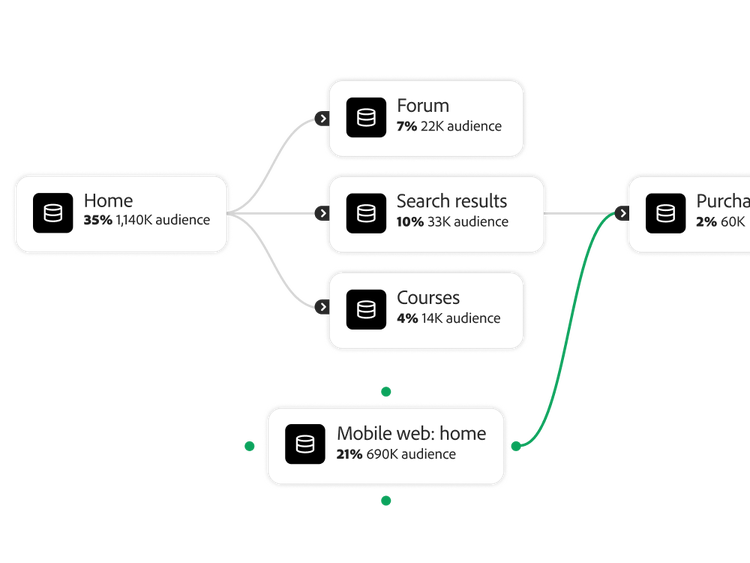
Visualise each step of the customer’s journey, in order and across channels, while putting every action into full context for insights that more accurately inform the next-best action.

  • Journey canvas. Tap into a powerful, intuitive journey canvas to visually map and analyse customer journeys. Add visual nodes to the journey canvas to mark critical touchpoints and chart key metrics.
  • Cohort analysis. Create and compare groups of customers over time with shared characteristics to recognise and analyse trends in retention, churn, latency or other unique cohorts.
  • Flow and fallout analysis. Explore customer movement across channels to quickly understand their journey by viewing entry, exit and sub-flow activities to create segments.
  • Guided analysis. Analyse product growth, engagement and release impact through guided workflows that surface trends in user acquisition, feature usage and performance over time.
  • Total population. Get full visibility into your entire customer base — including customers who aren't engaging — so you can answer questions like “What percentage of digital customers were active last week?” or “How many gold members missed visits?”

More about customer-level analysis.

Content as a Service v3 - individual feature - Friday, 27 February 2026 at 11.04

#D0F1E1

Learn how to use customer-level analysis features.

Find what you need in Experience League, our vast collection of how-to content — including documentation, tutorials and user guides.

Learn more | Learn more how to use customer-level analysis features

Questions? We have answers.

How is "customer-level" analysis different from the session- or visit-based reporting I already have?
Customer-level analysis resolves anonymous and known interactions into a single person profile over time, rather than measuring isolated sessions or visits the way session- or cookie-based tracking does. Customer Journey Analytics does this through identity stitching, which retroactively re-associates earlier anonymous activity once a person is identified, for example backfilling ten anonymous pageviews with an email identity the moment that visitor logs in on the eleventh. The result is a customer-level view, not a device- or session-level one.
How does Customer Journey Analytics stitch my data together and what do I need for it to work?
Customer Journey Analytics supports two stitching modes and which ones you have access to depends on your CJA licence tier. Field-based stitching connects data using a common identifier that is literally present in each dataset, such as a device ID or email address and restates historical anonymous events once that identifier appears.Graph-based stitching instead uses the Adobe Experience Platform Identity Graph to resolve a person across identity namespaces, such as an ECID, device ID and email, without needing the same identifier stamped on every dataset and it must be enabled for your AEP tenet to work. Confirm your CJA tier and whether graph-based stitching is enabled for your tenet with your Adobe account team before assuming both modes are available.
Can I build and compare attribution models on my stitched customer data?
Yes, Customer Journey Analytics lets you build and compare attribution models using your stitched, cross-channel customer data, so credit for a conversion can be spread across the touchpoints that led to it rather than assigned to a single last-touch event. Because the underlying data is person-level and cross-channel, an attribution model here can span web, app and offline touchpoints in the same view, not just a single channel's session data.
Does identity stitching change my historical data or only new events going forward?
Identity stitching is retroactive and non-destructive: it re-associates historical anonymous events with an identity once that identity is known, without altering the underlying raw event data itself. This runs as a report-time process, so your source data in Adobe Experience Platform stays intact and stitching can be reprocessed as your identity resolution improves rather than locking in whatever was known at collection time.
What do I need in place before customer-level analysis works?
You need a consistent Person ID present in every source dataset you want stitched, populated on every row, in the same format across sources and free of personally identifiable values (hash anything sensitive before it reaches the data view). Beyond that, each dataset needs to be connected into Adobe Experience Platform with the appropriate schema; once Person ID and your connection are in place, stitching and the resulting customer-level metrics apply automatically in Analysis Workspace.