
As the demand for personalized customer experiences grows, digital channels are seeing a huge surge of content. There are more channels, markets, and formats to deliver content than ever before — and a greater need for seamless experiences across these touchpoints.
Every company has processes to create and activate content, but many are inefficient and fragmented. These processes can be improved with clear roles and responsibilities, well-defined strategies, and integrated AI, technology, and data.
90% of marketers expect content demand to at least double by 2028.
Source: Adobe
What is a content supply chain?
A content supply chain is an end-to-end business process that organizations use to plan, produce, manage, deliver, and measure content for marketing campaigns and personalized customer experiences. It connects the people, workflows, and technology involved throughout the content lifecycle.
Even if they don’t call it a content supply chain, every company has one. It can involve a few people in the creative process or span a large, global enterprise, bringing together marketers, creatives, external agencies, executive stakeholders, and operations teams.
As customers demand more and better experiences at an increasingly faster pace, it’s important to get your organization’s content supply chain running smoothly to break down silos and unify the workflows you need to plan, produce, manage, deliver, and measure content quickly. This helps boost efficiency and engagement with customers, helping you get more value from your technology investments.
What are the benefits of an efficient content supply chain?
Every organization has some form of content supply chain, but not every content supply chain operates efficiently. Streamlining it helps organizations keep pace with growing content demands and move content more efficiently from planning through delivery. Beyond speed and efficiency, it can improve collaboration, strengthen brand consistency, and help teams deliver more relevant customer experiences. Here are six key benefits:
- Faster time to market: Streamlined workflows eliminate bottlenecks, enabling teams to respond quickly to market opportunities and customer needs without sacrificing quality.
- Greater operational efficiency: By reducing manual work, duplicated effort, and unnecessary handoffs between teams, organizations free up more time for strategic work.
- Content at scale: Reusable assets, templates, and automated workflows help teams create and adapt content for different channels, audiences, formats, and markets without starting from scratch each time.
- Better cross-team collaboration: Marketing, creative, operations, and agency teams gain shared visibility into content status, assets, and priorities, reducing miscommunication and accelerating decision-making.
- Stronger brand consistency and control: Centralized processes and controls help teams maintain brand standards and compliance requirements as content scales.
- More personalized customer experiences: Connected content workflows help teams create and deliver more relevant content across audiences and channels.
What are the core components of an effective content supply chain?
A scalable content supply chain depends on six interconnected elements that support how content moves through its lifecycle. Together, they help teams coordinate work, manage assets, and maintain consistency.
- People and roles: The marketing, creative, operations, agency, and other teams responsible for planning, creating, reviewing, delivering, and measuring content.
- Processes and workflows: The connected workflows that move content between teams and through each stage of the marketing lifecycle.
- Technology and systems: The tools and platforms that help teams plan, create, manage, deliver, and measure content. These may include work management platforms, content management systems (CMS), digital asset management (DAM) systems, and analytics tools.
- Content and assets: The copy, images, videos, templates, and other assets that teams create, manage, reuse, and deliver.
- Data and insights: The customer, content, and performance data teams use to make decisions and improve content over time.
- Governance: The standards, permissions, brand guidelines, and compliance requirements that help teams maintain consistency and control.
What are the five stages of a content supply chain?
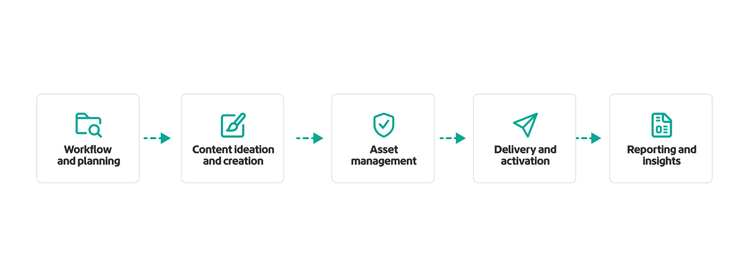
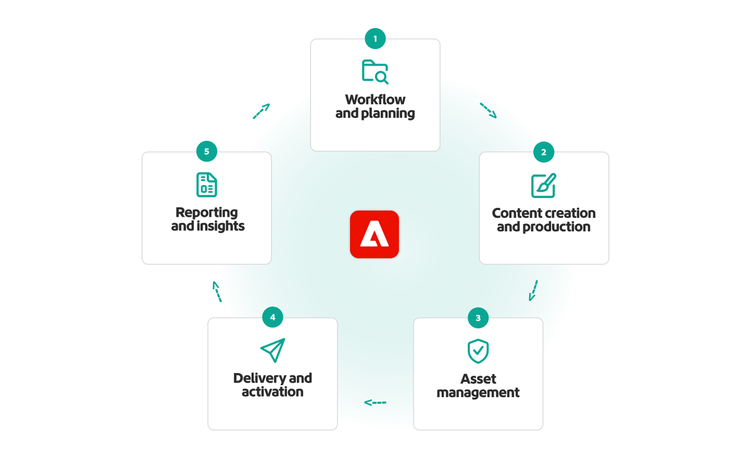
The core components of a content supply chain come together across five stages, from planning and content creation to asset management, delivery, and measurement. Connecting workflows and technology across these stages helps teams reduce manual work, improve efficiency, and scale content production. Let's look at the five stages, what it takes to automate and accelerate work at each stage, and how Adobe puts these approaches into practice.
1. Planning and workflow management
A smooth content supply chain requires a work management tool that supports centralized creative review and collaboration across teams to connect projects with data-driven outcomes. This tool should enable your marketing team to prioritize work strategically and communicate those priorities to your creative team.
Creative briefs, asset versions, and feedback should also be connected across applications within each project, so your team doesn’t have to search through old emails to find what they’re looking for.

How Adobe marketing approaches planning and workflow management.
We start by receiving hundreds of content requests from cross-functional teams across the business and prioritizing them based on our quarterly goals and key tasks. A content request intake dashboard in Adobe Workfront provides visibility into requests, so we can align and secure sign-off across our marketing, creative, web, and subject matter expert teams on upcoming content creation plans. When the brief and Workfront requests are created, we capture the necessary metadata to keep content organized and searchable from the start.
In the planning and workflow management stage, we create a record of our commitments, giving marketing execution teams advance visibility to plan their work and programs. We give our creative and web teams visibility into the total request volume, so they can plan for resourcing as early as possible. Managers can also monitor their team’s workloads easily and understand how long it takes to create different types of assets.
Our goal at this stage is to continually optimize our processes, encourage collaboration, improve visibility into content plans, and keep content governance centralized in a single place.
2. Content creation and production
Producing the volume of content needed for one-to-one personalized experiences requires streamlined creative processes. That means creatives use generative AI to speed up content production and brainstorm new ideas and to automate routine asset updates. Real-time collaboration is an important part of the process, helping teams reduce revisions, maintain better version control, and conduct seamless handoffs through centralized reviews and approvals.

How Adobe marketing approaches content creation and production.
As we start the content production process, approved requests get converted into projects that provide our creatives with more detailed information, including creative briefs, web landing locations, and promotional requirements. Our creative teams develop content for every channel, market, and audience using Adobe GenStudio for Performance Marketing and Adobe Creative Cloud applications, drawing on their generative AI capabilities where useful — all while maintaining alignment with our brand guidelines.
Our goal at this stage is to enable our teams and agency partners to move quickly through creative tasks without sacrificing the quality of their output.
3. Asset management
With a digital asset management (DAM) solution that’s integrated with tools across the content supply chain, your team can easily find, use, update, and repurpose relevant assets. The right DAM streamlines asset distribution and accelerates time to market by automating asset tagging and asset variation development. For enterprise businesses, DAMs play an important role in content governance and digital rights management by setting clear access, permissions, and other controls.

76% of companies cannot easily find and store assets.
Source: Adobe
How Adobe marketing approaches asset management.
We use Adobe Experience Manager Assets as our DAM to store and organize read-to-use content in a central repository. We also rely on Workfront’s Adobe Experience Manager integrations, which have helped us cut our publishing time in half.
A key element of asset management is metadata, which makes asset retrieval easy for stakeholders across the business. We use pre-established naming conventions and processes for adding the metadata to ensure consistency across all our creative and marketing teams.
Metadata added during planning or content creation is transferred to the DAM, where updates can be synchronized automatically. This helps automate repetitive work and gives our teams time back to focus on creative work.
Once assets are ready for review, they can be automatically shared for approval, so review requests don’t get lost in email inboxes or Slack threads. After assets are added to the DAM, we look for opportunities to reuse and repurpose them for future projects.
We’ve also started tracking user journeys within our DAM, allowing us to see what they search for, which assets they look at, and what they download. This helps us identify frequently used or underutilized assets and understand what interests stakeholders, informing future content creation.
Our goal in the asset management stage is to maintain a repository of assets that anyone in our organization can find and reuse in a way that aligns with our brand and compliance guidelines.
4. Delivery and activation.
When it’s time to deliver content, your DAM helps teams catalog, track, and locate assets using metadata tags. Your customers want to move quickly, so your team needs to move even faster — finding videos, infographics, photos, messaging, and more in a few seconds.
Your DAM should also support automatic image resizing and version control and help reduce duplication across geographies by integrating with other tools in your tech stack. Together with AI capabilities, these connected tools can shorten the time needed to create content variations tailored to customer location, interests, and actions.
To distribute this content to all your digital platforms, you need a platform that can meet your customers where they engage. The right platform can also auto-generate and publish assets optimized for each channel, including creating new sizes, formats, resolutions, aspect ratio, or effects. This lets you test enough content variations and use performance insights to inform future interactions.

How Adobe marketing approaches delivery and activation.
Once content has been finalized and is ready for delivery and activation, we upload our offers, assets, and promotional content to Adobe Experience Manager Assets, which syncs with Adobe Experience Manager Sites. In addition, Adobe Customer Journey Analytics integrates with Experience Manager to give us visibility into how assets have been used within customer journeys — so we can get insights directly within the DAM.
We rely on Experience Manager Sites to publish quickly across channels and platforms, test multiple content versions to optimize for key performance indicators, and personalize experiences for different audiences, so we can drive our desired business outcomes. Our goal is to use the integration of generative AI to make updating content a straightforward, automated process where making changes to a webpage is as easy as editing a Word document.
5. Reporting and insights
The final stage in the content supply chain focuses on measuring content performance and impact through analytics, engagement metrics, and lead scoring. Once content has been published, teams can continuously test variations and placements to understand what works, collect deeper insights about customers, and maximize impact. This data can then inform future content strategies and drive continuous improvement.
When you have intuitive dashboards and reporting, you get a real-time view of how your content is performing. Using integrated tools throughout the content supply chain gives you granular insights at the page, asset, and attribute level.

How Adobe marketing approaches reporting and insights.
Our seamlessly integrated tools allow us to generate reports to track and analyze how our processes and assets are performing. We can understand how individual assets within a campaign resonate with certain audiences by looking at performance at a granular level, filtering for audience segments and other groupings.
Our goal is to use insights we gather to help leadership make better decisions and allow our teams to maintain consistency and cohesiveness in our content and the processes behind it.
What can disrupt your content supply chain?
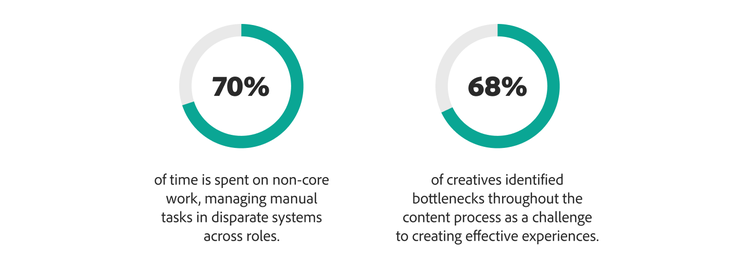
Content supply chains can break down due to the cross-functional nature of content lifecycles. Lack of uniform workflows, poor resource tracking, or disjointed communication are some factors that make it hard to keep the work moving. These issues can create internal misalignment, drain budgets, wear out employees, and slow the velocity of delivering content to the market.
Build your content supply chain with Adobe GenStudio.
Optimizing your content supply chain unlocks increased efficiency, consistency, and quality in your content creation and publishing process. A streamlined content supply chain is the first step towards delivering personal experiences that appeal to your customers — wherever they may choose to engage with you.
To help organizations realize these benefits, Adobe GenStudio brings together best-in-class products with AI capabilities to connect workflows, automate processes, and optimize content operations across all five stages of the content supply chain.
We can help you take the next step, whatever that looks like for your business. Learn more about accelerating and simplifying your content supply chain with Adobe GenStudio.
Content Supply Chain FAQs
Recommended for you
https://business.adobe.com/fragments/resources/cards/thank-you-collections/content-supply-chain