What is business intelligence (BI)? Definition, purpose and importance

Adobe for Business Team

05-01-2025

Business professional using a laptop at a train station, with floating graphics showing audience metrics and overlap data analysis.

Business intelligence (BI) is the driving force behind many business decisions – yet capitalising on its potential can feel challenging. Learn how to develop a business intelligence strategy with Adobe.

Use this guide to business intelligence to transform raw data into easy-to-use insights and translate them into effective action.

In this guide we’ll cover:

What is business intelligence in simple terms?

At its core, business intelligence is a form of data analytics – a process that involves gathering, analysing, and visually presenting data. With the right knowledge, this data can be transformed into actionable insights that inform decision-making.

Put simply, it analyses data and makes it actionable. This is typically achieved through BI tools, drawing on a broad range of data – in-house, third-party, current and historical.

Why is business intelligence so important?

Business intelligence (BI) is essential for organisations seeking to use data-driven insights for smarter decision-making. When integrated effectively, BI provides a competitive edge, drives innovation, reduces risk, and improves overall business performance.

According to McKinsey, in 2025, data-driven enterprises will significantly outperform their competitors by applying advanced analytics, AI, and automation to anticipate market trends, enhance customer experiences, and optimise business processes.

How does business intelligence work?

To understand how business intelligence works, it helps to examine the core processes and methods that underpin it:

Green icons representing stages of data handling: data collecting, data preparation, analysis, reporting, and data visualisation.

These core processes work together to generate actionable insights by analysing data against key performance indicators (KPIs) and shaping a clear action plan. In practice, this can mean optimising processes, refining marketing strategies, addressing supply chain challenges, or elevating the customer experience to drive stronger business performance.

What do organisations use business intelligence for?

Organisations use business intelligence solutions to understand how to strengthen their decision-making based on the reports and visuals available to them. The goal of BI is to improve business operations through data – which can support everything from high-level strategy to day-to-day execution.

Consider, for example, a company that launches three new products. Quotas and performance metrics are assigned to salespeople, customer success managers, and others involved in selling those products. Business intelligence tools would draw on financial data sources each quarter, visualise that data in a report, and use it to identify what is and is not working. A key strength of BI software is its ability to bring many different types of historical data into a single environment, enabling better-informed business decisions.

Business intelligence serves organisations across sectors, each monitoring different metrics but pursuing the same underlying goal. Whether you manage a retail chain comparing cost-saving approaches across different regions, a sales organisation producing detailed targeting reports, or a security firm seeking to strengthen its protection – BI provides the data needed for more effective decision-making. The result is more time spent on action and less on accumulation.

Why is good data governance important?

Many new businesses overlook setting up their data analytics and business intelligence, choosing instead to focus on sales and other seemingly more pressing priorities. Yet sound data governance is a fundamental part of business intelligence – ensuring that data is used and managed correctly from the outset.

One of the key challenges in modern business intelligence is the time taken to receive answers to data queries – which can range from two days to two months. This has led to the emergence of self-service BI: a system designed to deliver answers more quickly, though not always with complete accuracy. Self-service BI is not without merit, as the answers it provides can still be reasonably reliable. However, without sound data governance, multiple people within an organisation may reach conflicting conclusions from the same data, and these conclusions can easily diverge.

Consistent data monitoring is equally important to ensure there are no leaks – data must not only be accurate, but also secure and private. Typically, a data analyst is responsible for ensuring these criteria are met, implementing appropriate access controls and security protocols, and distributing data in a clear, usable format.

Although this may appear a considerable undertaking, it is important to establish these practices in the early stages of BI implementation. Given the sensitivity of this information, there is also likely a need to keep it in-house.

What is a business intelligence platform and its core functions?

A business intelligence platform is a technology solution that enables organisations to gather, process, and visualise data in support of evidence-based decision-making. If business intelligence is the concept, a business intelligence platform is what puts it into practice.

Business intelligence core functions

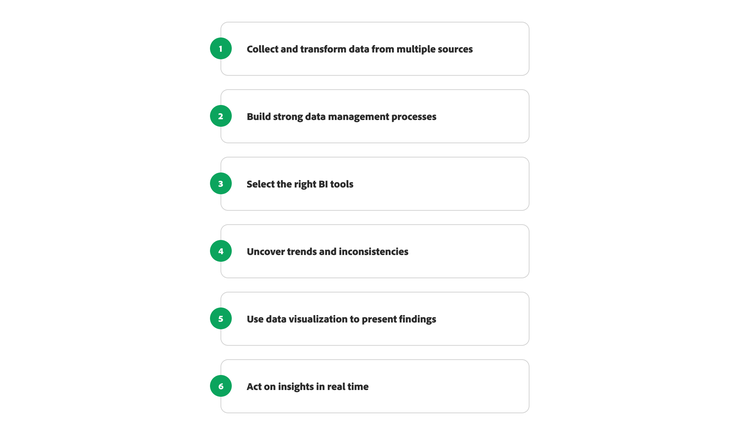
How can I develop a business intelligence strategy?

List of steps in data strategy: collect data, build processes, choose BI tools, identify trends, visualise findings, and act on Insights.

1. Collect and transform data from multiple sources

Effective BI relies on data drawn from across your organisation. ETL (extract, transform, load) processes are essential for gathering both structured and unstructured data from a wide range of sources into a unified, easily accessible repository. This enables you to apply BI best practices across multiple areas of your business, using clean, consistent, and up-to-date data.

2. Build strong data management processes

A sound data management process is essential for keeping data usable, secure, and manageable. It also ensures your BI tools receive high-quality, relevant data. Without sound data management, data integrity can be compromised – leading directly to poor decision-making.

3. Select the right BI tools

Selecting the right BI tools is one of the most effective steps towards achieving BI success. In some cases, your organisation may require multiple BI tools to address the needs of different departments.

Ultimately, aligning your tool selection with your specific business needs and user requirements ensures your business intelligence solutions are well matched to your organisation’s structure and objectives.

Data mining draws on exploratory, descriptive, statistical, and predictive analytics to identify trends, patterns, and anomalies within your data. Automation supports this process by rapidly processing large datasets, improving accuracy, and enabling real-time Insights.

5. Use data visualisation to present findings

Converting complex data into clear, accessible visual formats is fundamental to sound decision-making. When findings are communicated concisely, they provide clear direction and support faster decisions. Dashboards, charts, graphs, and maps are all effective tools for visualising complex data and making it easier to communicate.

6. Act on Insights in real time

Data without action quickly becomes outdated and loses its value. BI supports real-time decision-making by providing immediate access to relevant data and Insights. Your organisation can then make both short and long-term adjustments to address challenges, adapt to market shifts, prepare for predicted outcomes, and improve operational efficiency.

How does business intelligence help improve a company’s efficiency and decision-making?

Business intelligence tools, methods and practices are far more than mere add-ons – they fundamentally reshape how your organisation thinks and operates. When properly implemented, BI drives a cultural shift and delivers a range of benefits:

The breadth and reach of business intelligence across an entire organisation supports more effective decision-making by providing a clear view of what has occurred across multiple data channels. Understanding the key developments within your company enables you to revisit and refine the strategies that underpin your business.

Improved decision-making and efficiency go hand in hand – the more efficient your processes, the better and faster your data-driven decisions can be. Business intelligence helps you surface stronger insights to work more efficiently, particularly when using a tool such as Adobe Analytics with Adobe Customer Journey Analytics. Compared with Adobe Analytics, other BI tools are considerably slower and offer less capability. The ability to pivot immediately and use BI or augmented analysis to answer pressing questions in real time is essential.

How does business intelligence evolve, and what impact does that have on a business?

As a business’s big data evolves, so too does its business intelligence. Business intelligence allows you to bring many different data channels into a single repository: financial data, supply chain data, and even HR data. While you may not have every data channel in place at the same time, new ones can be added over time. Each new data set yields fresh insights about your organisation as it’s combined with the existing sets.

These are insights that would not emerge from examining each data set in isolation, and they only serve to improve your business’s efficiency.

What are the key challenges of implementing business intelligence?

Conflicting interpretations and bias in self-service BI

Self-service BI tools, whilst empowering for individual teams, can lead to conflicting conclusions and undermine a cohesive organisational strategy. Unconscious bias can influence data and distort analysis, with a consequent negative impact on decision-making. Remaining critical, impartial and logical when handling data is therefore essential.

Data integration complexity and skills gap

Data integration is inherently complex, particularly when consolidating raw data from diverse sources before it is distilled into actionable reports. Your team will need specialisms in data science, engineering, and architecture to underpin both data accuracy and reliability.

High upfront investment and long-term ROI

Business intelligence is not an area where partial commitment will suffice – it demands a substantial upfront investment in both knowledge and implementation. Equally, sweeping improvements to ROI will not materialise overnight. The real value emerges over the long term, enhancing decision-making and operational efficiency rather than generating immediate cash flow.

Examples of business intelligence use cases

Customer service

With access to a unified data source, customer service teams can resolve queries more effectively and identify friction points within customers' purchase journeys. This not only improves the overall customer experience but also enables staff to deliver a consistently positive interaction with your brand.

Retail

Retailers can use BI to analyse customer behaviour in response to marketing campaigns, review regional sales data, and monitor stock levels. Beyond this, BI can help identify and resolve supply chain issues before they escalate.

Sales and marketing

Sales teams can use BI tools to draw on customer data, identify market trends, assess campaign performance, and make data-backed decisions when developing new strategies to drive sales growth.

Healthcare

BI helps your staff work more efficiently by streamlining inventory tracking and management, reducing time spent on manual checks and calculations. You can ensure essential medication remains in stock and give customers the means to find answers to time-consuming questions without waiting for medical personnel.

Finance

Financial organisations can draw on predictive data to inform present-day decisions that support long-term success. Identify investment opportunities, assess performance metrics at branch level, and make well-informed decisions using granular data.

What will business intelligence look like in the future?

Business intelligence has evolved considerably as a technology – not only have the underlying tools advanced, but users have also become more adept at putting them to effective use. Looking ahead, there are several notable changes to anticipate:

Can I hire an outside agency to manage my company’s data?

Given the breadth, scope, and sensitive nature of your company data, managing it in-house is the more prudent approach. Every organisation has its own processes, goals, and priorities – a third-party team simply cannot replicate that contextual understanding. Developing a data governance plan tailored to your organisation’s specific needs is considerably more straightforward when handled internally. This need not be the team’s sole remit; it should, however, form one of the clearly defined responsibilities within your organisation.

It is also worth weighing the financial implications of outsourcing data management against building an in-house team. Beyond the greater control this affords your organisation, an internal team can be scaled as your needs grow, and your business accrues expertise that is genuinely specific to your operations.

How Does Business Intelligence Differ from Business Analytics

Business intelligence and business analytics are often used interchangeably, yet there are fundamental differences between them. While they are closely related, business intelligence operates as a subset of business analytics.

Business analytics takes a forward-looking approach, drawing on processes such as data mining, modelling, and machine learning to anticipate future events. Business intelligence, by contrast, focuses on evaluating historical business data – giving context and meaning to existing information. It uses past data and business KPIs to inform decisions, rather than forecasting what lies ahead.

Getting Started with Business Intelligence

A solid grounding in business intelligence starts with its core components: data analysis, data visualisation, and database management. With these foundations in place, business intelligence solutions can support better data-driven decisions and drive growth by turning raw data into actionable insights.

Tools such as Adobe Customer Journey Analytics consolidate data from multiple channels to deliver real-time, omnichannel insights, supporting more informed, data-driven decision-making across your organisation.

https://business.adobe.com/fragments/resources/cards/thank-you-collections/customer-journey-analytics