Choosing the wrong ecommerce model or platform early on creates structural costs that compound over years, misaligned pricing logic, incompatible fulfilment workflows, and data architectures that cannot support personalisation at scale. This guide provides a clear ecommerce definition, explains the mechanics, compares business types and revenue models, and closes with a decision framework that connects organisational conditions to platform choices.
What is ecommerce? A complete definition for UK businesses
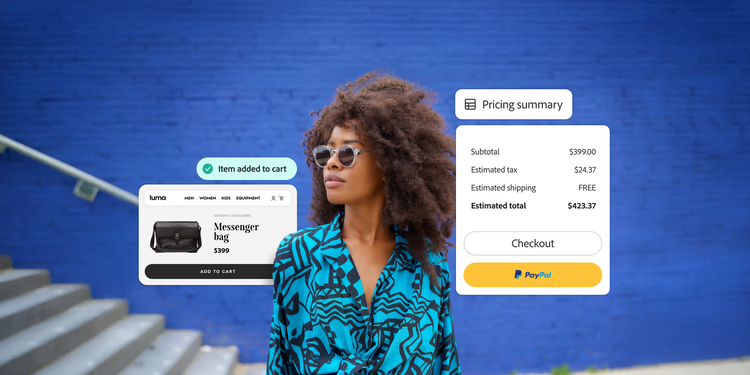
What is ecommerce?
The governing principle is straightforward: ecommerce is the buying and selling of goods or services conducted over the internet. That single definition encompasses everything from a sole-trader ceramicist selling through a single-product storefront to a multi-brand B2B marketplace processing thousands of wholesale orders daily across the United Kingdom.
Within any organisation, ecommerce decisions touch several roles simultaneously. Marketing leads assess whether paid search or marketplace listings offer a more efficient acquisition channel. Operations managers evaluate how warehouse management systems integrate with online order flows. Business owners weigh revenue diversification against the capital outlay required for platform licences, payment infrastructure, and logistics partnerships.
Ecommerce becomes strategically relevant at identifiable inflection points: when customer demand migrates online faster than in-store footfall can compensate, when geographic ambition, serving Edinburgh from a Bristol warehouse, for instance, exceeds the reach of physical premises, or when a competitor begins capturing digital market share that was previously contested only offline.
How does an ecommerce transaction work?
Every ecommerce transaction follows a sequential chain, and the principle that governs platform design is that each link in that chain is a potential conversion leak. The end-to-end flow runs: product discovery (organic search, paid media, or marketplace listing) → product page → basket → payment gateway → order management system → fulfilment → post-purchase communication.
Payment gateways and security protocols, SSL encryption and PCI-DSS compliance, function as trust signals. In the UK market, consumers increasingly expect checkout options such as Apple Pay, Klarna for buy-now-pay-later flexibility, and Open Banking integrations that allow direct bank transfers without card details. A checkout page that omits these familiar options risks abandonment at the final step.
Organisations also face a structural choice between owning the full stack (storefront, payment processing, fulfilment) and selling through a marketplace where the platform handles discovery and payment but retains a commission, typically between 8 and 20 per cent per transaction. The storefront model preserves margin and first-party customer data; the marketplace model trades margin for immediate reach. A professional services firm launching a digital training platform, for example, would likely favour the owned-stack approach to retain learner data and control pricing, whereas a homeware brand with limited marketing budget might prioritise marketplace visibility first. In both cases, post-purchase communication remains critical for driving repeat transactions and long-term loyalty.
What are the principal types of ecommerce?
The principle here is that business type determines operational architecture, pricing logic, fulfilment routing, and customer relationship management all follow from this foundational choice.
Model
Definition
Illustrative UK scenario
Key operational consideration
B2C
Business sells directly to individual consumers
Online stationery retailer shipping nationally from a Midlands warehouse
High order volume, lower average order value, returns management
B2B
Business sells to other businesses
Electrical components distributor serving contractors across multiple regions
Complex pricing tiers, bulk ordering, credit terms, account hierarchies
C2C
Consumer sells to consumer via a platform
Seller on a peer-to-peer vintage clothing marketplace
Platform dependency, limited brand control
D2C
Brand sells directly, bypassing intermediaries
British fragrance house bypassing department store concessions
Full margin capture but full fulfilment and customer service responsibility
B2G
Business sells to government entities
IT consultancy listed on a Crown Commercial Service digital framework
Compliance-heavy, longer sales cycles, contract-based revenue
Many UK organisations operate hybrid models. A food manufacturer might sell B2B to supermarket chains while running a D2C subscription box, creating complexity in pricing (wholesale vs retail), fulfilment (pallet vs parcel), and channel conflict management. Recognising this complexity before selecting technology prevents costly re-platforming.
B2G is expanding as Crown Commercial Service and local authority procurement shifts to digital frameworks. For mid-market suppliers with compliant catalogues, government contracts represent a stable, often-overlooked revenue channel worth investigating alongside consumer-facing sales.
Which revenue models sustain ecommerce businesses?
The principle governing revenue model selection is that margin profile and operational complexity must align with the organisation's existing capabilities, choosing a model that demands infrastructure the business lacks creates structural profitability problems.
Revenue model
How it works
Margin profile
Operational complexity
Direct sales
Sell owned inventory at a markup
Medium-high (pricing control)
High (inventory, fulfilment, returns)
Subscription
Recurring charge for regular delivery or access
High (predictable revenue, lower per-order acquisition cost)
Medium (retention systems, churn management)
Marketplace commission
Take a percentage of each third-party sale
Low per transaction but highly scalable
Medium (seller onboarding, dispute resolution)
Freemium
Free base product, paid upgrades
Variable (depends on conversion to paid tier)
Medium-high (product development, segmentation)
Advertising-supported
Free content or service, revenue from advertisers
Low unless at significant scale
Medium (audience measurement, ad-tech integration)
Dropshipping
Sell products fulfilled by a third-party supplier
Low (no inventory risk but thin margins)
Low-medium (supplier reliability, quality control)
A subscription model suits consumable products with predictable reorder cycles, a speciality coffee roaster shipping fortnightly, for instance, because customer lifetime value compounds and fulfilment can be batched. Marketplace commission, by contrast, suits organisations with broad catalogues but limited warehousing capacity; the business earns on each transaction without holding stock. Dropshipping appeals to early-stage ventures testing product-market fit, but margin compression means it rarely sustains growth beyond the initial phase without transitioning to owned inventory.
What are the advantages and disadvantages of ecommerce?
The principle for balanced assessment is that every advantage carries a corresponding risk or cost, and UK organisations must weigh both sides against their specific operating context.
Advantages: Lower overhead than high-street retail (no lease, reduced staffing per transaction), 24/7 availability for international customers across time zones, ability to scale revenue without proportional headcount growth, and access to data analysis tools that reveal customer behaviour patterns and inform merchandising decisions in near-real time.
Disadvantages: Intense price competition from global marketplaces that compress margins, reliance on third-party platforms whose algorithm or fee changes can erode revenue overnight, logistics complexity for bulky or perishable goods where last-mile delivery costs erode margin on low-AOV orders, and the need for robust data governance to comply with UK GDPR when collecting and processing customer information through online channels.
Each disadvantage maps to a quantifiable risk line item. Platform dependency creates revenue concentration risk, if a marketplace suspends a seller account, that revenue disappears immediately. Data governance non-compliance carries ICO enforcement action including fines up to £17.5 million or 4 per cent of global annual turnover, whichever is higher. Organisations that treat compliance as an afterthought rather than a design constraint expose themselves to material financial and reputational harm.
How should your organisation choose an ecommerce platform?
The governing principle is that platform selection should be driven by organisational conditions, not feature lists. A decision framework built on if/then logic prevents the common failure of choosing a tool that fits today's requirements but cannot accommodate next year's complexity.
Decision framework:
- If your organisation has fewer than 500 SKUs and a single storefront with no B2B requirements, a SaaS platform optimised for speed-to-market is likely sufficient.
- If you operate multiple brands, combined B2B and B2C channels, or need custom pricing rules and complex catalogue hierarchies, an enterprise platform such as Adobe Commerce provides the architectural flexibility required.
- If you want zero fulfilment responsibility and are testing demand before investing in infrastructure, a marketplace-first model reduces upfront capital outlay.
Evaluation criteria: Total cost of ownership (not just subscription fee, include integration, maintenance, and opportunity cost of workarounds), compatibility with existing ERP and CRM systems, scalability for peak events (Black Friday, January sales), native support for UK payment methods, and the ability to personalise experiences using first-party customer data. Organisations should also consider whether the platform supports automating repetitive design tasks across product pages and campaign assets, a factor that becomes material at scale.
Adobe Commerce is positioned for the enterprise tier: organisations with complex catalogues, multi-site architectures, or combined B2B/B2C operations benefit from its native headless capabilities, AI-powered personalisation, and integration with the broader Adobe Experience Cloud. This connects commerce, content, and data through unified data pipelines and integrated services across the Adobe ecosystem, a structural advantage when managing thousands of SKUs across multiple UK and international storefronts.
Explore Adobe Commerce for your organisation
The right platform decision depends on where the business operates today and where it needs to scale. Organisations managing multiple brands, complex pricing, or personalisation across B2B and B2C channels benefit from unifying commerce with the broader customer journey simultaneously.
Find out how Adobe Commerce supports complex ecommerce operations. Request a demo or explore features.
Recommended for you
Title
What is ecommerce? A complete definition for UK businesses.
CardDescription
Get a clear ecommerce definition, understand the main business models, and learn how online commerce works, with practical guidance for UK organisations.
cardDate
2026-09-09
cardImage

primaryTag
caas:content-type/blog
Tags
caas:content-type/blog, caas:products/adobe-commerce, caas:topic/trends, caas:blog-author/adobe-for-business-team