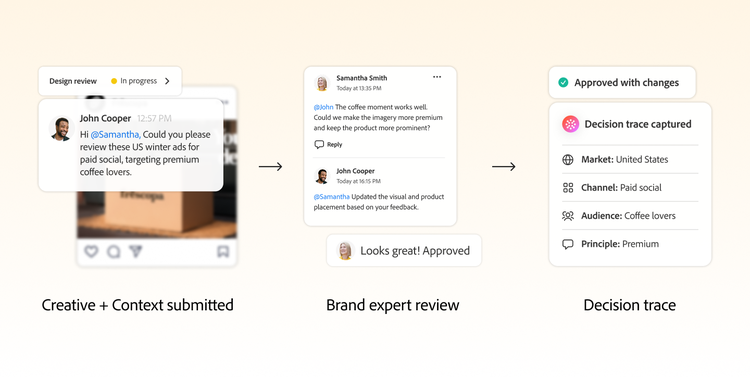
Decision traces are structured records of meaningful brand judgements that preserve the reasoning, context and circumstances behind how teams interpret and apply brand standards. They capture what was decided and why that judgement was appropriate, enabling organisations to learn from accumulated expertise and apply past decisions to future challenges. Decision traces can include comments, redlines, edits, approvals or rejections that are denoted during review cycles for content or creative assets.
Where do decision traces come from?
Decision traces emerge from signals generated during creative asset and content review workflows, but they need to be recorded to become reusable knowledge. When teams evaluate work against brand standards, they produce valuable contextual information about brand judgement. Signals such as reviewer comments explaining why something does or does not work, requested revisions that clarify expectations and approved exceptions can help to expand meaningful context within brand knowledge.
However, not every workflow event should automatically become meaningful brand knowledge. For example, an approval timestamp indicates an event occurred, but not why the event was significant. Useful decision traces identify individual choices with enough context to understand when and how that choice should inform future decisions.
What context makes a decision trace useful?
The value of a decision trace depends heavily on the context preserved and the choice itself. Relevant context can include the target audience, geographic market, distribution channel, campaign or initiative, asset type, messaging purpose and the specific brand principle being applied or interpreted.
Context distinguishes a reusable precedent from a one-time exception. A decision about tone flexibility for a youth-focused social campaign may not apply to executive communications or a visual style approved for a specific regional market may require different considerations elsewhere. When teams create on-brand content, context establishes the scope of previous decisions, clarifying when, where and under what conditions a past judgement should or should not inform future work.
Why brand knowledge goes beyond written guidelines.
Brand guidelines document standards such as approved colours, typography, logo usage and voice principles. But experienced teams also rely on tacit and institutional knowledge that guidelines rarely capture. Implicit knowledge develops through repeated decisions about messaging nuance, image selection, compositional choices, audience expectations and channel-specific adaptations.
This knowledge often remains fragmented in review and approval workflows or scattered across individual project files. When a senior brand manager explains why a particular headline approach works better for one audience segment than another, that insight stays in a single conversation. Recording these previous choices through decision traces retains brand knowledge that might otherwise disappear when people leave an organisation or when projects conclude.