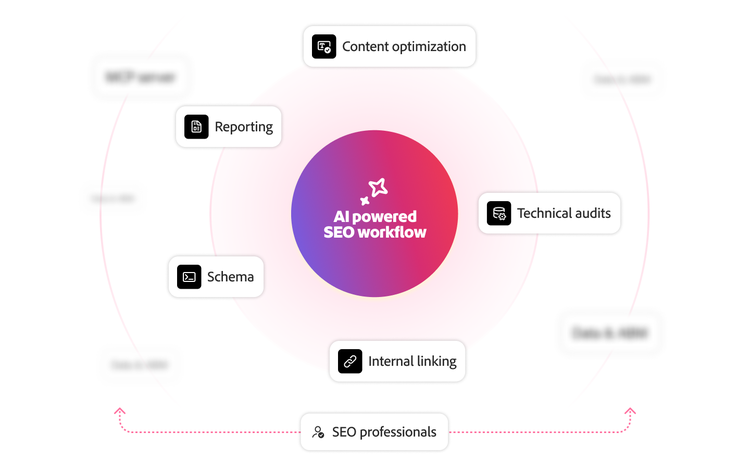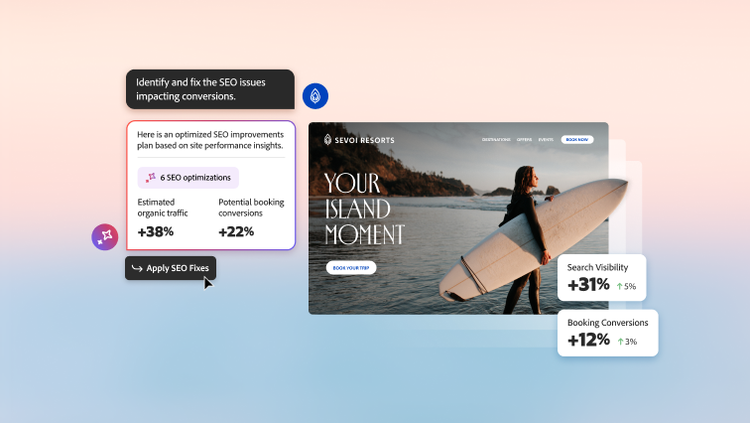
Enterprise SEO teams are under pressure to manage a growing volume of operational SEO work across large, complex websites while still making time for strategy. Technical audits, recurring performance reports, metadata reviews across regional properties, internal linking analysis, and schema validation all play an important role in search performance. Together, they can consume time that would otherwise go toward content optimization, strategic planning, and identifying new opportunities to improve visibility.
AI for SEO helps reduce that burden by taking on repetitive, rule-based tasks, so SEO teams can move faster without replacing the expertise required for strategic decision-making. For organizations managing distributed workflows, multiple CMS environments, and ongoing reporting cycles, AI improves consistency, reduces manual effort, and gives SEO and content teams more capacity to focus on higher-impact work.
AI for SEO is the use of artificial intelligence to automate, analyze, and optimize search engine optimization tasks. It is not a replacement for SEO strategy, editorial judgment, or human decisions that shape how a site performs in search. Instead, AI handles necessary yet time-consuming tasks, so SEO professionals can focus on work that requires advanced expertise and creativity.
AI is effective for SEO tasks that are data-heavy, high-volume, and rule-based. These tasks are easy to validate but time-consuming to manage at scale. In these cases, AI reduces manual effort, identifies issues earlier, and helps teams standardize repeatable workflows.
AI performs the initial work by gathering data, identifying issues, clustering keywords, drafting metadata, summarizing reports, and flagging anomalies. SEO teams then review those outputs, refine them, and make the final decisions.
Traditional SEO tasks
What AI automates
When human expertise is essential
On-page SEO
Metadata generation, H1 and H2 alignment checks, alt text suggestions, and URL consistency reviews
Final copy approval, intent alignment, brand voice, and YMYL content decisions
Technical audits
Crawl error detection, broken link identification, redirect chain mapping, and duplicate content detection
Prioritization decisions, root cause analysis, and implementation planning
Reporting
Data aggregation, performance summaries, anomaly flagging, and trend visualization
Root cause analysis, strategic recommendations, and stakeholder communication
Content audits
Thin content identification, freshness scoring, duplicate content detection, and gap analysis
Quality assessment, editorial decisions, brand alignment, and compliance review
Structured data
Schema opportunity detection, JSON-LD generation, and validation
Accuracy verification, entity consistency, and deployment decisions
Internal linking
Orphan page detection, link opportunity identification, and anchor text suggestions
Relevance confirmation, user value assessment, and business priority
Keyword mapping
Cluster organization, intent classification, cannibalization detection, and gap identification
Strategic targeting decisions, content prioritization, and competitive positioning
Style
grid-width-8
Automate on-page SEO tasks.
On-page SEO involves dozens of elements across potentially thousands of pages. AI helps automate and streamline this work across three key areas.
Metadata optimization. AI drafts title tags and meta descriptions, identifies duplicate or missing metadata, and flags pages where metadata doesn't match its content. This is particularly valuable for large sites with regional variations or product catalogs where metadata tagging at scale would otherwise require significant manual localization.
Page structure improvements. AI checks H1 and H2 alignment, identifies pages missing clear introductions, suggests snippet-ready summaries, and flags FAQ opportunities. These structural elements directly affect how search engines understand and display content. Even still, humans should verify if what AI suggests matches user intent and is valuable.
Asset and template quality assurance (QA). AI audits image alt text, checks URL consistency, verifies breadcrumb accuracy, and ensures page titles follow established patterns. For sites using templates across hundreds or thousands of pages, these checks catch issues that manual review misses.
The key is to treat AI recommendations as a starting point for humans to then review and adjust. Human review helps ensure on-page optimizations improve search visibility while remaining accurate, helpful, and aligned with user intent.
Enhance technical SEO audits and monitoring.
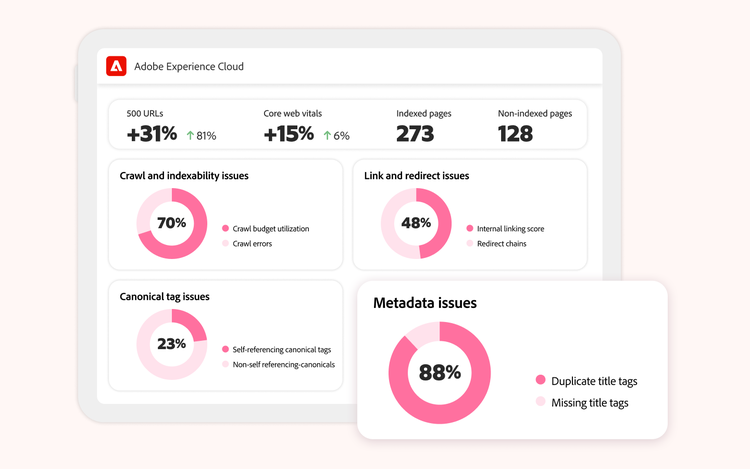
Technical SEO represents one of the highest-value areas for AI automation. When sites, like ecommerce websites, contain thousands or millions of URLs, manual auditing is time-consuming. AI processes crawl data at scale and surface issues that might otherwise go unnoticed.
Crawl and indexability issues. AI identifies crawl errors, no-index problems, and orphan pages. These issues impact discovery and crawl budget, particularly for large sites where search engines can't access every page on every crawl.
Link and redirect issues. AI maps broken links, identifies redirect chains and loops, and flags URLs pointing to non-canonical destinations. Left unchecked, these issues dilute link equity and create poor user experiences.
Metadata and canonical signal problems. AI detects duplicate titles and descriptions across pages, identifies missing canonical tags, and flags conflicting canonical signals that make it difficult for search engines to determine which version of a page to index.
Performance and sitemap quality. AI identifies slow pages, detects core web vitals across page templates, and audits sitemap quality. Effective sitemaps include only canonical and indexable URLs, while excluding duplicates, redirects, and no-indexed pages.
What makes AI particularly valuable for technical SEO is its ability to group issues by severity, URL pattern, template type, traffic impact, and indexability risk. This prioritization helps teams focus on fixes that will have the greatest impact.
Automate SEO reporting and anomaly detection.
SEO reporting is a good candidate for AI automation. Reports are recurring, data-heavy, and stakeholder-facing, making them well-suited for AI support.
Performance summaries. AI aggregates weekly, monthly, and quarterly data, including rankings, traffic, clicks, impressions, click-through rate (CTR), and conversions. Rather than manually pulling data from multiple sources, teams receive consolidated summaries ready for review.
Anomaly detection. AI flags traffic drops, ranking volatility, and unusual patterns by page group, template, market, or region. Instead of discovering problems days or weeks later, teams receive early alerts that prompt investigation.
Data translation. AI produces plain-language summaries of Google Search Console data, analytics reports, ranking changes, and crawl information. Technical data becomes accessible to stakeholders who need to understand performance without having to dive into dashboards.
Stakeholder communication. AI drafts updates, executive summaries, and lists of pages needing deeper analysis. This doesn't replace human communication. Instead, it provides a starting point that teams can refine and personalize.
Humans remain essential for validating data accuracy, conducting root cause analysis, and connecting insights to business goals. AI surfaces the patterns while SEO professionals interpret them.
Use AI for keyword mapping.
Keyword mapping is another SEO workflow where AI adds value. By analyzing large keyword sets alongside existing site content, AI helps teams organize keywords, identify content opportunities, and streamline planning.
Keyword organization. AI groups related keyword clusters, identifies long-tail opportunities, and classifies keywords by search intent.
Page mapping. AI maps keywords to existing pages, identifies content gaps, and flags pages where the target keyword does not align with the page content or search intent.
Cannibalization checks. AI detects pages competing for the same or similar keyword targets, helping teams identify consolidation or optimization opportunities before rankings are affected.
While AI accelerates keyword mapping and analysis, SEO teams remain responsible for content prioritization, keyword targeting, and competitive positioning.
Accelerate content optimization audits.
Content optimization audits help SEO teams identify opportunities to refresh, expand, and consolidate to match existing pages to search intent. AI accelerates that work by analyzing page content, performance signals, and keyword targets to highlight the updates most likely to improve visibility and search performance.
Content quality issues. AI identifies outdated content, thin pages, duplicative material, weak introductions, and unsupported claims. These issues affect both rankings and user experience.
Search intent alignment. AI flags pages that are missing sections, frequently asked questions (FAQs), or proof points that competing content includes. It also identifies pages that no longer match the intent behind their target keywords, which is a common problem as search behavior evolves.
Optimization prioritization. AI groups pages by traffic, current rankings, date, business value, and estimated level of effort. This prioritization helps teams focus on updates that will have the greatest impact rather than working through pages alphabetically or by publication date.
Next-step recommendations. For each page, AI suggests whether to optimize, consolidate with related content, redirect, leave unchanged, or add to the content calendar for future updates. These recommendations provide a starting point for editorial planning.
The goal is to identify where meaningful improvements are needed rather than applying generic updates at scale. While AI surfaces optimization opportunities, human review remains essential, especially for content covering your money or your life (YMYL) topics or regulated industries. Legal, financial, medical, product, and compliance claims require expert verification that AI can’t provide.
Streamline structured data and schema quality assurance.
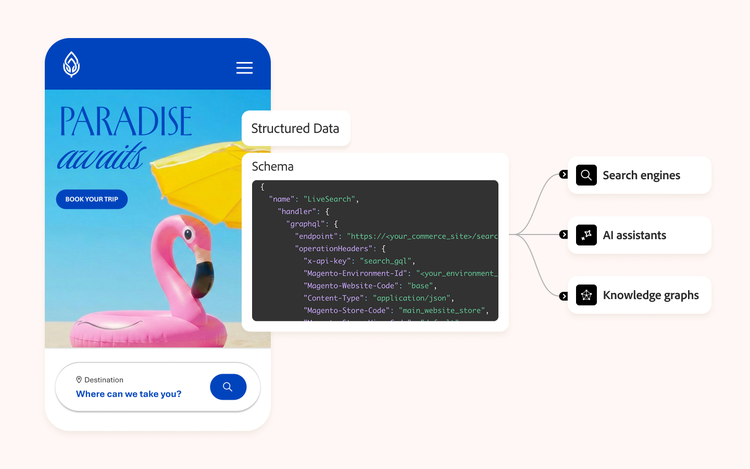
Structured data is a good candidate for AI automation because it follows repeatable patterns across page templates. Once schema requirements are defined for a template type, AI helps ensure consistency across every page using that template.
Schema opportunity detection. AI identifies pages that are missing structured data and recommends appropriate schema types based on the template and content type. A product page without product schema, or an article without article schema, represents a missed opportunity that AI flags.
Markup drafting. AI generates JSON-LD markup for organization, product, article, author, FAQ, breadcrumb, and location schema. These drafts follow standard patterns and can be reviewed and refined before implementation.
Schema accuracy checks. AI verifies that required and recommended properties are present and that the schema implementation is consistent across templates. Incorrect schema markup reduces eligibility for rich results and limits the value of the implementation.
Validation and accuracy. AI flags structured data (schema) that conflicts with visible page content or contains inconsistent entity details. Structured data must reflect what is on the page. Markup that claims something different from the visible content can create problems for users and search engines.
Structured data provides additional context about a page for search engines, site systems, and internal knowledge graphs. Accuracy matters more than coverage, and schema markup must reflect what's visible and true on the page.
Improve internal linking.
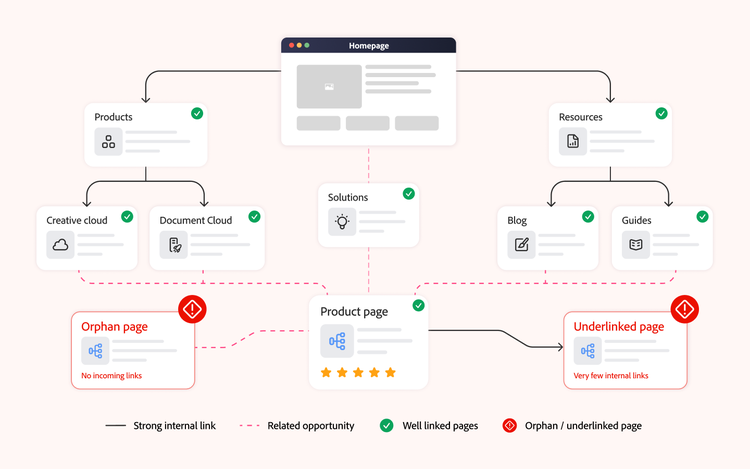
AI helps teams connect large keyword sets to site content by identifying relationships between queries, topics, and pages. That becomes especially valuable as sites grow and content expands, making internal linking harder to manage at scale. By surfacing relevant connections across pages, AI helps teams build and maintain a more effective linking structure.
Link opportunity discovery. AI helps teams identify underlinked pages, orphan content with no incoming internal links, and relevant linking opportunities based on topical relationships. It also identifies cases where high-value pages don’t have enough internal links.
Anchor text and topical relationships. AI supports internal linking by suggesting anchor text options and surfacing related pages across topic hubs, content clusters, and site sections. This helps teams maintain stronger semantic consistency across internal links.
Link quality checks. AI is useful for identifying links that point to redirected, broken, or non-canonical URLs. It flags internal link depth issues as well, helping teams spot important pages that are buried too deep in the site structure to receive enough crawl attention or link equity.
Internal links should be useful for readers, point to canonical destinations, and support the overall content structure. AI identifies opportunities while humans confirm relevance, user value, and business priority.
SEO teams should lead AI task adoption and final QA.
Adopting AI responsibly is important for SEO teams. AI is most effective when it supports execution, not strategic judgment. A useful way to think about it is a 70/30 rule where AI handles the repetitive first pass — gathering data, surfacing issues, clustering keywords, drafting metadata, and summarizing reports — while people own the final 30%.
The final 30% includes prioritization, quality review, compliance checks, brand alignment, and approval. These decisions require context, judgment, and accountability, especially when the output affects crawling, indexing, or published content. In those cases, AI supports the work, but people should make the final call.
That principle applies at any scale. Whether a team manages a small site or a large enterprise footprint, any AI-driven recommendation that changes what search engines crawl or what users see should be reviewed by a person before it goes live.
Explore Adobe AI for Business to see how AI helps your teams move faster while keeping quality in human hands.
Are you sure you want to end your chat session? Chats can't be re-opened once ended.
Message failed to send. Please try again.
Your use of this automated chatbot constitutes consent that the personal information you provide in the chat session will be collected, used, disclosed, and retained by Adobe and service providers acting on Adobe’s behalf in accordance with the Adobe Privacy Policy. Please do not provide sensitive personal information (such as financial or health information) in the chatbot.
I'm the Adobe Assistant. How can I help you today?