This deep demand for transparency signals that consumers will embrace automated pricing, but only if experiences are built on ethical, verified brand data. Marketers must abandon intrusive, low-trust behaviours and establish predictive, context-aware engagement surfaces that respect data privacy. By deploying the experimentation capabilities in Adobe Journey Optimizer, brands can run experimental marketing across email, push, SMS, in-app and web experiences using AI-powered analysis to understand why certain treatments win and to scale what works across campaigns and journeys.
Learn more about Adobe Journey Optimizer by watching the overview video.
Finally, we look at the specific moments where friction removal matters most to shoppers and the AI features they expect to become standard by 2027.
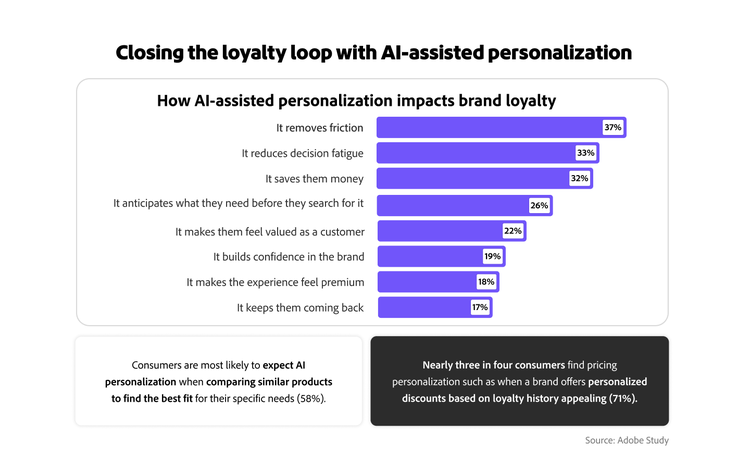
Eliminating shopping friction drives long-term retail loyalty because convenience is what shoppers value most from AI-assisted personalisation. Removing friction (37%), reducing decision fatigue (33%) and saving money (32%) are the top reasons personalisation keeps them loyal and a quarter (26%) value AI that anticipates what they need before they search for it. These practical benefits rank well ahead of emotional ones like feeling valued. Every step AI simplifies gives a brand another chance to earn that loyalty.
How do companies manage content creation at scale?
Shoppers expect AI-driven personalisation at a wide range of touchpoints. Meeting this expectation requires a high volume of content. Among shoppers, 58% want a personalised experience when comparing similar products, 38% want it when searching a new category without a brand in mind, 35% want it when looking for accessories or complementary items, 34% want it during a technical issue or delivering delay and 33% want it when they have items left in an abandoned basket. Smaller but still meaningful percentages of shoppers want it for ‘how-to’ content on a product they own (28%), for milestone moments like a birthday or anniversary (25%) and for location-based offers when they're near a shop (18%).
Delivering personalisation across so many moments requires a steady flow of relevant creative assets. Every audience segment, offer, channel and lifecycle stage can demand its own content variation, making manual production difficult to sustain. Brands need a content supply chain that can generate, adapt and govern creative assets without sacrificing quality or brand consistency.
Managing content at that scale isn't realistic with manual production alone. It takes an enterprise content marketing tool that can resize assets, adjust copy and generate relevant content blocks quickly enough to keep pace with real-time personalisation. Adobe GenStudio for Performance Marketing — a performance marketing software built around AI for content creation — enables marketing teams to leverage generative AI safely to create, manage and optimise campaign content variations. Automating the production of on-brand assets for paid media, display ads and email accelerates the creative supply chain.
What benefits does content management software provide?
Content management and brand compliance software give teams a central, secure hub to keep every asset on-brand while still moving fast on pricing and offers that convert. Consumers find AI-driven pricing scenarios appealing at similar rates to how trustworthy they find them: 71% find an unprompted, loyalty-based discount appealing, 62% find a discount offered after they push back on price appealing and 57% find a proactive, basket-abandonment discount appealing.
Content supply chain solutions make it possible to keep every localised asset, personalisation variant and pricing layout preapproved, version-controlled and brand-compliant before it goes live in any market.
How can businesses use AI agents to improve efficiency?
Handing operational tasks to automated workflows lets brands run thousands of personalised customer journeys with minimal manual effort, freeing up teams to focus on strategy instead of execution. Looking ahead to 2027, shoppers expect several AI-powered capabilities to become standard across major retail brands:
- Personalised product recommendations: 54%
- A built-in AI chat assistant: 54%
- Proactive deal alerts: 51%
- AI-generated product summaries: 49%
- Visual search: 46%
- Automated returns and exchanges: 45%
- Real-time personalised pricing: 45%
- Virtual try-on: 42%
Older generations lean toward chat assistants (55% of baby boomers and 57% of Gen X), while younger generations lean toward personalised recommendations (53% of millennials and 58% of Gen Z).
What will drive customer retention in the next era of commerce?
As consumers grow more comfortable with AI in their everyday shopping, from product discovery to proactive pricing, they're also raising their expectations for what a brand experience should feel like: efficient, personalised and honest about when AI is involved. The brands that win long-term loyalty will be the ones that treat retention, trust and transparency as one connected discipline, not three separate initiatives.
By leveraging Adobe CX Enterprise — Adobe’s unified customer experience platform that brings together brand visibility, customer engagement and content supply chain solutions on a common AI-powered foundation — brands can create proactive, transparent and tailored journeys that seamlessly integrate AI into the shopping experience.
Methodology
This article is informed by proprietary research conducted by Adobe. The study surveyed 1,001 consumers across the United States, providing a 95% confidence level with a ±3% margin of error. Respondents were asked about their direct experiences, expectations, trust metrics and brand loyalties regarding AI-driven personalisation across the digital and physical commerce landscape. As with all self-reported data, results may reflect personal perceptions and experiences rather than actual behaviours.