AI-powered assistants have become the starting point for high-stakes decisions — and increasingly, the endpoint too. Visitors arriving from AI channels convert at 31% higher rates than other channels, according to Adobe Digital Index data. Customers have already done their research and had their point of view shaped by what an AI told them before they arrive to your brand's site.
That's what makes the stakes so high. Showing up in an AI-generated answer isn't enough. What matters is how your brand shows up — whether you're the authoritative choice or one option among many — AI is either building trust in your brand or quietly eroding it before you get a chance to speak for yourself. Our research shows that 80% of companies have significant gaps in how their content surfaces in LLM results and many don't know what AI systems are actually saying about them.
Treat generative engine optimisation (GEO) as a practice, not a project.
When Adobe applied GEO discipline to Adobe.com, we saw a 5x increase in citations for Adobe Firefly, a 200% increase in LLM visibility for Adobe Acrobat and a 41% lift in LLM referral traffic — within weeks. As for our customers, Slalom Inc.'s digital team recently achieved up to 100% content visibility across 100+ pages and 10x more citations as a result. GM was able to create LLM-friendly content pages that led to a 23% increase in AI visibility and 35% increase in citations.
Results like these don't come from presence alone. Our mission with Adobe Brand Visibility was to go beyond surfacing insights and put the means to act on them directly in your hands. Every capability we build is in service of closing the distance between knowing and doing.
That discipline takes shape across three core capabilities: measure and monitor how your brand appears across AI surfaces; act and improve your content based on those insights; and use and collaborate so optimisation becomes a continuous, cross-functional discipline.
Those three pillars are what Brand Visibility is built around.
Measure and monitor: Seeing the whole picture.
You can't optimise what you can't see, but most brands are working with an incomplete picture. Your own analytics — like engagement data, conversion metrics and site behaviour — represent only a fraction of the signals that matter for AI visibility. The rest — what AI systems believe about your brand, which of your pages they're crawling, how they're characterising your products and how that compares to competitors — has largely been invisible.
Adobe Brand Visibility makes that picture whole with key capabilities and integrations:
- Enriched LLM referral traffic with Adobe Analytics. An out-of-the-box integration with Adobe Analytics that connects LLM referral traffic directly to business outcomes including revenue, conversions and engagement. Teams can prove the ROI of their GEO efforts inside the same reporting environment they already use.
- Support for multi-brand and brand hierarchy. For organisations managing a portfolio of brands or sub-brands, Brand Visibility provides unified tracking and management from a single platform. Compare visibility across brands, identify portfolio-wide gaps and manage optimisation without switching between instances.
- Brand claims. AI-generated responses are full of implicit and explicit claims about your brand: product quality, pricing, reliability and competitive position. The brand claims feature automatically groups these statements into structured categories, revealing where perception gaps exist and where AI may be getting things wrong. For brands that have worked hard to control their narrative, this is the visibility they've been missing.
- Prompt generation from agentic & referral traffic. Rather than guessing which prompts matter most for your brand, Brand Visibility can automatically convert real agentic visits and referral signals into new monitoring prompts. The questions that are already driving AI traffic to your site become the questions you're measuring — grounded in actual customer behaviour, not assumptions.
- Google Search Console integration. Connect to your Google Search Console to surface trending search queries automatically, so the prompts you monitor reflect what customers are genuinely asking and your GEO strategy stays grounded in real demand.
Taken together, these capabilities give teams a much clearer view of how their brand is actually showing up across AI surfaces, not just in terms of traffic, but in how they're being interpreted and compared.
But growing your brand presence alone doesn't change outcomes. The next step is using those insights to identify where gaps exist and, just as importantly, where there's an opportunity to improve.
Act and Improve: Closing the gaps at speed.
Visibility without action is just a dashboard. The second pillar of a strong GEO practice is the ability to act on what you learn — quickly, at scale and without creating new technical dependencies that slow teams down.
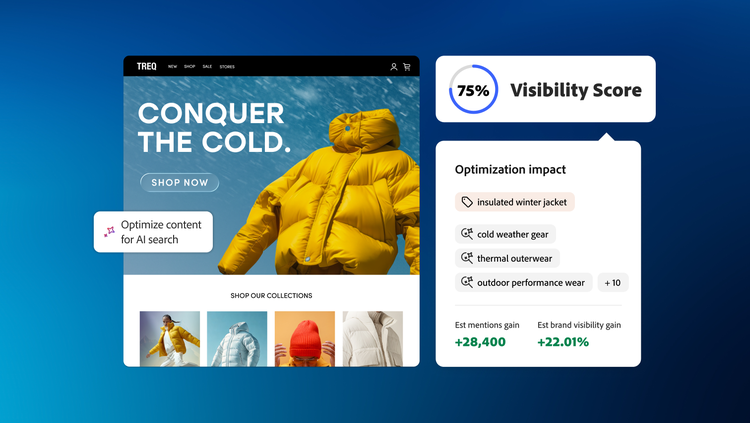
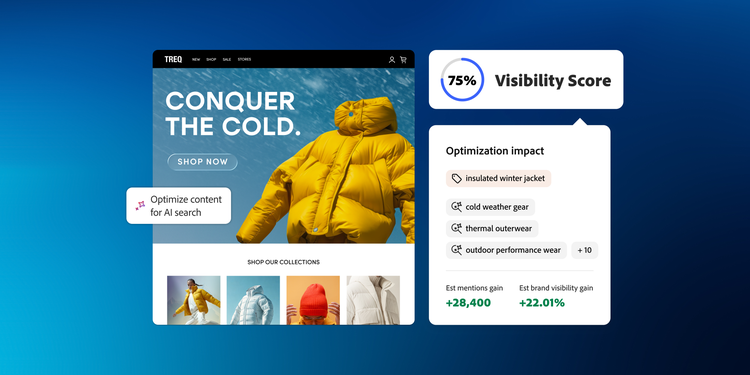
- Optimise at edge. Most content optimisation requires developer involvement, CMS changes and lengthy publishing cycles. Optimise at edge removes that dependency entirely. It's a no-code deployment capability that serves AI-friendly content improvements — LLM-friendly summaries, relevant FAQs, simplified content and recovered hidden content — directly at the CDN layer, targeting only AI agents without affecting the experience for human visitors or SEO bots. Identified opportunities can be live in minutes, with full preview, edit and one-click rollback capabilities built in. It works with any CDN configuration, including Adobe Experience Manager Cloud Service, Fastly, Akamai and Cloudflare. For marketing, SEO and content teams who have struggled to get engineering cycles for GEO work, this changes the equation significantly.
- Product & catalogue enrichment for discovery. For commerce and retail brands, product discoverability in AI-generated answers depends on how well LLMs understand your catalogue. Product & catalogue enrichment exposes catalogue attributes and adds narrative product context directly in Brand Visibility, helping AI systems understand what your products actually are, reducing ambiguity and improving the accuracy of recommendations in AI-driven discovery experiences.
- Social & community offsite optimisation opportunities. Your brand's presence in AI answers isn't determined solely by what's on your website. Third-party platforms including YouTube, Reddit, community forums and review sites are heavily weighted sources for most LLMs. Brand Visibility analyses and surfaces improvement opportunities across these offsite channels, giving teams a complete view of where they're missing from the conversations that shape AI answers.
- Verified business impact. Brand Visibility ensures every optimisation is measurable, attributable and statistically validated. Through controlled experimentation, adaptive measurement and baseline validation, it transforms optimisation into a continuous, closed-loop system tied to real business outcomes.
These capabilities make it possible to move from insight to action much more quickly, removing many of the traditional bottlenecks that have slowed down content optimisation.
As teams begin to close visibility gaps and improve how their content is being understood, the focus naturally shifts from individual optimisations toward building a more consistent, repeatable approach.
Use and Collaborate: Making GEO a shared discipline.
GEO doesn't live in a single role. It connects SEO, content, brand, product marketing, PR, social and more. The third pillar of a strong practice is the infrastructure that lets every relevant team member act on insights with clarity, appropriate access and shared context — rather than working from siloed information or duplicating effort.
- Alerts & notifications. When your visibility score drops, a competitor gains significant citation share or a key prompt generates unfavorable brand claims, you need to know immediately. Brand Visibility delivers configurable email and in-product notifications so teams can respond to changes quickly, with links embedded directly into the dashboards and optimisation opportunities that are most relevant to each alert.
- Opportunity workspace. A shared workspace where teams can collaborate on optimisation tactics, assign ownership and measure the impact of changes on brand visibility. It closes the loop between insight and execution, making GEO a team sport rather than a solo effort.
- Seamless workflows with project management tools. GEO work doesn't happen in isolation from the rest of your marketing operations. Brand Visibility will soon integrate with Jira, Slack and Workfront, so teams can create and track optimisation tasks directly in the tools they already use, keeping GEO work moving with the rest of the work on their plate.
- User roles & permissions. As GEO work expands across marketing, SEO and content functions, governance becomes essential. Role-based access control allows administrators to configure admin and read-only permissions, with a roadmap toward more granular roles that support scalable governance across larger teams. With the right workflows and shared context in place, GEO work becomes easier to co-ordinate across teams and roles that were previously operating in silos.
Over time, that co-ordination is what turns optimisation into an ongoing practice — one that continues to evolve as AI surfaces and customer behaviours change.
Revisit key sessions from Adobe Summit.
These capabilities represent a meaningful leap in what's possible for brands that are serious about their presence in the AI-driven discovery landscape. But the strategy behind them is what we explored in depth at Adobe Summit. Check out the following sessions:
Whether you're just beginning to understand your brand's AI visibility or looking to build a more sophisticated GEO practice, these sessions can show you what it looks like in action with real customer stories, live product demos and the frameworks to help you to move fast.
Start building your GEO practice today.
The brands winning in AI-driven discovery aren't waiting for the landscape to stabilise. They're measuring where they are now, acting on what they find and building the team habits that make optimisation continuous.
Adobe Brand Visibility is designed to support that work at every stage — from establishing your first baseline to running a mature, cross-functional GEO programme.
Explore Adobe Brand Visibility and review our GEO best practices to learn more.
Karthik Muralidharan is a Group Product Marketing Manager, leading a team focused on go-to-market and product strategy for Adobe's agentic web applications and growth product lines in Adobe Experience Manager. During his 8+ years at Adobe, Karthik has helped organisations elevate their digital experiences across a wide variety of use cases — including brand visibility, content management, forms management, digital signage and more. Before Adobe, he worked as a management consultant, advising clients on sales force optimisation, channel effectiveness and customer loyalty programmes.