#F5F5F5

ADOBE COMMERCE FEATURES

AI-driven commerce

Drive greater product visibility, conversion and loyalty across human and AI-led shopping journeys.

LLM-optimised product discovery

Go from being discovered to chosen. Adobe Commerce helps ensure your products are surfaced and recommended across LLMs, search engines, marketplaces and digital advertising channels.

  • Continuously optimise product content. Refine product attributes, titles and descriptions to improve relevance, visibility and ranking across channels.
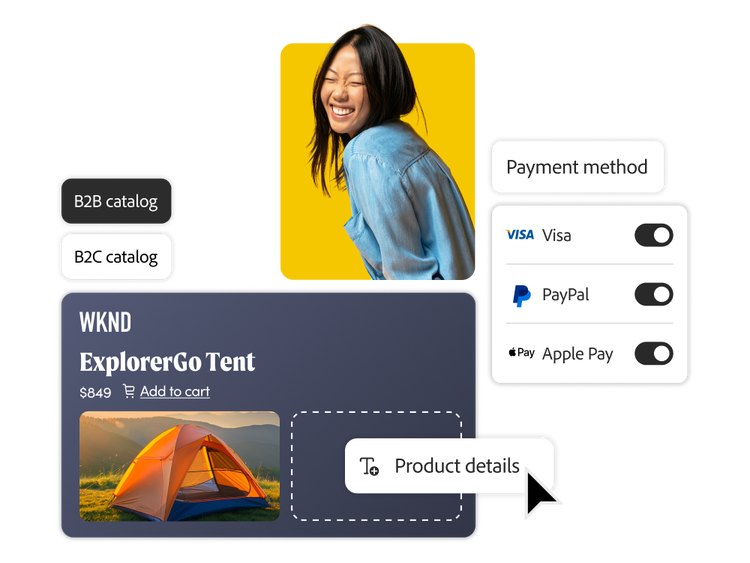
  • Make product detail pages AI-ready. Ensure LLMs can access complete product details through structured metadata — without requiring changes to your shop front design.
  • Simplify product feed management. Automatically generate and maintain channel-ready product feeds aligned with destination requirements, reducing manual work and time to publish.
  • Automatically close gaps in product data. Detect and resolve incomplete or inconsistent product information which limits discoverability.

Conversational shopping guidance

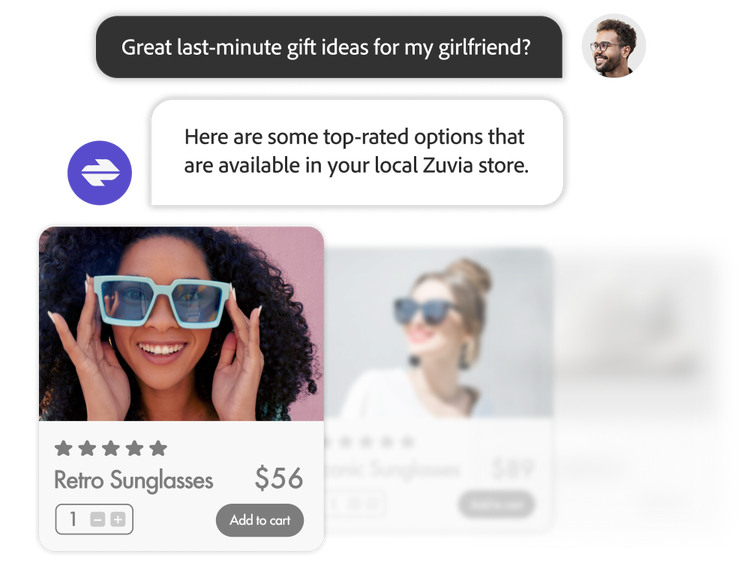
Turn conversations into transactions. Adobe Commerce’s integration with Adobe Brand Concierge ensures every interaction surfaces the right product at the right time.

  • Accelerate product discovery. Match customers to the most relevant products with catalogue content and real-time pricing and inventory from the Adobe Commerce catalogue.
  • Increase conversions and order value. Drive confident purchases with visually engaging product cards, comparisons, contextual recommendations and soon, seamless in-conversation checkout.
  • Build trust with every interaction. Deliver accurate, brand-approved responses backed by enterprise-level AI governance and data privacy controls.

Semantic product discovery

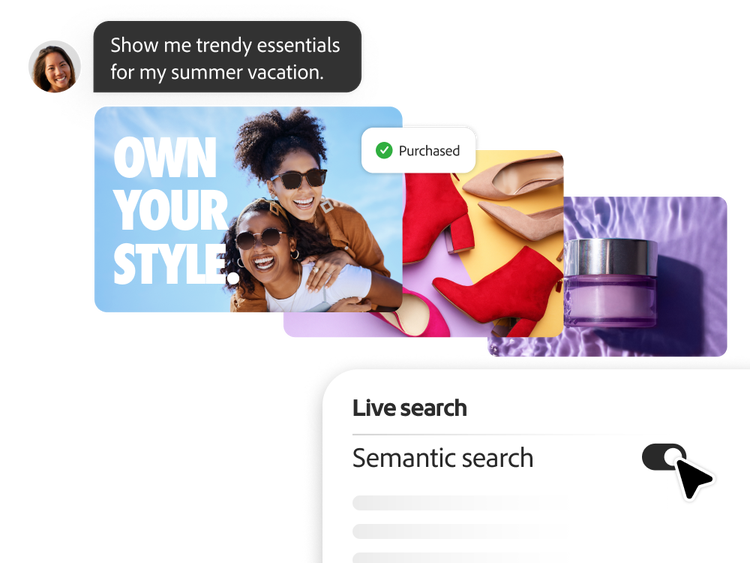
Go beyond keyword matching with AI-powered search that understands shopper intent. Semantic search helps customers discover relevant products faster.

  • Understand shopper intent, not just keywords. AI-powered semantic search interprets the meaning and context behind search queries to deliver more relevant product results.
  • Improve product discovery. Connect shoppers with the right products — even when their search terms don't exactly match your catalogue — creating more intuitive shopping experiences.
  • Drive better business outcomes. Reduce zero-result searches, increase search relevance and help shoppers find products faster to improve engagement and conversion.

Customised agentic commerce experiences

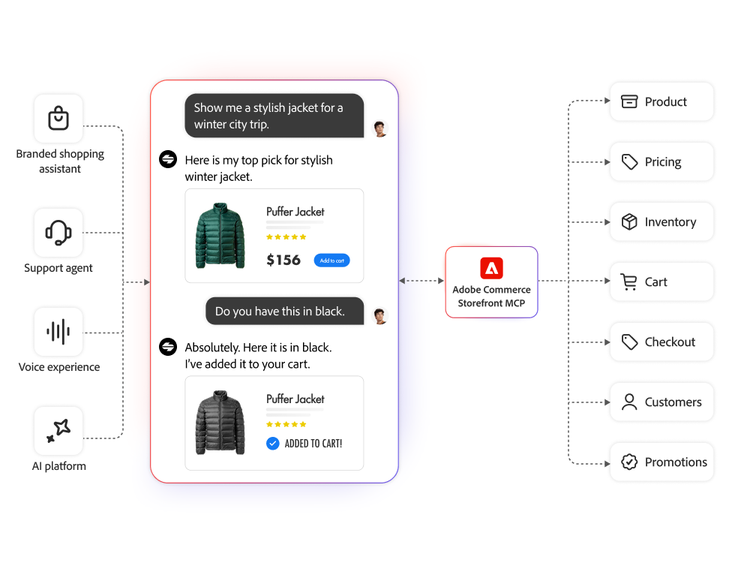
Build any agentic shopping experience you can imagine. The Adobe Commerce Shop Front MCP (Model Context Protocol) server gives developers direct access to your live Commerce data and services.

  • Create customised agentic experiences from discovery to checkout. Build branded shopping assistants, support agents, voice experiences and more — all powered by your live Commerce data.
  • Integrate with third-party AI agents and solutions. Connect Adobe Commerce to any MCP-compatible assistant or platform, without building customised point-to-point integrations.
  • Power every experience with real-time Commerce data. Agents get accurate product details, pricing and inventory so every interaction reflects what’s actually available in your store.
#FFECD0

Be everywhere commerce happens.

Through partnerships and our commitment to supporting new agentic commerce protocols including Universal Commerce Protocol (UCP) and Agentic Commerce Protocol (ACP), you can capture demand across AI assistants, online marketplaces and digital advertising channels — without managing separate integrations

Learn more about Adobe’s support for agentic commerce protocols.

Questions? We have answers.

What is LLM-optimised product discovery and why does it matter for ecommerce?

LLM-optimised product discovery focuses on structuring and enriching product catalogues and product detail pages so large language models (LLMs) can clearly understand what products do, how they’re used and why they matter. For ecommerce brands, this improves how products are interpreted and surfaced in AI search experiences — increasing the likelihood they appear in AI-generated summaries, recommendations and conversational shopping results aligned with shopper intent.

What is agentic commerce and how do ACP and UCP work?

Agentic commerce is a model where agents act on behalf of shoppers to research products, compare options and complete transactions. Adobe Commerce supports both the Unified Commerce Protocol (UCP) from Google and Agentic Commerce Protocol (ACP) from OpenAI. This allows agents to securely access product data, check availability and pricing and complete transactions on the customer’s behalf.

How does conversational commerce increase conversions and order value?

Conversational commerce enables shoppers to interact with AI assistants or chat experiences that can answer questions, guide discovery and suggest relevant products or bundles using real-time, accurate product information. By reducing uncertainty and helping customers make confident decisions, brands can improve conversion rates, increase average order value and drive repeat purchases.
Semantic Search uses AI to understand the intent and meaning behind a shopper's query, rather than relying solely on exact keyword matches. It analyses the context of both search queries and product catalogue data to identify products that are relevant, even when shoppers use different words, phrases or natural language than what's in your catalogue. This helps reduce zero-result searches, improves product discovery and enables shoppers to find the products they're looking for faster — without requiring extensive manual merchandising or synonym management.

What is the Adobe Commerce Shop Front MCP server and how does it work?

MCP (Model Context Protocol) is an open standard that allows AI agents to securely connect to your live data. The Adobe Commerce Shop Front MCP server exposes tools that agents can use to search your product catalogue, retrieve real-time pricing and inventory, manage basket contents and complete checkout — all without requiring customised point-to-point integrations. This means any compatible AI assistant or agent can deliver accurate, on-brand shopping experiences powered by your actual store data.