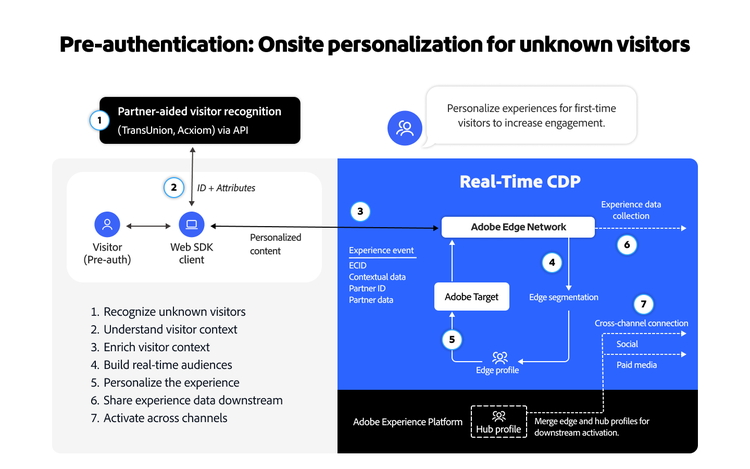
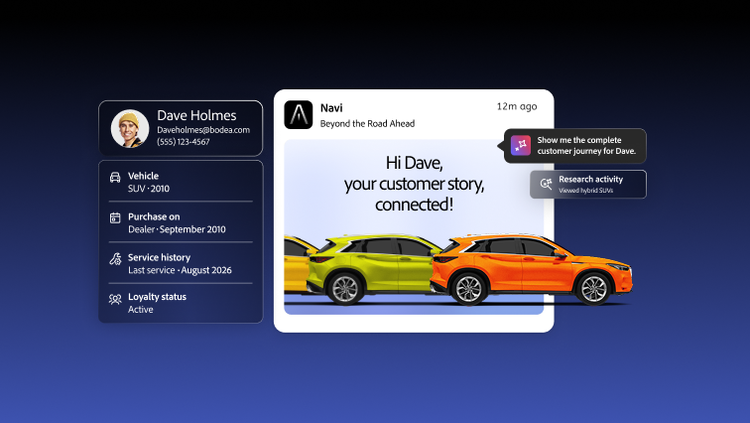
Adobe Experience Platform Web SDK collects behavioural signals in real time across your website and mobile app. Adobe Real-Time CDP builds a unified profile from those signals, anonymous or known and whether online or offline and evaluates audiences at the edge before a page even finishes loading. That’s the foundation on which everything else runs.
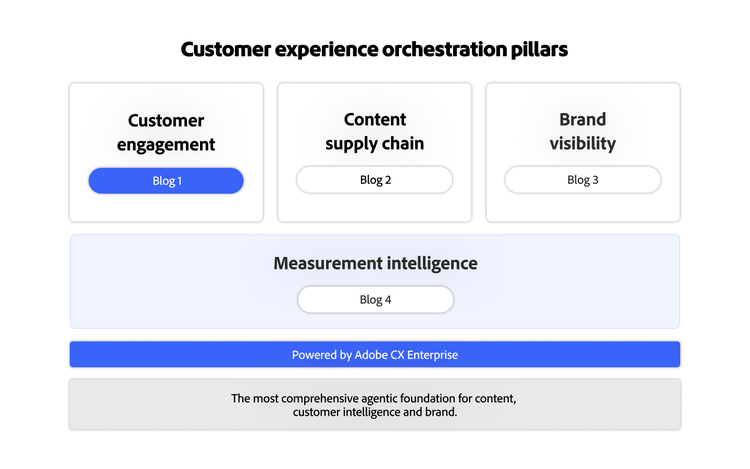
Partner-aided visitor recognition is great for anonymous, on-site visitor personalisation. However, it doesn’t create a visit that never happens. That’s a brand visibility problem, not an identity one. In the Blog 3 of the series, we go deeper into our latest product release, Adobe Brand Visibility, which incorporates capabilities from both Adobe LLM Optimizer and Semrush to help close that gap.
Phase 2 — Buy
By the time a customer is ready to buy, they've already spent some time comparing trims and narrowing down options elsewhere. When they land on an OEM site to get specific answers related to pricing, financing and actual stock, among others, they touch at least three separate OEM-owned systems: a build-and-price configurator, a financing pre-qualification form and a dealer-locator lead form. On top of that, the customer often has to navigate a similar journey on the dealer's own site: build-and-price tools, financing checks and browsing inventory or location-specific deals.
This is a dealer problem too, not just an OEM one. Customers configure vehicles, check financing and search inventory across both OEM and dealer sites, so the identity gap spans both sides of the relationship. But even before dealer systems enter the equation, the customer thread is already broken across the OEM’s own systems.
A customer builds a vehicle on the OEM site. Financing sits behind a separate log in. The lead that reaches the dealer often carries no build context. Real-Time CDP connects data from these disparate OEM-owned touchpoints into a single profile the moment a real identifier appears — an email address on the financing form, a phone number on the lead form or a CRM ID when a customer logs in.
Even though an email address is a fantastic identifier for confirming identity with third-party partners, shoppers may be reluctant to share their phone or email ID until later in the process, so OEMs and dealers need a reason for them to raise their hand earlier: save the build, unlock payment options or compare accessories.
This simple value exchange gives the customer a reason to share an email address or phone number and signals to the OEM the context needed to carry into the next phase. This also helps with building a richer profile for downstream systems, including customer journey analysis, audience retargeting and 1:1 journey orchestration.
The signal doesn't just get stored, it’s acted upon. Once Real-Time CDP has stitched the identifier, something has to decide what happens next — which message, which offer or which channel — and that decision has to be made in real time, not in the next scheduled send. That's a different job than identity resolution. Real-Time CDP tells you who the customer is. Something else has to tell you what to do about it in the moment.
Phase 3 — Own
A familiar problem is that OEMs have telemetry and apps, while dealers have service history — and neither has the full picture. But the bigger problem starts before that data ever needs to cross the OEM-dealer divide. Even OEMs with large, connected fleets or cars typically see active subscribers running well below half that number. The signals exist in the vehicle, but they don’t make it into the customer profile when subscription and app engagement lapse.
Many systems touch the customer during ownership — the website, dealer DMS data, owner app, loyalty programme, financing system, in-vehicle data (telemetry data can be separate from entertainment data), even the second key fob — and none of them share memory. Vehicle telemetry fails to enrich the customer profile even after two years of ownership.
Governance can't be an afterthought here. Telemetry only earns trust if the owner has knowingly opted in and understands what they will get in return — a warning before a battery fails in the cold, a heads-up before a tyre failure or a reminder for an oil change. Proper data collection and informed consent are critical components of a foundational architecture. Organisations should also incentivise customers to opt in to sharing their data for notifications and warnings.
Phase 4 — Retain
Your best customers are your best media asset. The loyal owner is the most valuable person in your ecosystem. And most OEMs aren’t systematically building that relationship. They’re leaving their best Shop-phase asset unused.
Your 90-day plan.
Adobe research found that 62% of automotive organisations feel ready for campaign planning, but only 20% can support full-journey orchestration. That gap reflects weaknesses in the underlying data foundation. Here’s how to approach closing it in 90 days without ripping out what you already have.
Step 1: Lay the foundation with Web SDK.
If you’re still running legacy tags, that’s the first thing to plan for and address. Web SDK is the foundation for modernising your data collection. It opens the door to real-time, telemetry-based journeys — partner-aided visitor recognition, Real-Time CDP Collaboration, Customer AI and the threshold-based triggers in Journey Optimizer described in Phase 3. You can't build a real-time profile on batch data.
Make standardising data collection across web, mobile and app a key initiative.
Step 2: Engage more with your known customers.
You already have known customers today — people who've shared an email ID or phone number through a build-and-price form, a financing application or your CRM — whether or not the web SDK is live yet. Build a simple Journey Optimizer email and SMS sequence for that list: a build reminder, a financing follow-up and an incentive nudge. It's a fast, parallel win that doesn't depend on the web SDK roll-out and lets you validate Journey Optimizer before you tackle anything telemetry-related in Step 3.
Step 3: Pick one trigger in the Own phase.
Service-overdue notifications based on vehicle telemetry are one of the easiest wins. Build a Journey Optimizer pathway that uses email, SMS or push notifications and is triggered when mileage or time since last service crosses a threshold. Measure the lift in service scheduling at 30, 60 and 90 days. This increase is usually sufficient to fund the next set of use cases without requesting additional budget.
Step 4: Run one Real-Time CDP Collaboration overlap.
Pick one media partner your customers already spend time with, such as a sports league, a streaming platform or a publisher. Run the audience overlap analysis, but don't stop at interests.
Interests tell you what your best owners like. Behaviours tell you who's ready to act.
Are they reading about EV powertrains or drifting back to ICE vehicles? Researching fuel economy? Willing to fill in a lead form with more than an email address? That's the difference between an audience that looks like your best customers and one that's actually in market. Use it to brief your next media buy. That's how Retain becomes Shop.
Step 5: Mirror one OEM signal that proves Step 3 worked.
You don't need dealer data to defend this pilot in a budget review. This blog has already flagged the identity break at the dealership door as a separate, harder problem and Step 5 shouldn't quietly assume it's solved. You need one number from the data you already own. Mirror your owner-app engagement data — a “schedule service” tap, an app open, a dealer-locator click — into Adobe Customer Journey Analytics via Data Mirror, join it against the Journey Optimizer trigger from Step 3 and you have row-level proof the message drove an OEM-side action. It's a proxy for the appointment, not the appointment record itself, but it's proof you can generate today, without waiting on dealer data-sharing to get solved.
Proving one trigger worked this way is different from proving the whole lifecycle worked, including what happens once the customer reaches the dealer. Full cross-channel attribution — dealer DMS, sales data, warehouse-triggered activation — requires the kind of controlled dealer cooperation this blog scoped out of Phase 2 and it's the subject of the fourth blog in the series.
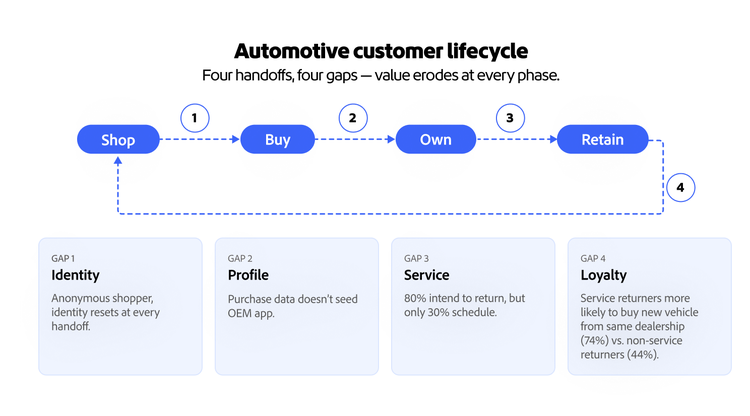
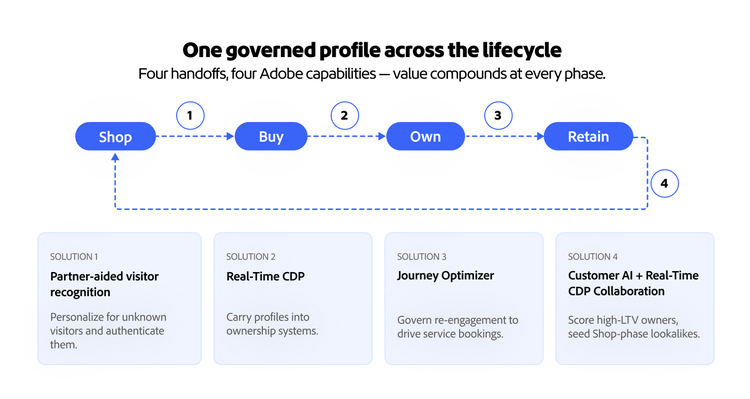
Most OEMs systematically rebuild the customer profile at each phase transition: Shop to Buy, Buy to Own and Own to Retain. Each rebuild throws away what the phase before it knew. The required data already exists within your ecosystem, the challenge is deploying an architecture that preserves continuity across every handoff.
What’s next?
Blog 2, Scaling marketing content in the automotive industry, focuses on the content supply chain. Once you know who your customer is, the next problem is producing content at the speed and scale required to engage them effectively. Adobe Workfront, Adobe Experience Manager Assets, Adobe Experience Manager Sites and Adobe GenStudio turn one approved asset into every variant a launch needs — without five teams rebuilding it manually.
Blog 3, Shaping brand visibility in the automotive industry, focuses on brand visibility. Customers increasingly research vehicles on AI platforms rather than on your site. Adobe Brand Visibility ensures your brand is found and represented correctly when they ask.
Blog 4, Proving marketing impact in the automotive industry shows how Adobe Experience Platform Web SDK, Customer Journey Analytics and Data Mirror connect online behaviours with offline sales, dealer service and enterprise data. Automotive marketers see the full lifecycle, prove what drives revenue and loyalty and invest with confidence.
Why work with Adobe’s automotive practice?
The usual market approach is to show up with a demo and a case study from a different industry. That's not what closes a gap like this — and it's not just a staffing difference, it's an architectural one.
Every phase explained in this blog runs on the same customer profile — the identity stitched at purchase, the segment that triggers a service reminder, the audience built from your own owner base — because Adobe Real-Time CDP, Adobe Journey Optimizer and Adobe Customer Journey Analytics are part of one platform, not three separate solutions someone had to integrate. Most partners working with automotive firms are still focused on assembling that stack for you. Adobe, on the other hand, delivers a unified platform out of the box.
If the first half is the architecture, the team is the other half. Adobe's automotive practice puts three things in the same room that usually aren't:
- An industry strategist who works on automotive full-time, not one vertical among several.
- An integrated services architect who has implemented Real-Time CDP, Journey Optimizer and Customer Journey Analytics inside OEM environments, not just presented a reference architecture.
- An enterprise architect who stays on the account through implementation, rather than handing off to services once the contract is signed.
Traditional service providers give you one of these: industry depth, hands-on build experience or continuity through delivery. You would rarely get all three on the same account. This practice puts all three in the room.
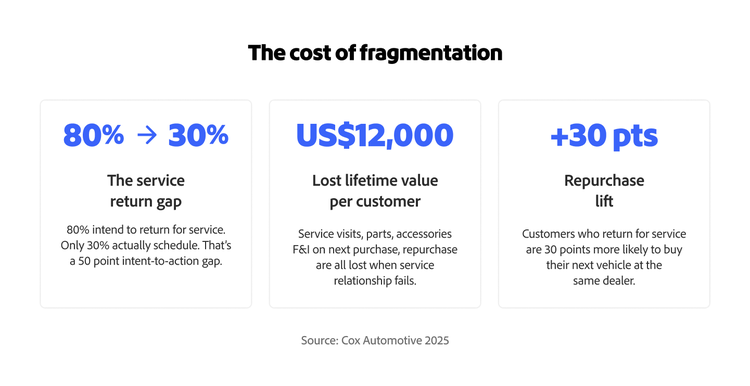
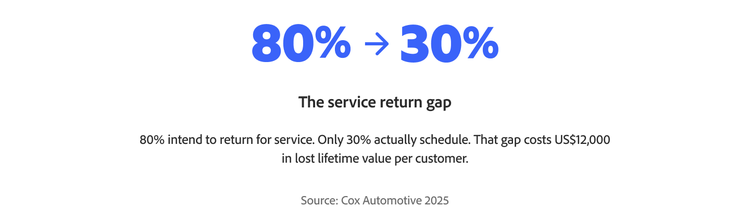
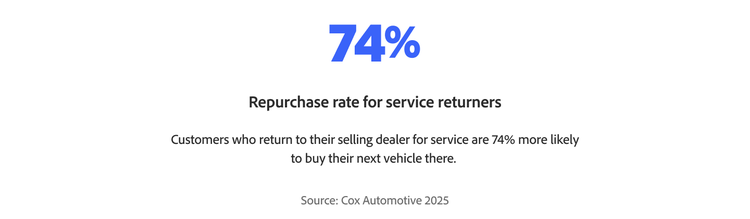
Explore Adobe's State of Customer Experience in Automotive in an AI-Driven World report to understand the trends behind the identity, service and repurchase gaps described in this blog. Furthermore, the automotive use cases on Adobe Experience League cover the reference architecture and OEM-specific blueprints for Adobe Experience Platform, Real-Time CDP and Journey Optimizer.