Driving the future: How AI is powering personalized automotive experiences.
The automotive industry has never lacked ambition.
We engineer world-class vehicles, obsess over design details most customers probably will never consciously notice and run global operations that would make many industries tap out by Tuesday.
But when it comes to customer experience, plenty of brands are still fighting yesterday’s battles with yesterday’s tools while customer expectations quietly sprint ahead.
Engineering excellence, brand legacy, and product innovation still matter. They always will. But they’re no longer enough on their own. Today, growth increasingly hinges on something far messier: delivering connected, personalized experiences across a customer journey that refuses to behave like a funnel or follow a PowerPoint slide, no matter how compelling that slide may be.
To understand how automotive leaders are navigating this shift, Adobe commissioned Incisiv to survey 560 automotive executives across nine global markets. The research explores where the industry is making real progress, where critical gaps remain, and how AI’s starting to redefine customer experience in practice, not just in strategy decks.
AI is the engine making that possible. Like any engine, though, it only performs if the rest of the system is actually built to support it. Dropping AI into a disconnected stack doesn’t create momentum, though it does create opportunities for awkward banter in quarterly reviews and an impressive number of “great question, let’s take that offline” moments.
Customer expectations aren’t slowing down.
From online research to test-drive scheduling to aftersales service, customers expect every interaction to recognize who they are and what they care about. Not eventually. Not after the next platform upgrade is rolled out. Immediately.
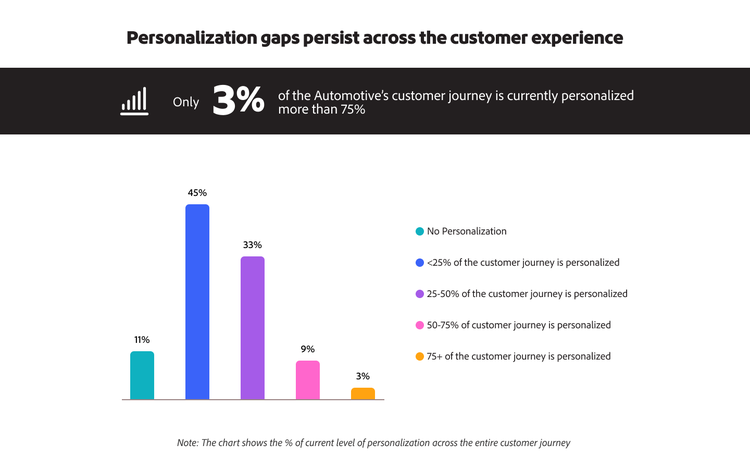
Yet today, only 3% of the customer journey is highly personalized.
This gap isn’t a lack of desire or imagination. It’s the result of legacy systems, dealer fragmentation, and disconnected data that make even basic personalization feel like a minor organizational achievement. The kind that earns a congratulatory slide (and a quiet hope it keeps working).
Most teams know exactly what they want to deliver. Far fewer have the operational foundation to do it consistently, at scale, and without heroics. AI can help close that gap, but in many organizations, ambition is still running several laps ahead of readiness. The intent is there. The plumbing isn’t. And no amount of vision statements will fix a leaky pipe.
Journeys are breaking down due to disconnected touchpoints.
This challenge becomes impossible to ignore as customers move between digital and physical touchpoints.
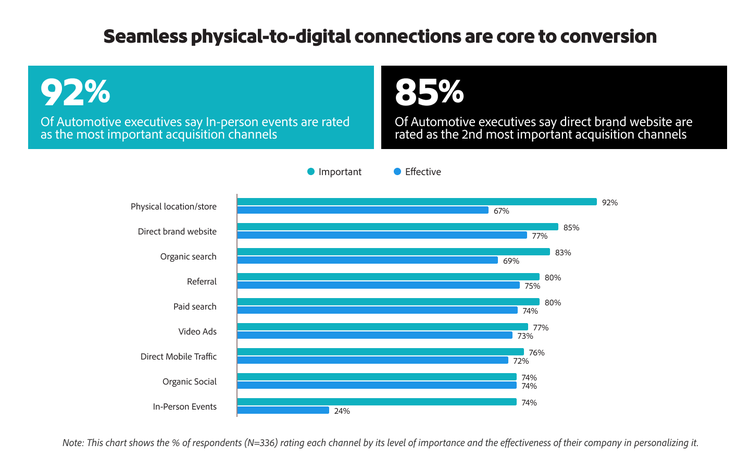
Automotive leaders overwhelmingly agree that high-value channels like in-person interactions and brand websites are critical acquisition drivers. Confidence drops sharply. However, when they’re asked whether those experiences are actually personalized in a meaningful way. Agreeing something’s important is easy. Making it work across teams, systems, and retailers is where things get interesting, and occasionally political.
At the same time, the front door to the journey is changing. Nearly 20% of automotive searches are expected to happen through AI-driven interfaces within two years. That means a customer’s first interaction may not be your website. It may be a conversational AI experience quietly deciding whether you’re even worth clicking on.
Brands that unify signals across research, showroom visits and ownership touchpoints gain earlier visibility and influence long before a lead looks like a lead or shows up in anyone’s dashboard in a comforting shade of green.
Marketing is being asked to prove impact, not activity.
If it feels like the pressure on marketing has increased, that’s because it has.
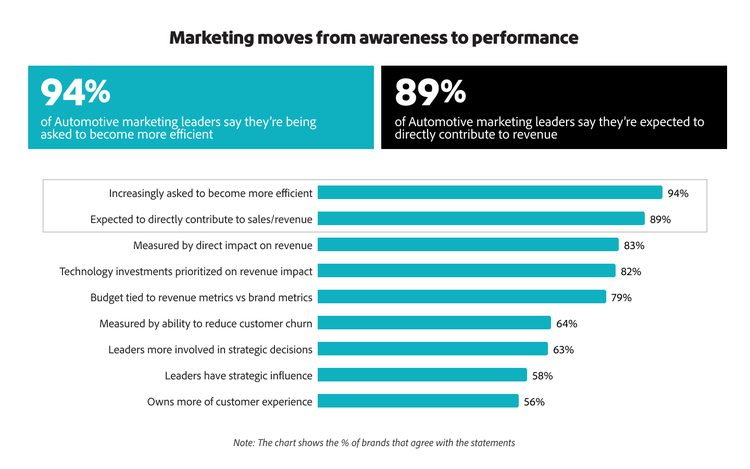
Per the survey, 94% of leaders report increased pressure to drive efficiency and 89% are now expected to directly demonstrate revenue impact.
Marketing is no longer just supporting the business. It’s being asked to behave like a performance engine that influences sales outcomes, showroom traffic, and lifetime value, often with the same budget and fewer people.
AI can absolutely help, but foundational blockers still loom large.
Reliability concerns, integration challenges, and the absence of clear AI governance keep many organizations stuck in experimentation mode. Without defined workflows and accountability, AI becomes impressive in demos and oddly quiet when results are discussed. It shows up strong in the concept phase and fades out somewhere between pilot and production.
The real bottleneck lies in the foundation.
To deliver connected journeys and deploy AI responsibly, automotive organizations have to confront some uncomfortable truths.
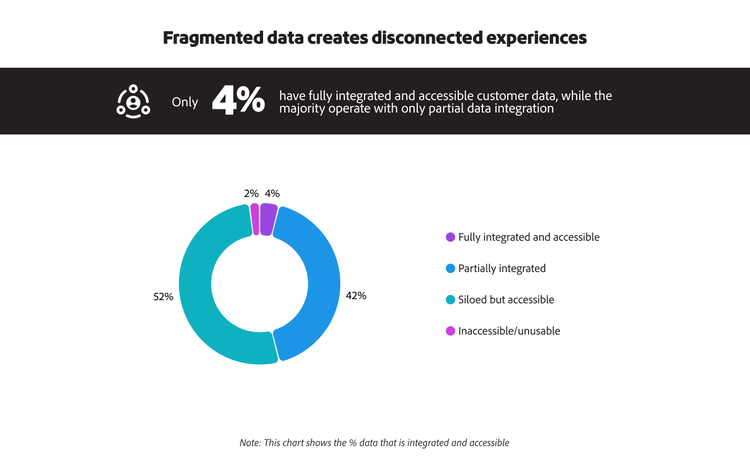
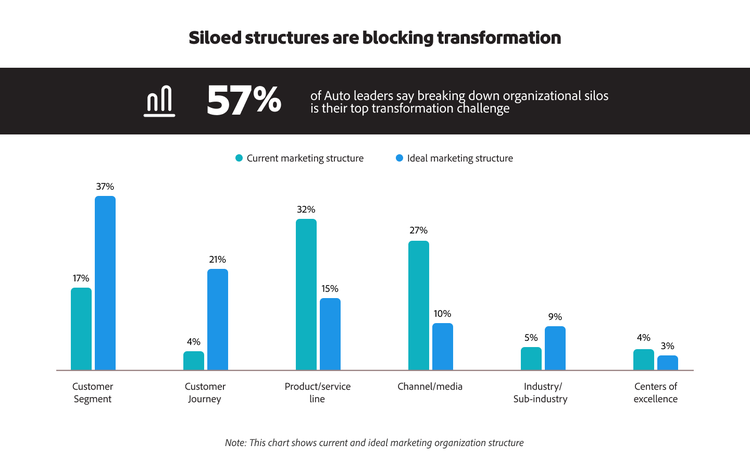
While 57% of leaders cite silos as their biggest challenge, only 4% have fully integrated customer data. That fragmentation doesn’t just slow execution. It limits what AI can realistically do, no matter how compelling the roadmap looks or how many roadmap slides exist.
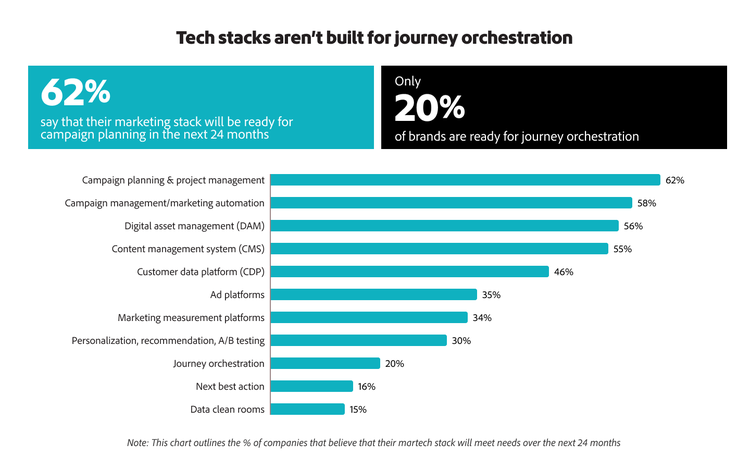
Additionally, many martech stacks were built for campaign execution, not dynamic AI-powered journeys. While 62% feel ready for campaign planning, only 20% believe their stack can support full-journey orchestration. Teams may feel ready to plan campaigns, but far fewer believe their technology can support end-to-end orchestration across the lifecycle. That gap shows up quickly once AI moves from experimentation to expectation and patience starts wearing thin.
This matters because AI is already reshaping content operations and decisioning. Generative AI increases output by 38% and reduces costs by 26%, but without orchestration, that content struggles to reach the right customer in the moments that matter most. Emerging capabilities like agentic AI will only raise the bar further and shorten tolerance for “we’re still figuring it out.”
The road ahead: Make AI operational.
Closing the gap between rising expectations and today’s reality doesn’t require chasing every new AI headline or rewriting the org chart for the third time this year. It requires focus and a willingness to fix the fundamentals before adding new features.
Automotive leaders should prioritize three things:
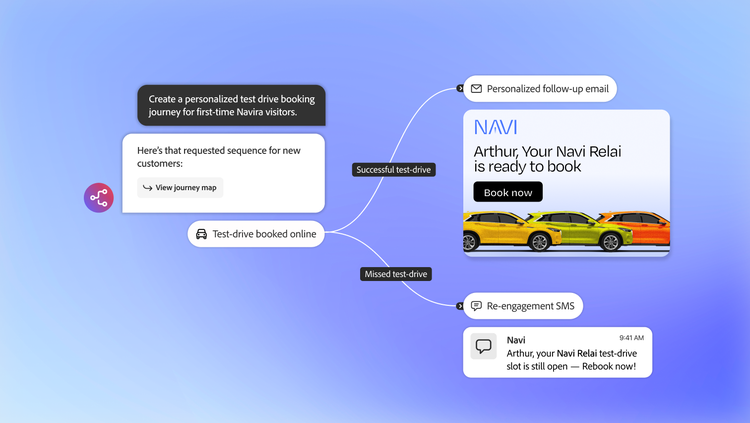
- Orchestrate connected, personalized journeys by unifying data and using AI-driven workflows to bridge digital and physical touchpoints in real time.
- Modernize the data, content and platform foundation to activate a single customer view and scale AI-ready experiences.
- Scale AI responsibly by embedding governance, skills, and accountability into everyday operations, not bolting them on later.
The brands that get this right won’t just use AI; they’ll operationalize it as a core capability and quietly raise the bar for what great automotive experiences look like. Everyone else will keep talking about transformation and wondering why customers aren’t feeling it yet.
Explore the full report to see how leading automotive brands are closing the personalization gap and scaling AI responsibly.
Jon Beebe is a transformational automotive executive and early digital pioneer with more than 25 years of experience in digital marketing, including over 15 years leading large‑scale digital transformation at Ford and General Motors. He is widely recognized for advancing emerging and social media in the auto industry and for launching award‑winning digital marketing campaigns. At General Motors, Jon founded and championed the company’s approach to integrated data and analytics, performance marketing, and unified customer identity. As the strategy matured, his organization expanded to include customer lifecycle management, including retail, dealer, and critical recall communications. He is known for his engaging presentation style, ability to translate complex technology into relatable stories that highlight growth opportunities, and industry thought leadership.