






The State of Customer Experience in an AI-Driven World

The Ongoing Evolution of Customer Experience

How AI is optimizing for customer experience at every step — from data to delivery

Executive Summary

For our 2025 State of Customer Experience in an AI-Driven World research we surveyed more than 3,400 senior executives across nine regions and eight consumer-led industries to understand how organizations are responding to seismic shifts in customer experience and how they are preparing for transformation alongside rapid AI innovation.

Customer experience continues to change at an accelerated pace, driven by rising expectations, shrinking attention spans, and the rapid advance of AI. For leaders, this isn’t a finish line but an ongoing journey where customer behaviors, channels, and tools are constantly shifting.

In this report you'll learn how organizations are navigating customer experience transformation across four major themes:

Headshot of Christopher Young.

“Success in today’s environment requires more than adopting the latest platforms or tools. It’s about building the right structures, fostering collaboration, and empowering teams to move quickly and confidently. AI is now a catalyst in this journey — accelerating innovation, enabling smarter decisions, and helping organizations stay agile in the face of constant change. The companies that thrive are those that treat transformation as a journey — one that demands agility, trust, and a relentless focus on outcomes.”

Christopher Young
Senior Director, Global Industry Strategy, Adobe

LLMs Are the New Front Door to Brand Discovery

Discovery looks nothing like it did five years ago. Journeys are fragmented, expectations are rising, and AI is changing the very starting point of how people search, explore, and connect with brands.

Customer Journeys Take New Directions

Today's customer journeys branch, loop, and recombine. Less like a line, and more like a graph. Our research shows buyers engage in seven meaningful interactions across different channels before making a purchase. They bounce between product pages and price comparisons, reviews and Reddit threads, influencer videos and in-store shelves. Moving across devices, customers expect brands to keep up and deliver instant responses, mobile-first experiences, and a consistent voice everywhere. Brands that fail to do so are falling behind.

Just as organizations begin to adapt, an even bigger shift is underway. AI is transforming the very starting point of discovery — reimagining how journeys begin and where customers place their trust.

“The modern shopper doesn’t follow a path — they are on multiple journeys simultaneously. Now, we thought mobile was transformative — and it was — but AI is the biggest wildcard I’ve seen.”

Chief Digital Officer

AI-powered discovery is quickly becoming the new front door to product and brand engagement. Instead of typing keywords into a search box, customers are chatting with AI assistants powered by large language models (LLMs) — advanced AI systems trained on massive amounts of text and language so they can generate natural responses. Tools like ChatGPT and Gemini are already reshaping how people find information.

For example, a consumer can ask an LLM, “What’s the best hiking backpack for weekend trips under $200?” and get curated recommendations. Meanwhile, an employee can ask, “Show me last quarter’s customer retention numbers in North America” and pull the exact data from internal reports in seconds.

This is the most consequential shift in discovery since the introduction of the search bar.  According to our research, just 1% of global organic B2C search is currently conducted on LLMs, but that number is expected to surge to 20% by 2027 (Figure 1). Brands that prioritize natural, credible content that reflects how people ask questions will earn discoverability and the trust of LLMs.

Figure 1: The current and expected volume of organic B2C search on LLMs.

Figure 1. Current volume of organic B2C search on LLMs in 2025 is nine percent. Expected volume in 2027 is twenty percent.

Trust Earns Discoverability

When LLMs answer consumer questions, they look for reliable sources to cite. That makes credibility markers and trust indicators essential for getting your content surfaced. Signals like clear authorship, consistent branding, accurate information, and content that goes beyond surface-level answers help prove that a brand is trustworthy.

Our research shows that 91% of organizations are already considering the impact of LLM search, underscoring just how transformational this shift is to customer experience. Leading organizations are responding by strengthening these trust signals and producing question-focused content to align with how AI systems decide what sources to surface during LLM-based search (Figure 2). But even as AI shapes discovery, the research indicates customers still place their deepest trust in something more familiar — each other.

Figure 2. Bar chart showing organizational strategies for LLM-based search, with 67% adjusting keyword strategies and 9% not considering AI.
Figure 2: Organizational strategies to address the shift to LLM-based search.

Customers Trust Each Other More Than Brands

In the last two years, customers consumed 72% more reviews and testimonials and 69% more influencer content before making a purchase — a clear sign they are engaging with more content than ever (Figure 3). They trust peer voices and authentic perspectives far more than polished marketing.

Influencer content and user-generated content (UGC) are rising sharply as buyers look for trusted voices that combine personal experience with expert guidance. The brands that capitalize will be those that amplify credible customer voices instead of competing with them. They’ll do this by surfacing reviews on product pages, weaving testimonials into social channels, and highlighting UGC throughout the journey, not just at checkout.

Figure 3. Bar chart showing top content types people use before purchasing: reviews, influencers, social media, UGC, and educational content.
Figure 3: Increase of content consumption before purchase from 2023 to 2025.

TAKEAWAY

Build for AI Discovery

AI is reshaping how customers find and trust brands. Content must now be structured for both human and agent readability.

  • Create AI-native content that answers questions directly and is structured for agent readability.
  • Strengthen trust signals with clear authorship, consistent branding, and analytics that track conversational discovery.
  • Amplify authentic voices by surfacing reviews, partnering with influencers on true product affinity, and investing in community-driven UGC.
  • Ensure journeys remain consistent across channels with clear response standards, especially on mobile.

Discover the specific insights for your industry.

Scaling Content at the Speed of AI

Generative AI can instantly create text, images, video, or audio from a prompt, and it’s completely reshaping how content gets made, scaled, and delivered. The speed and personalization it brings come with new demands for workflow, governance, and quality.

Maintaining Content Quality

Even as content demand outpaces what most organizations can deliver, brands are preparing their content operations for volume by installing compliance and brand safety standards (Figure 4). Generative AI gives marketers a way to keep up by making it easier for teams to produce more content variations faster and deliver relevant, personalized experiences to customers at scale — but maintaining brand integrity is key.

Many teams still find themselves recreating assets from scratch. The more efficient option is to reimagine workflows around modular systems and break content into reusable components. With embedded brand and approval standards, along with established review processes, the path to generative AI adoption will be swifter.

Figure 4. Bar chart showing brand preparedness in for various areas of content creation operations over the next twenty four months.
Figure 4: Brand preparedness for the following areas of content operations over the next 24 months.

The Early Adopter Advantage

Generative AI is accelerating work as well as redefining it. Nearly 90% of organizations are adopting, exploring, or using generative AI for content creation, though most remain in a trial phase of strategizing on governance, integration, and quality control (Figure 5).

Early adopters — including the 19% running proofs of concept and 11% scaling deployments — are already learning what a hybrid model of creatives and AI looks like. These teams report faster throughput, more personalization, and operational efficiency. Even small-scale use now helps organizations understand the opportunity of a future where people and AI collaborate in new ways, and the economic impact it delivers.

Figure 5: Stages of generative AI adoption for content creation.

Figure 5. Bar chart showing stages of generative AI adoption: most are learning, others are exploring, testing, or scaling.

The Economic Opportunity

Generative AI is already transforming content operations for organizations putting it into practice. Those moving beyond pilots are reporting measurable gains. Brands that are deploying it report:

Thirty-one percent.

lower costs per asset

Forty-nine percent.

increase in content throughput

Thirty-six percent.

faster time-to-market

Thirty percent.

higher quality control costs

Eight percent.

increase in conversion rate

The story isn’t just about going faster. The economics of content are being rewritten as significantly more is being created. The byproduct of a higher volume of content is that more needs to be reviewed. Sure, there’s a slight initial uptick in quality control costs in the short-term as standards strengthen, but brands that balance efficiency with the right guardrails are proving that AI can scale both performance and quality.

AI Thrives Under Governance

The hardest part of generating AI content can be trusting it. AI speeds up creation, but if teams doubt its accuracy or compliance, everything comes to a halt. Early adopters are learning that the real unlock is governance. By embedding the right guardrails — like fact-checks, copyright scans, and standardized templates — directly into workflows, organizations are reducing review times and building confidence in their AI outputs.

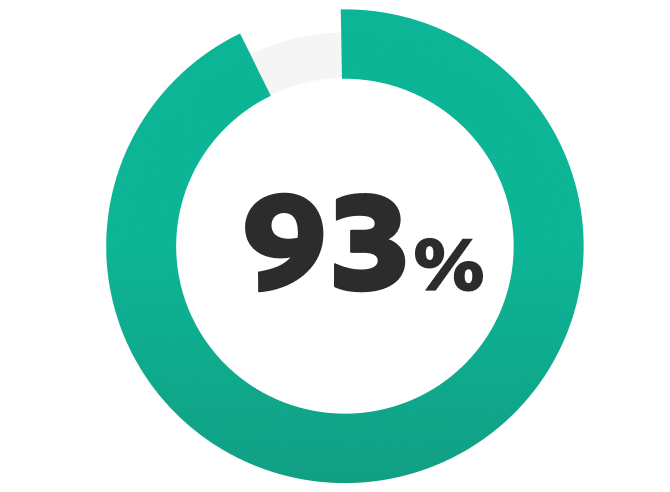
Ninety-three percent

Reported challenges in integrating their generative AI content efforts with their existing content systems.

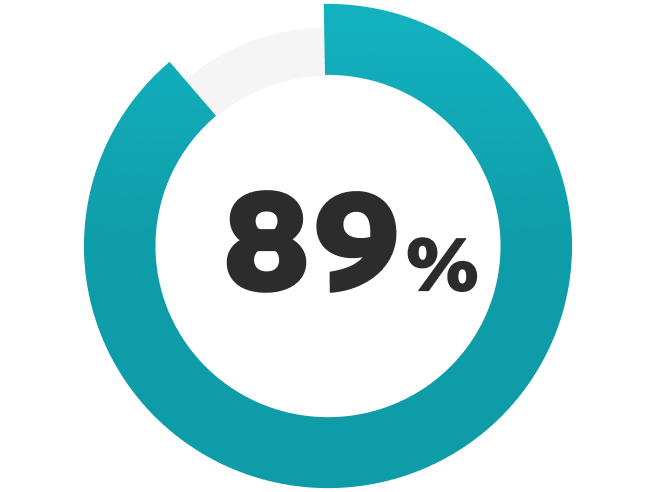
Reported factual inaccuracies and hallucinated content with their generative AI content.

Eighty-nine percent

The research backs this up. The top three capabilities brands are prioritizing to reduce review burdens are copyright and IP compliance scanning (61%), automated fact-checking and accuracy verification (59%), and pre-approved templates for repeatable use cases (36%). Once this foundation is in place, the real test is in the channels where content must live and perform.

Staying Relevant on All Channels

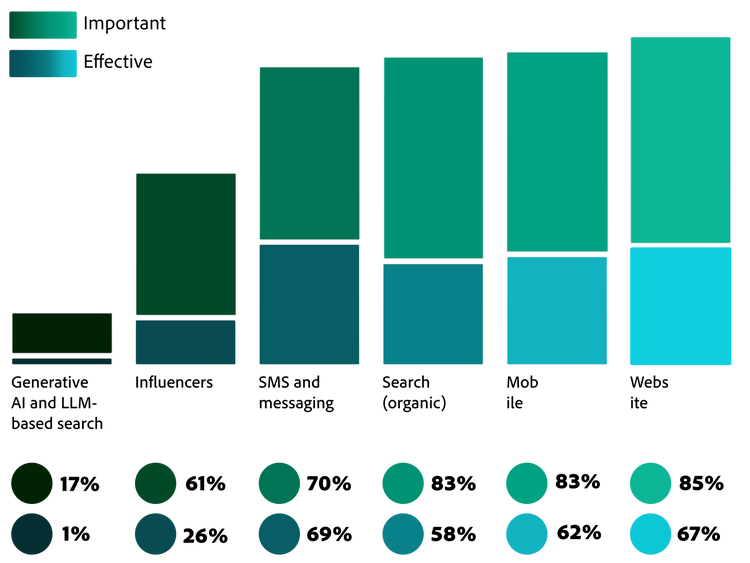
While established platforms still matter, most organizations are unprepared for the AI-driven channels defining what comes next. Mobile is the clearest example. Despite years of “mobile-first” strategies, our research shows many brands still haven’t captured their full potential (Figure 6).

The readiness gap is even wider in fast-moving spaces like influencer ecosystems and AI-driven discovery, where customer behavior is evolving quicker than brand capabilities.

Figure 6. Gap between importance and effectiveness is high for Generative AI and LLM-based search and Influencers.
Figure 6: The importance of a channel for customer acquisition versus how effective an organization is in leveraging it.

TAKEAWAY

Balancing Scale and Quality

Generative AI raises both opportunity and pressure. The brands leading the way will be those that scale with quality control and authenticity.

  • Build modular systems that reuse content while keeping standards intact.
  • Pair human expertise with AI to deliver personalization at scale.
  • Strengthen governance with guardrails for quality, compliance, and brand trust.
  • Treat mobile, influencer ecosystems, and AI-driven discovery as priority channels to optimize continuously.

Modern Journeys, Modern Tech, Modern Teams

Modern customer journeys are more complex than ever, yet most organizations are still navigating them with outdated structures. The research shows that despite heavy investments in data and technology, organizational silos and skill gaps continue to hold marketing back from delivering true, connected experiences.

Marketers Are Under Pressure to Perform

Marketing is under unprecedented pressure to deliver on performance metrics. The survey uncovered that 97% of organizations say their teams are being asked to become more efficient, and the demands don’t stop there (Figure 7):

  • 93% are expected to directly contribute to sales and pipelines.
  • 89% see marketing tech investments prioritized by revenue impact.
  • 85% say budgets are tied more closely to revenue than brand metrics.

This focus on performance is reshaping the role of marketers. They are being held accountable for efficiency and sales impact and feel it is now their defining priority, while traditional brand-building receives less investment.

Figure 7. Bar graph shows increasing agreement that statements about marketing metrics and expectations are growing.
Figure 7: The percentage of respondents who agree with statements about how their marketing departments are evolving.

Data Fragmentation Blocks Personalization

Brands agree the future should be built around customer journeys, but the reality of execution often falls short. Our research shows that today, most marketing structures still prioritize products (28%) rather than customer segments (14%), even though executives overwhelmingly say customer segments are the ideal model. That shift can only happen with an integrated and accessible data foundation, yet most organizations remain held back by fragmented data.

Customer information is trapped in separate systems or dispersed among teams that don’t connect. Only 4% of brands have fully integrated and accessible data, and 49% have partially integrated data. Without a singular, usable customer profile shaped by near real-time data, personalization stays shallow and inconsistent.

Modernizing data and making it usable unlocks new opportunities. Retail media networks, data monetization, and AI-driven services all require a level of integration that most organizations lack, letting data-mature competitors step in to capture disproportionate value. If companies don’t close this gap, they risk falling further behind in delivering the contextual, real-time content that customers expect.

A Gap in Technology Confidence

Personalization can’t deliver without orchestration, which is the ability to coordinate touchpoints across the full journey. Most brands don’t trust their tools to get them there. The research shows organizations are losing confidence that current platforms will meet their needs over the next 24 months as AI-driven customer experience accelerates. Only 28% of executives are confident in their measurement platforms, just 21% trust their personalization and recommendation engines, and a mere 15% believe their journey orchestration platforms will deliver (Figure 8).

Without reliable orchestration, it’s harder to connect marketing to real results, prove value, and keep up with customer expectations. Brands need to take a look at their technology stacks and ask what can be upgraded, what can be integrated, and what gaps must be closed to stay competitive. They also need to consider whether they have the staff and structures in place to make the most of the transformation.

Figure 8. 57% of executives believe campaign planning and project management will meet their needs. Other platforms are less.
Figure 8: Percentage of executives that believe their current platform will meet their needs over the next 24 months.

Upgrading Employee Skillsets

Upgrading technology is only half the battle. Executives consistently rank organizational and talent challenges above technical ones as the biggest barriers to transformation, with breaking down silos and finding or retaining talent with modern skillsets being their top priorities. The problem is misalignment. Leaders may have the right vision, but on the ground, teams are still divided by departmental functions and competing incentives.

It takes cross-functional collaboration, supported by structural changes and modern talent, to realize the value of new technology. Without the right people and team design, even the most advanced platforms underdeliver.

“We've learned the painful way that technical transformation without corresponding organizational change is destined to fail. You can implement the most sophisticated marketing platforms available, but if your teams remain in functional silos with competing priorities, you'll never realize the potential.”

Chief Strategy and Digital Officer

Putting It All Together

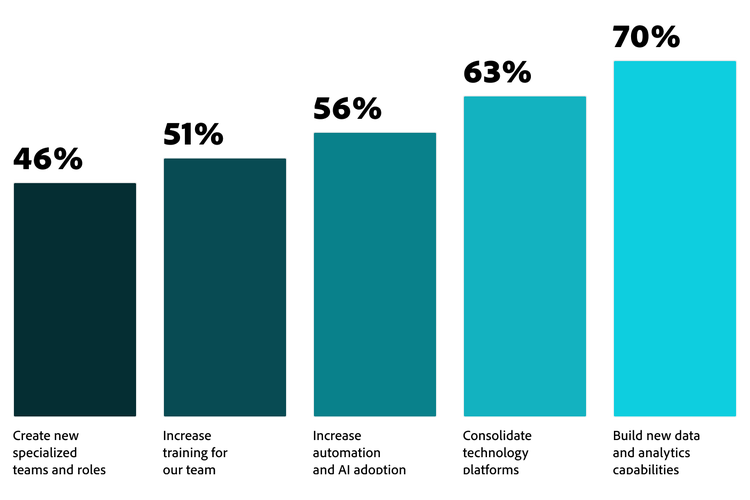
Executives keep saying people and talent are the number one priority, yet most of the changes planned in the next 12 months focus on technology (Figure 9). Over three-quarters of brands are planning new data and analytics capabilities or consolidating platforms, while far fewer are prioritizing training, specialized roles, or hiring from other industries.

That gap between ambition and execution is real, and it means even the best tech and data upgrades will fall short without the right people and team structures. The companies that close this gap — by staffing modern skills, breaking down silos, and building customer-centric teams — will be the ones that turn marketing into a durable growth engine.

Figure 9: Changes coming to marketing in the next 12 months.

Figure 9. Majority of marketing changes are focused on training, AI and automation adoption, tech stacks, and data.

TAKEAWAY

From Complexity to Clarity

Driving transformation takes more than new tech. It’s about rethinking how teams, data, and measurement frameworks work together to deliver consistent customer experiences.

  • Simplify tech stacks and prioritize orchestration tools that connect journeys end-to-end.
  • Break down silos by hiring modern skillsets and aligning incentives to customer outcomes.
  • Balance brand and performance by rewarding long-term relationships as much as short-term results.
  • Build unified measurement frameworks that track the full journey, not just channel-specific wins.

AI Gets an Agentic Upgrade

Agentic AI refers to systems that go beyond simply generating answers. Instead of waiting for a team member to execute the next step, agentic agents can automate workflows, route tasks across departments, or surface insights from different systems.

Agentic AI and Why It Matters

According to the research, 30% of organizations plan to adopt agentic AI capabilities by 2027. The real opportunity lies in agentic AI’s ability to understand context, anticipate needs, and help teams move faster while delivering better customer experiences. At scale, that means AI shifting from a support tool to an active partner in operations like handling routine processes, surfacing insights in real time, and freeing people to focus on higher-value work.

But big opportunities often come with big risks. If trust and oversight are missing, agentic AI can create more problems than it solves. The right governance, however, transforms risk into reward.

“We've discovered that strong governance actually accelerates adoption by creating clear guardrails and decision frameworks that give teams confidence to move forward with innovation.”

Chief Technology Officer

Governance as an Accelerator

AI without oversight exposes businesses to risk, yet most organizations still lack formal governance. Where structures do exist, they often prioritize compliance over enablement (Figure 10).

With the right leadership, governance is an incredible growth driver. Clear frameworks, accountability, and ethical guidelines reduce uncertainty, giving both AI and teams the confidence to move faster. Organizations that put governance in place now will be the ones ready to scale agentic AI safely and competitively.

Figure 10. Majority of organizations using AI lack formal measures, and half as many prioritize compliance, legal safeguards.
Figure 10: The adoption of different elements of AI governance.

TAKEAWAY

Preparing for Scalable AI

Agentic AI has the potential to reshape how work gets done. But realizing that potential requires trust and control. The path forward includes piloting real use cases while putting governance in place, ensuring fast and responsible adoption.

  • Pilot agentic AI in high-value, low-risk use cases to prove ROI and build confidence.
  • Pair human expertise with AI to shift work toward higher-value problem solving and stronger customer experiences.
  • Establish governance frameworks that go beyond compliance, creating guardrails and accountability that accelerate adoption.

Lead the transformation

AI is redefining how discovery, content, data, and customer experience come together. To capture its potential, organizations need the right structures, talent, and data foundations to make it work. The companies that thrive will be those that make the customer their organizing principle, break free from silos, and align teams around journeys that extend across all channels.

When you’re ready to scale, partners like Adobe bring the technology and expertise to help organizations turn AI into growth for a lasting competitive advantage.

Methodology

For The State of Customer Experience in an AI-Driven World, Adobe partnered with Incisiv to survey 3,467 senior executives across nine regions and eight industries. Nearly two-thirds came from billion-dollar companies, and more than half held VP-level roles or higher, ensuring we captured the perspectives of real decision makers. The result is a comprehensive snapshot of how organizations are approaching customer experience transformation in an AI-driven world.

Let’s talk about what Adobe can do for your business.

Get started