Customers now find, evaluate, and select brands through AI search interfaces, and most marketers are not tracking it. As Generative Engine Optimization (GEO) becomes essential for brand discovery, marketing teams need a clear system to measure and improve how AI surfaces their brand.
ChatGPT alone receives 2.5 billion prompts from global users every day. A twelve-month comparison from February 2025 to February 2026 shows that Google AI Overviews coverage grew by 58%. These numbers reflect a change in how people find and engage with information.
Roughly 80% of consumers now rely on AI-generated results for at least 40% of their searches, reducing organic web traffic by 15% to 25%. LLMs and AI platforms continue to change how people search, often influencing decisions before a user clicks on a blue link.
This shift has created a blind spot for many organizations. Teams that have invested heavily in SEO lack visibility into how their brand appears across AI search engines. In many cases, they do not know whether their content is being cited, summarized, or ignored.
GEO is critical when it comes to brand visibility. As AI-driven traffic continues to grow, GEO establishes a repeatable way to measure, improve, and scale visibility across AI ecosystems. This article provides marketing teams with clear, practical guidance on how to measure, improve, and scale brand visibility in a structured way.
JUMP TO SECTION
- The shift to AI-driven discovery
- What brand visibility means in AI search engines
- How AI models decide which brands to recommend
- How brand visibility in AI search is measured and influenced
- 5 mistakes enterprise brands make with AI search visibility
- A 7-step GEO framework to improve AI search visibility
- Scaling visibility across enterprise systems
- Improving visibility in AI search
The shift to AI-driven brand discovery.
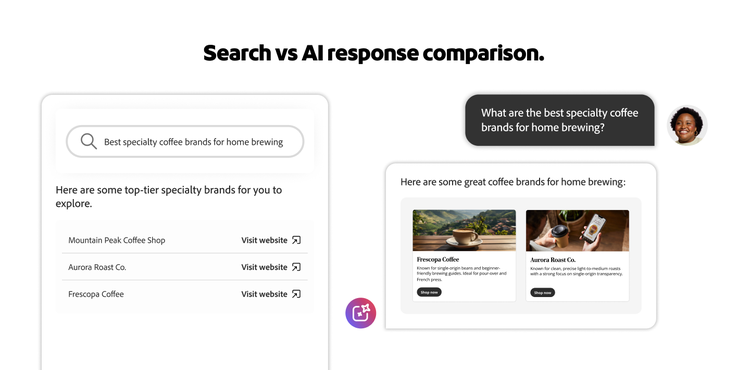
AI-driven discovery is changing how users search and decide. Queries are increasingly conversational and contextual, and many are resolved without a click. Instead of scanning links, users receive a single, synthesized answer, often with brand recommendations embedded within it.
This is called zero click search, and enterprises must prepare for it.AI interfaces now help users make decisions, compressing the traditional discovery journey into a single conversation. Visibility is no longer about appearing for keywords in search engines. It is about being included in the answers users look for.
For teams already exploring the impact of AI search on brand discovery, this new dynamic requires a broader lens. With little incentive for users to click and explore further, enterprises must focus on earning brand value through mentions, citations, and recommendations within AI outputs.
Where AI-driven discovery happens today.
AI-driven discovery now spans multiple environments, making it critical for businesses to think about visibility across AI surfaces.
These include:
- Chat-based assistants, such as ChatGPT, Gemini, Perplexity, and Claude.
- AI-enhanced search, including Google AI Overviews and Bing Copilot.
- Embedded AI agents within enterprise tools and SaaS platforms.
Each surface represents a new way brands can be introduced to users, where inclusion depends on how AI systems synthesize, interpret, and prioritize content.
What brand visibility means in AI search engines.
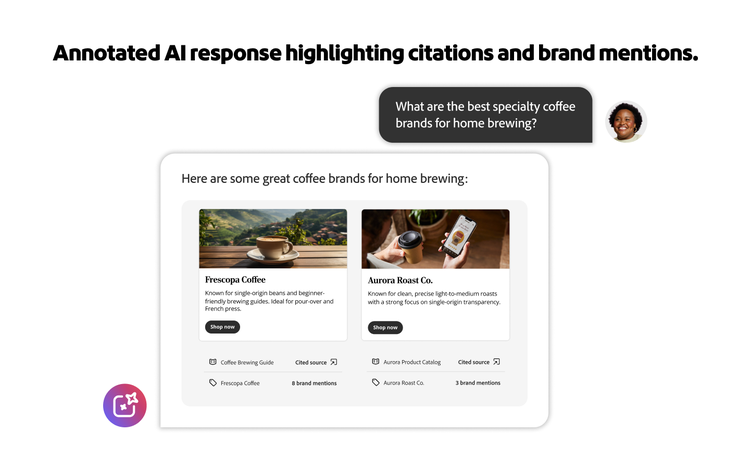
Brand visibility in LLMs and AI search engines is defined by three core signals:
- Being mentioned in direct responses, often without a link.
- Being cited as a source, typically through a URL.
- Being recommended in answers, especially within a list or comparison.
These signals appear across chat responses, search summaries, and embedded AI recommendations. For instance, when a user asks, “What are the best customer journey orchestration platforms?” AI systems may list three to five vendors. Brands included in that answer gain immediate visibility and authority.
Those excluded from these responses risk being left out of the user’s consideration set, regardless of their traditional search rankings. This creates a new concept of share of voice in AI responses. Instead of ranking positions, brands compete for inclusion within a limited set of recommendations.
How AI models decide which brands to recommend.
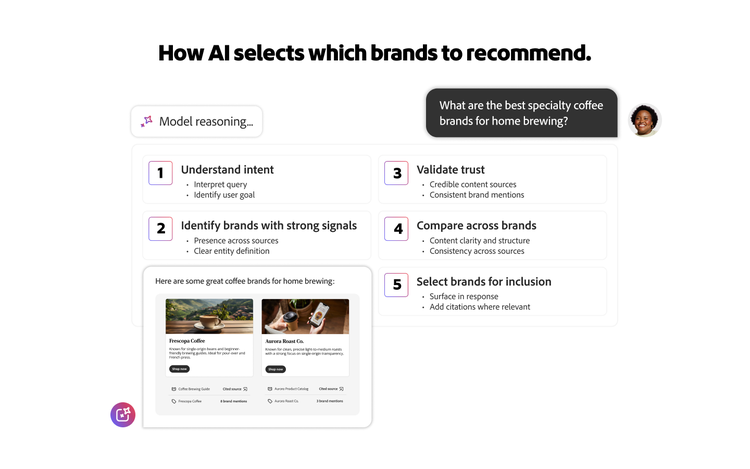
AI models do not rank content in the traditional sense but synthesize data from across the web ecosystem. AI systems select information based on confidence signals:
- Trust and authority signals from reliable sources like news sites and expert reviews. Example: When asked “what project management software options are there?” AI may cite Workfront as it is reviewed by Gartner, a reputable source.
- Entity clarity, based on how clearly your brand and offerings are defined. Example: A brand with a well-maintained Wikipedia entry, consistent schema markup, and brand mentions across authoritative publications gives AI a clear entity.
- Content structure and readability, which make information easier to extract. Example: a brand that publishes well-structured pages with clear headings, a strong narrative flow, FAQs, product descriptions, and schema markup that AI can easily extract.
- Source diversity and consensus, reinforcing credibility across multiple references. Example: A brand that consistently appears across analyst reports, review sites, news coverage, customer reviews, industry blogs, and even Wikipedia.
In practice, this means that AI systems typically favor content that is clear, consistent, and widely supported. They combine training data with real-time retrieval to generate answers.
For marketers already working with SEO and broader digital marketing strategies, this calls for a renewed approach. Instead of optimizing purely for rankings, teams need to focus on extractability, authority, and trust.
How brand visibility in AI search is measured and influenced.
Traditional SEO practices alone can’t capture brand visibility, reach, and discovery in AI-driven environments. Rankings on their own cannot show whether your brand is being surfaced, trusted, or recommended inside AI-generated answers.
To manage AI visibility effectively, teams need a measurement framework that reflects how LLMs evaluate and present information.
Core AI visibility metrics are:
Citation rate
Citation rate measures how often your content is referenced directly in AI-generated answers. A citation signals editorial trust, showing the model considers your content authoritative enough to support an answer.
Citation rate is influenced by how easily your content can be extracted and validated. Structured formats, schema markup, answer-first writing, and strong technical crawlability make it easier for AI systems to interpret, trust, and reuse your content.
Brand mentions
Brand mentions capture when your brand is named or included in an AI-generated response, even without a direct link. Mentions may be obvious or inferred, tagged or untagged, and often appear as part of synthesized responses that aggregate multiple sources.
They matter because they shape how AI systems associate your brand with specific topics. Consistent mentions reinforce identity and authority. Over time they help models understand what your brand stands for, and when it belongs in an answer. These signals are influenced by earned media, PR, community discussions, user-generated content, and broader content marketing efforts, including unlinked references across the web.
Share of voice (SoV) across prompts
Share of voice measures how often your brand appears relative to competitors when users ask category-level or problem-based questions. It reflects how visible your brand is within AI-generated answer sets, where inclusion is inherently limited.
AI responses surface a small set of brands, often in a short list or comparison. If your brand is not included in that group, it becomes invisible at a critical decision point. Share of voice is driven by citations, mentions, and broader authority signals, particularly for brands that consistently define category narratives and publish original, differentiated thought leadership content.
AI referral traffic
AI referral traffic measures visits coming from AI-driven platforms and interfaces. As AI becomes a primary method of discovery, this traffic is increasingly reshaping traditional search journeys.
Not every AI interaction results in a click, but referral traffic remains a critical downstream signal. It reflects when AI systems not only mention or cite your brand but also drive user action. This metric is influenced by both visibility and relevance, where strong citations, clear calls to action, and intent-aligned content increase the likelihood of engagement.
Together, these metrics provide a more complete view of how your brand performs across AI-driven discovery. They go beyond surface-level visibility and help teams understand how brands are interpreted, prioritized, and recommended by AI systems.
When Adobe implemented similar measures, the impact was visible quickly.
“When Adobe applied GEO discipline to Adobe.com, the results included a 5x increase in citations for Adobe Firefly, a 200% increase in LLM visibility, and a 41% increase in referral traffic from LLMs for our Acrobat pages — within weeks,”
Nathan Etter, Senior VP of Digital Marketing
Adobe
This outcome reinforces a key point. AI visibility is not abstract or speculative. It can be quantified, influenced, and improved when teams align content, authority, and measurement around the right signals.
5 mistakes enterprise brands make with AI search visibility.
Most challenges in AI visibility do not come from lack of effort, but from applying outdated assumptions to a fundamentally different system. Without a clear understanding of how AI models interpret, select, and present brands, teams often invest in the wrong areas, measure incomplete signals, or unintentionally disconnect visibility from business impact.
The most common mistakes include:
1. Treating AI visibility as an SEO side project.
AI visibility cuts across content, PR, analytics, and product marketing. Treating it as an extension of SEO limits its impact. At an enterprise level, it requires coordination across teams, systems, and workflows, with shared ownership of both content and measurement. Without that alignment, efforts remain fragmented and fail to deliver the scale and consistency needed for strong AI visibility.
2. Measuring only AI visibility metrics.
Tracking mentions without understanding the underlying causes can prevent teams from acting effectively. AI visibility metrics show what is happening, but not why it is happening. Without visibility into how AI crawlers access, read, and process content, teams cannot diagnose whether gaps in visibility stem from content structure, technical accessibility, or lack of authority.
3. Optimizing the wrong pages.
Pages that perform well in search are not always the ones accessed by AI systems. Optimization must reflect actual usage patterns across AI discovery. AI crawlers often surface deeper, structurally rich content rather than top-performing landing pages. Optimizing only for traditional search rankings misses a significant portion of AI visibility.
4. Publishing low-quality AI-generated content.
Content without original thinking or expertise is less likely to stand out as a credible source. Depth and credibility matter more than volume. AI systems tend to favor content that provides unique value, whether through proprietary insights, clear frameworks, or expert perspectives. Publishing a lot of generic content can dilute authority and reduce the likelihood of being cited or referenced.
5. Not connecting visibility to revenue.
Without clear attribution, AI visibility efforts struggle to justify investment. Linking metrics to outcomes is essential. Enterprise teams need to connect visibility signals such as mentions, citations, and share of voice to downstream impact, including traffic, branded search lift, and pipeline.
A 7-step GEO framework to improve AI search visibility.
Improving brand visibility in AI search is a continuous process that combines content structure, authority signals, and measurement best practices. The most effective approach is to treat it as a repeatable system and refine performance over time.
Follow this seven-step GEO framework to build, measure, and scale your brand visibility:
1. Assess your AI footprint.
Start by building a clear picture of how your brand currently appears in AI environments. On the output side, run a set of 20-50 buyer-intent prompts across platforms, such as ChatGPT, Perplexity, Claude, and Gemini. Track mentions, citations, sentiment, and competitor presence to understand how AI describes your brand.
On the input side, analyze how AI crawlers interact with your site through available logs or traffic signals. This reveals whether your content is accessible, crawlable, and structured in a way that AI systems can interpret. Together, these insights show how AI presents your brand and how effectively it can understand your content.
2. Structure content for users and crawlers.
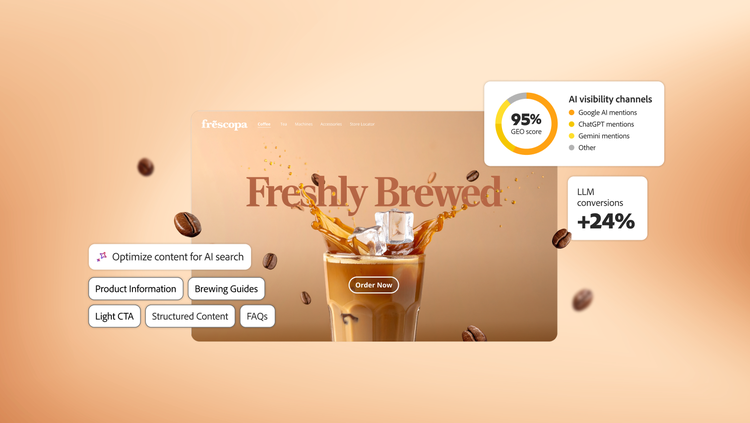
AI systems prioritize content that is easy to parse, validate, and reuse, demanding greater consistency in how content is written and organized. Instead of long, unstructured sections, write content to be clear, modular, and self-contained.
Use answer-first paragraphs under each section, followed by structured elements such as lists, tables, and definitions. Avoid hiding key content in tabs or interactive elements that may not be rendered by AI crawlers. These changes improve extraction accuracy and increase the likelihood of being cited in AI-generated responses.
3. Build entity authority through topical clusters.
Visibility in AI is driven by how clearly your brand is understood as an entity, not just how well you rank for individual keywords. This requires consistent, structured coverage of the topics that define your category.
Create dedicated pages for core concepts, products, and capabilities, and interlink them using clear, descriptive, and entity-rich anchor text. Reinforce semantic relationships between topics so that AI systems can map how your brand connects to specific areas of expertise. Over time, this builds a stronger, more coherent presence in AI-driven discovery.
4. Earn third-party citations on trusted sources.
AI models rely heavily on external validation to determine credibility. But not all sources carry equal weight. Industry publications, analyst reports, and recognized platforms are more likely to influence how your brand is surfaced in responses.
Focus on earning coverage in credible sources and contributing original insights that others reference. Proprietary research, unique data points, and well-defined frameworks often become repeated citation sources, strengthening both your authority and visibility.
5. Expand FAQ and conversational coverage.
AI interactions are driven by natural language. Your content should reflect the way users ask questions in the real world.
Develop FAQ sections that address specific buyer queries with concise, direct answers. Align phrasing with detailed prompts and update content regularly to reflect changing user behavior. This ensures your content remains relevant and increases the chances of being matched to conversational queries. While Google no longer supports FAQ Page Schema, FAQs are still valuable to include on pages.
6. Participate in trusted communities.
Your brand’s visibility is also shaped by signals outside your owned channels. AI systems draw from a wide ecosystem of sources, including community discussions and expert contributions. For instance, Reddit frequently appears in ChatGPT responses, especially for discussion-driven or recommendation-style questions.
Participate in professional forums, review platforms, and industry conversations with a focus on depth and usefulness. Credible contributions from subject matter experts build trust signals that AI systems recognize and incorporate into responses over time.
7. Measure, attribute, and close the loop.
AI visibility should be treated as part of your broader performance ecosystem, not a standalone effort. Tracking key signals such as mentions, citations, and share of voice is only the starting point.
The real value comes from connecting these signals to downstream outcomes such as referral traffic, branded search lift, and pipeline. Using integrated data capabilities, teams can align visibility metrics with business impact, turning AI discovery into a measurable and optimizable growth channel.
Scaling visibility across enterprise systems.
Improving and scaling AI visibility requires coordinated execution of GEO strategies across systems, teams, and workflows that shape how content is managed across the organization.
This level of coordination becomes possible when data is unified. Teams that lack a unified view of how their brand appears across AI surfaces will struggle to bring together visibility signals, content performance, and customer journey data into a single perspective.
Cross-functional collaboration and governance become equally critical for a coherent strategy. Marketing, SEO, product, and analytics teams all influence how the brand is represented in AI responses. Aligning workflows ensures that messaging and content structures remain consistent across touchpoints. Governance provides clear standards for how content is created, structured, and maintained at scale.
Enterprise growth teams can ensure alignment by bringing together data, content, and insights into a single framework using customer data orchestration solutions such as Adobe Experience Platform. This allows teams to scale optimization efforts with greater control and consistency across channels, and connect AI visibility to business outcomes.
Improving visibility in AI search.
AI is not replacing search. It is expanding it.
As conventions change, brands will depend upon clarity, authority, and consistent optimization for inclusion and visibility in AI search. It can be built over time through structured content, strong entity signals, and increased presence across both owned and third-party environments.
Teams that treat this as an ongoing practice rather than a one-time effort will be better positioned to sustain and scale their presence across rapidly evolving AI surfaces.
GEO provides a framework to do exactly that. It turns AI visibility from a passive outcome into an active strategy, enabling enterprise SEO and growth teams to measure what matters, optimize with intent, and continuously improve how their brand is surfaced and trusted across AI-driven discovery.
Take the next step and explore how to improve your AI brand visibility, or learn how to unify data and scale AI-driven experiences with Adobe Experience Platform.
Recommended for you
https://business.adobe.com/fragments/resources/cards/thank-you-collections/generative-ai