
Talking with OEMs, their technology partners, creative agencies, and content creators, a common scenario keeps coming up: A regional lead pulls up three versions of the same marketing hero image, each with its own unique errors. One may still be using an incentive that has expired. Another may be missing legal's disclosure copy. And one might even be error-free, though nobody's certain since each came from a different place: a shared drive, an agency email, a digital asset management (DAM) system no one recognizes.
That's the moment the content supply chain problem stops being theoretical and starts costing time and money. Blog 1, The driver’s seat: Unifying customer engagement in the automotive industry, covered the unified customer view that personalizes the journey. Content is where that insight and the goals that leadership has funded get practical: one approved asset needs to be turned into dozens of variants across trims, regions, dealers, and channels, and most teams are still building those manually.
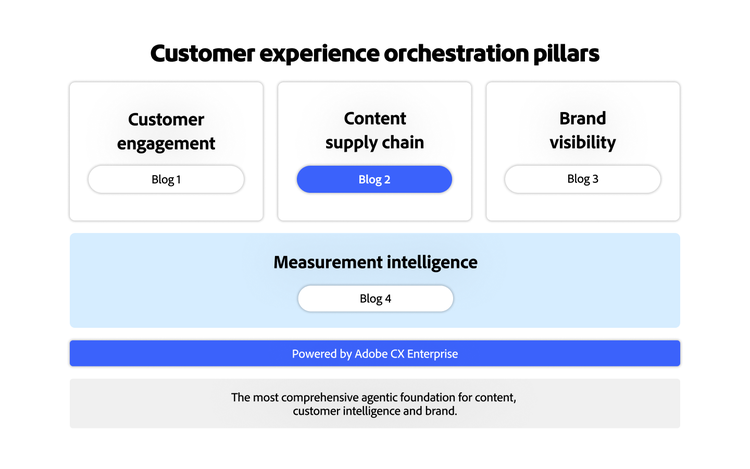
Adobe's automotive strategy is built on three pillars — customer engagement, content supply chain, and brand visibility — all powered by Adobe CX Enterprise. This four-part blog series explores each of these pillars in depth, and the data and insights that help marketers measure, optimize, and prove impact across all three:
- Blog 1 — The driver's seat: Unifying customer engagement in the automotive industry.
- Blog 2 — The driver's seat: Scaling marketing content in the automotive industry.
- Blog 3 — The driver's seat: Shaping brand visibility in the automotive industry.
- Blog 4 — The driver's seat: Proving marketing impact in the automotive industry.
Leadership goals decide what gets funded and passed down through markets, brands, and campaigns until they reach creative, delivery, and activation. A unified customer view shapes that work at every stage of the customer journey, from Shop and Buy to Own and Retain. This blog covers the foundation a content supply chain needs, the agentic layer that runs on top of it, and how people and AI agents can share workflows.
The content challenge is becoming an operating model challenge.
Research cited by Adobe and Deloitte found that 85% of marketers say they're under pressure to create assets and deliver campaigns more quickly (3 secrets to a streamlined content supply chain). That pressure isn’t automotive-specific, but the fragmentation described in this post is one of the biggest reasons it’s so hard to relieve. Multiple brands, business units, dealerships, online platforms, and partners each run their own tools and approval paths, so speed gained in one place stalls at the next handoff.
Transforming a content operation doesn't require replacing every DAM system, agency process, workflow, and tool at once. Start with one high-friction workflow: an asset library nobody can search, an approval process still running through email, or a high-volume set of dealer variants still built by hand. Connect it end to end, measure the result, then expand. That's the same principle behind the 60-day plan below.
Findability takes more than putting content in one place. Teams need to align on how content is organized, what it means, and the rules for using it. Experience Manager’s AI agents can help apply that shared understanding at scale so content from tagging and organizing to helping govern it. That’s what makes content usable by whoever needs it, whether a teammate or an AI agent.
VP, Strategy & Product, Adobe
An unmanaged content supply chain has a cost and a liability, even without a dollar figure attached.
Ask a regional or dealer team where their assets live and you rarely get one answer: the brand DAM system, a shared drive from the last agency, a file-sharing folder from ages ago. Without a shared workflow, requests to resize or localize an asset travel by email and messaging platforms with no tracked owner. Without a shared library, an approved hero image gets rebuilt from scratch by multiple teams that don't know if the other teams already have it with them. None of this is due to one bad decision, it's many small, reasonable ones, with no one responsible for the whole picture.
The lack of a centralized DAM system and process to manage it also carries liability. Automotive content travels farther than its usage rights. A model may be licensed for twelve months, an image for a specific market, or a photographer’s work for a particular campaign. But once that creative enters the content supply chain, it can spread across national campaigns, regional teams, dealer websites, social media posts, showroom displays, service-lane posters, brochures, and video.
The risk is real. Mercedes-Benz faced a copyright dispute after G-Class campaign photography in Detroit included protected murals in the background. Rights issues can exist even within seemingly ordinary vehicle photography. As automotive content gets cropped, resized, localized, and recomposed, those rights become harder to track. When a license expires or an asset needs to be withdrawn, the problem is not simply whether the brand has permission to use it. The problem is knowing everywhere it went.
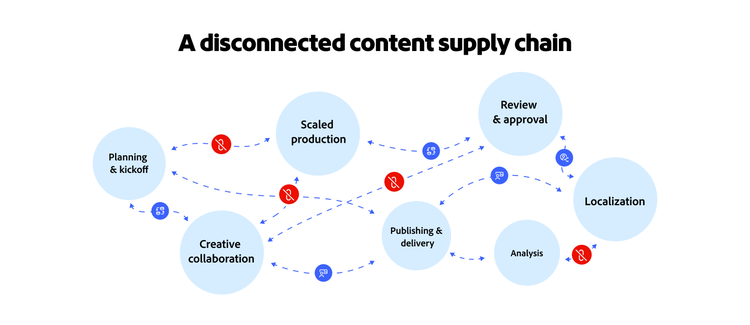
The OEM and dealer usually aren't on the same system, so an approved asset still has to be handed off and reformatted before a dealer can use it. This is the same identity gap from Blog 1, just showing up in content instead of data. Many OEMs also run this process through an outsourced agency with no direct visibility into it, and even a large, mature DAM system isn't exempt. An asset library with no connected workflow around it is still a silo, just a bigger one. Underneath it all is usually the simplest gap of all: No center of excellence owns the content supply chain end to end, and no centralized tool coordinates it, so even a well-intentioned process lives in someone's head rather than a system that enforces it.
Content fragmentation costs more the longer you ignore it.
An out-of-compliance ad is a legal exposure, not a copy error. A wrong price, a missing disclosure, or an expired incentive in a dealer ad can bring regulatory and legal scrutiny, forced corrections, and consumer claims. The OEM’s brand is on the asset, so the exposure lands there first.
For an OEM, the cost compounds first where content leaves its hands. The OEM owns the master asset and the brand guardrails, with agencies helping produce it. Dealers sit downstream, and many use their own agencies, so after a national launch asset is approved centrally, regional dealer groups and their agencies each rebuild the pricing, incentive, and legal copy for their market. Approved assets and guardrails have to travel with the file, and when they don't, the variants drift. Nobody at the OEM sees the drift until a compliance review, or a customer screenshot finds it.
Every new launch, model-year change, and incentive cycle repeats the rebuild and content volume grows with every trim, region, and channel, so the same fragmentation costs more each quarter. Each rebuilt variant also needs its own legal and compliance review, so the cost of rework and the waiting stacks up.
Waiting on approvals has a cost too. A creative director interviewed for a Forrester study commissioned by Adobe described it this way:
"If you're in EMEA, you would have to get your content reviewed and approved by a legal team or a quality risk management team. And that process can take days. So, you're no longer speaking [to your audience] in the moment; you're speaking three days after the moment."
Source: Forrester
Agentic workflows only work on a process you’ve already defined.
Marketers and agents can only act on assets they can find and requests they can track. So, every quarter the library stays fragmented is another quarter the content, review, and approval processes aren’t ready for agentic workflows. Regional teams keep rebuilding near-identical components because of a lack of shared visibility to spot the overlap. Each duplicate adds to the cleanup needed before an agent can safely reuse assets. Agents can catch easy errors and shorten the wait, but a person still makes the final approval, so that path must be mapped before automation scales it. OEMs that start with one high-friction workflow now will have the taxonomy, ownership, request tracking, and a defined approval path in place when agents are ready. OEMs that wait will need to do the same cleanup later, only with more content to clean.
How Adobe solves this.
The instinct is to patch this problem with another tool like a DAM system or a workflow tracker and each such fix just adds another disconnected system to the pile.
Adobe GenStudio brings together the foundational tools to build a connected content supply chain, including Adobe Workfront, Adobe Experience Manager Assets, and Frame.io for Business: one intake process, one asset library, one review trail everyone downstream can see.
Most OEMs we talk to are running a content management system (CMS), a DAM system, and a workflow tool that were onboarded separately, and the work of stitching them together falls to the OEM's own team. Each of those products may be able to do their jobs well. What they lack is one workflow, one asset record, and one review trail. Workfront, Experience Manager Assets, and Frame.io are built to provide that as a connected system.
“If you’re a brand within Volkswagen, your main concern is your identity. Each brand needs to be perceived completely differently, but the underlying tech stack can be harmonized.”
Stefan Imme
Head of Group Sales IT, Volkswagen Group
Volkswagen consolidated on a centralized platform it calls "One CMS," built on Adobe Experience Manager Sites, Experience Manager Assets, Adobe Analytics, and Adobe Target. The platform gives each brand content management, personalization, and analytics and is helping Volkswagen save costs, accelerate time to market, and deliver innovation to customers faster.
Adobe’s published findings illustrate the benefits of connected content workflows, reporting a 30% increase in project capacity and 70% shorter time to market with an end-to-end content supply chain solution, and a marketing company that increased on-time delivery to 98% after centralizing requests.
Those results depend on a standard taxonomy. Workfront can track a request, Experience Manager Assets can store the master asset (the approved source creative every regional and dealer variant derives from), Frame.io can log an approval, and GenStudio for Performance Marketing can generate variants. But the integrations only run smoothly, and data only moves cleanly between systems, when the people who manage the process agree on how trims, campaigns, and assets are defined. That agreement requires moving off spreadsheets, slide decks, and consumer file-sharing drives.
Most of the metadata behind that taxonomy should come from the process itself, not from people applying tags. It starts at strategic planning with the campaign, and each gate adds to it until the finished asset carries the full record of how it got there. That also means marketers can find work by the campaign name they already search for. Smart tags, the AI-driven metadata layer inside Experience Manager Assets, and image attributes supplement process metadata; they don’t replace it.
This also sets up what comes next. Agents need enterprise context and a system of record to make reliable decisions. Without them, they’re guessing. Taxonomy and metadata provide both: An agent can only reuse an asset it can find and act on a request it can track.
Intake and orchestration with Adobe Workfront.
Every request to localize, resize, or adapt an asset becomes a tracked work item instead of an email that eventually gets lost. Brand, regional, and dealer teams work from one shared queue, and that same queue extends to an outsourced agency or production partner, so a request stays just as visible whether that work is outsourced or in-house. That tracked request is also what an agent like CX Enterprise Coworker can act on later.
One proof point on the workflow side: an automotive aftermarket retailer running 4,200 retail stores and 7 websites reports a productivity increase of more than 50% with Workfront and fewer status meetings. The company says it is “only using half of Workfront’s capabilities” so far.
I’ve led brands in the CPG vertical and run marketing operations in the Financial Services vertical, but no matter the vertical, the foundation of the content supply chain is critical. If the workflows and associated metadata aren’t standardized and tracked centrally in a system of record and the approved content isn’t systematically tagged and stored centrally, it is very costly and slow to get campaigns launched quickly.
VP, Adobe GenStudio · Customer Experience Orchestration, Adobe
Adobe Experience Manager Assets as the single source of truth.
The approved master asset lives in one place with usage rights and brand guidelines tied to it through metadata and asset relationships. It’s supported by a folder structure and naming conventions so every team pulls from that record instead of a local copy that drifts out of date. Content Hub in Experience Manager Assets gives authorized dealers and agencies a curated, self-service view of approved assets, governed by configured access policies, without requiring them to use the full DAM system interface. That same asset record gives connected agents a source of approved content to discover and reuse.
With Experience Manager Assets, our marketers can find an asset in under five minutes, and this used to take two to eight hours.
Source: IDC
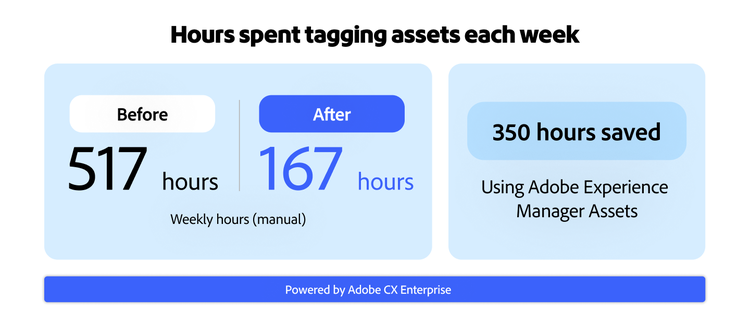
Adobe and IDC’s report, The Business Value of Adobe Experience Manager Assets, found that time spent tagging assets fell from 517 staff hours per week to 167 with Adobe Experience Manager Assets, an average saving of 350 staff hours per week. IDC also reported an average 58% efficiency improvement in tagging activities. That is a small, self-reported sample, and none of the organizations were automotive.
Reviews and approvals with Frame.io.
Video and campaign creative move through timestamped, frame-accurate review instead of a comment thread that disappears the moment the file gets renamed. The Workfront and Frame.io integration keeps projects, assets, and status synced across both, so the request and the review happen against the same record. Review stays a human decision, which makes it the approval gate for any agent-assisted work.
Variant generation with Adobe GenStudio for Performance Marketing.
Once an asset has approved status in Experience Manager Assets, GenStudio for Performance Marketing generates channel, market, and dealer-specific variants directly from it, using approved content and brand controls, replacing hand-rebuilt variants with a process that starts from one asset everyone agrees is correct.
Lenovo, a GenStudio for Performance Marketing beta customer, put a number on the volume problem. Tim Furlow, Lenovo's senior manager of ecommerce personalization, described a single campaign spanning 4 products, 8 marketing channels, 4 languages, and 3 variations, amounting to a total demand of 384 assets. Lenovo sees generative AI as an opportunity to meet that growing content demand by helping teams turn approved assets into finished, on-brand marketing content using templates across channels, audiences, and geographies.
Once the foundation is in place, the system can go agentic.
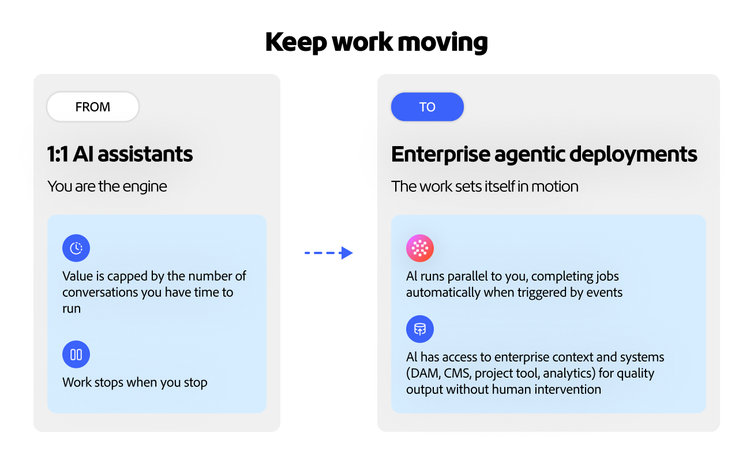
An agentic content supply chain is one where people and AI agents work together across the whole process, from planning through reporting. Agents take on the repetitive, time-intensive work, such as assembling variants and checking assets against brand rules, using the same context and brand understanding as the people they support. People stay in the lead: they set strategy and creative direction, make the judgment calls, and approve the work. The foundation above is what makes agent output reliable and trustworthy. For most OEMs, a sensible first use is generating variants from centrally approved assets for regional and dealer markets.
The shift is from an AI assistant that works prompt by prompt to agents that can respond to defined workflow events and carry out tasks in parallel with people. Connected to enterprise context and systems such as the DAM system and project management tools, agents can continue assigned work without someone prompting every step. That requires clear triggers, permissions, and handoffs, with people retaining oversight and approval.
An end-to-end content supply chain workflow, from planning to reporting, is supported by an agentic system, built from the bottom up. Starting with your agentic infrastructure, and building through brand intelligence, the agent ecosystem, and human-agent workflows to the agentic harness, a conversational interface where agentic work is executed. Each layer depends on the one below it, which is why the foundation comes first. The diagram below shows how the pieces fit together.
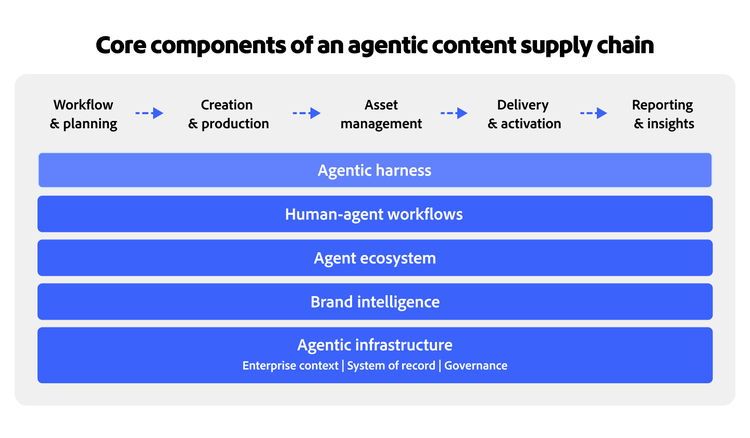
The foundation sections above covered the bottom layer: a system of record and governance, built from Workfront, Experience Manager Assets, and a standard taxonomy. That layer also holds the goals, brand guidelines, and approvals that leadership sets, so agents work from the same context people do. The next two sections cover the layers above it, starting with how people and agents share the work.
Human-agent workflows with Adobe CX Enterprise Coworker.
Once the foundation is in place, the next step is orchestrating work across people and agents. Workfront and Experience Manager Assets give an agent a request it can track and an asset it can find, which is the precondition for running human and agent workflows end to end instead of in separate tools. Adobe CX Enterprise Coworker is the conversational interface and agentic harness for that work, and it spans the Adobe pillars rather than sitting inside one product. Teams can also leverage AI Collaborators they’ve built in Workfront to execute tasks seamlessly within their workflow. Each handoff needs a defined completion signal back to Coworker so the workflow can continue when a person or agent finishes a task.
Production at scale with Adobe Firefly Creative Production for Enterprise and Adobe Brand Intelligence.
Firefly Creative Production for Enterprise and Brand Intelligence use AI to scale production while keeping content on brand. Central teams and agencies can create approved variants for regional and dealer markets, while dealers access and reuse content according to defined permissions. Central teams can also provide Adobe Express templates with locked brand elements, allowing regional and dealer teams to adapt permitted text and imagery for local use.
Most automotive brands are still in the early stages of agentic adoption, so this is a direction to build toward, not a requirement to get started.
A worked example: An OEM regional marketer asks Coworker for dealer-market variants of an approved launch asset. The request opens as a tracked item in Workfront, and an agent pulls the master file from Experience Manager Assets. For template-based adaptations, regional teams can use Adobe Express templates with locked brand elements or Dynamic Media templates built from layered Photoshop masters to produce localized versions. GenStudio for Performance Marketing then can also help create and optimize channel- and market-specific variants using approved content and brand controls, and a person reviews them in Frame.io before anything is published. Agents handle the repetitive production. People keep the approval.
Producing variants faster doesn't tell you which ones work, that's a measurement question, and it's where Content Analytics within Customer Journey Analytics picks up: once a connected supply chain is producing at this pace, Content Analytics shows which trim, region, and channel version is actually driving engagement, the same identity gap from Blog 1, approached from the content side. Blog 4 covers that in depth.
Your 60-day plan.
Now that we’ve outlined the challenges and solutions, here are Adobe’s recommended next steps.
Not every OEM starts in the same place. The diagram below shows four common starting points for an agentic content supply chain.
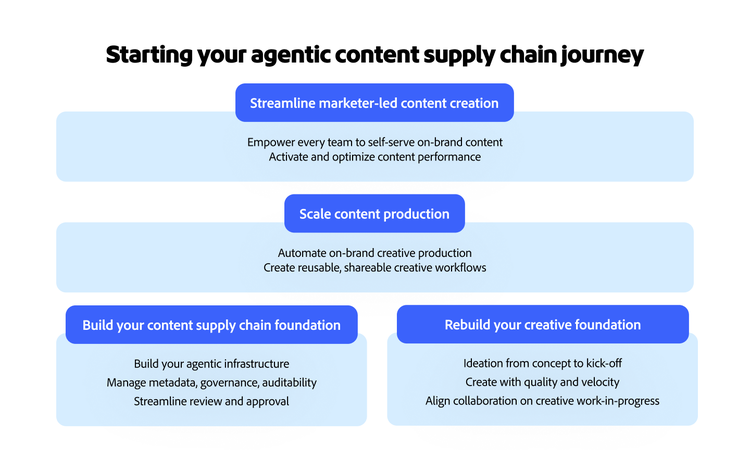
Step 1: Choose one campaign and define how the work should move from request through production, approval, and delivery. Identify owners, required inputs, and handoffs, and record current turnaround times, effort, and rework.
Step 2: Establish a shared marketing system of record, with Workfront tracking the work and AEM Assets maintaining the approved content. Agree on required metadata, naming conventions, usage rights, and access permissions.
Step 3: Run the campaign through that human-defined process, using Frame.io for creative reviews and approvals. Fix missing information and unclear handoffs before automating them.
Step 4: Automate one repeatable task, such as producing standard crops with Dynamic Media or adapting approved templates in Adobe Express for local markets. Compare quality, review effort, and cost with the manual approach, and refine where needed.
Step 5: If the process and data are ready, test one narrowly defined AI or agent role. Specify its inputs, permitted actions, human review requirements, and the signal that returns completed work to the workflow. Measure errors, exceptions, and total cost.
Step 6: Review each agent’s accuracy, error rate, review effort, and total cost against the human process. Refine its role, use a lower-cost model, or return the task to a person where that delivers better results. Build the business case from measured improvements and expand agent responsibilities only where the evidence supports it.
What's next?
Blog 3, Shaping brand visibility in the automotive industry, covers brand visibility. Customers increasingly research vehicles on AI platforms rather than your site, and Adobe Brand Visibility helps ensure your brand is found and represented correctly when they ask.
Blog 4, Proving marketing impact in the automotive industry, shows how Adobe Experience Platform Web SDK, Customer Journey Analytics, including Content Analytics, and Data Mirror connect online behavior with offline sales and dealer data, including which content variants from this post actually moved the needle.
Why work with Adobe's automotive practice?
OEM teams commonly describe the same problem: the approved asset exists, but nobody can tell which of several storage systems holds it. The conversation gets easier once Workfront, Experience Manager Assets, and Frame.io are treated as one connected system instead of three separate procurement decisions. Adobe’s automotive practice supports that conversation with three roles working together:
An industry strategist who works on automotive full-time, not one vertical among several.
An integrated services architect who has implemented Workfront, Experience Manager Assets, and Frame.io inside OEM environments, not just presented a reference architecture.
An enterprise architect who stays on the account through implementation, rather than handing off to services once the contract is signed.
Explore Adobe's State of Customer Experience in Automotive in an AI-Driven World report for more on the data and content gaps described in this series.
Recommended for you
https://business.adobe.com/fragments/resources/cards/thank-you-collections/automotive-mobility