Connected Customer Engagement in the Automotive Industry
The driver’s seat: Unifying engagement in the automotive industry.
Greg Paul
09-22-2026
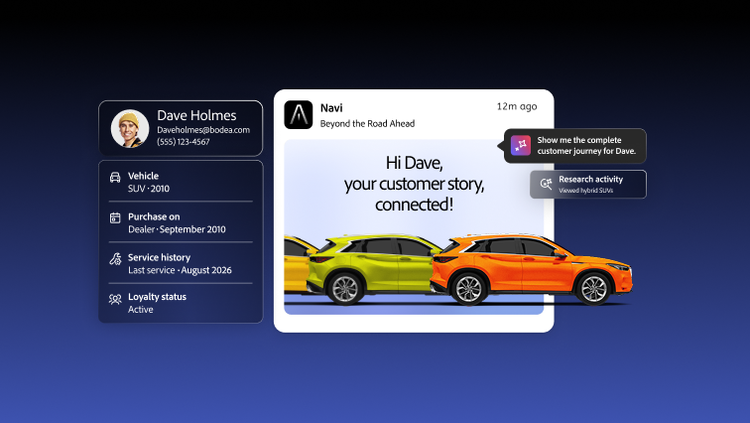
I’ve noticed a pattern across several OEMs I work with. Connecting with customers and prospects, and staying connected across the full buying experience, is a consistent industry challenge. The data needed to act on this exists, it’s just scattered across multiple systems which were never designed to work together.
The OEM has website behavior, app activity, and vehicle telemetry. The dealer has the transaction, the service history, and a rich set of data for their customers. And somewhere between those two organizations, the customer disappears. Nobody connects the journey. Your best customer is shopping for their next vehicle right now. You don’t know who they are. Neither does your dealer.
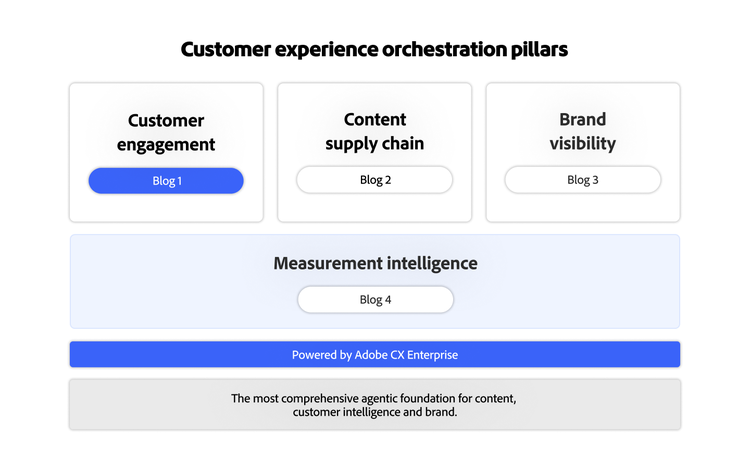
Adobe’s automotive strategy is built on three pillars — customer engagement, content supply chain, and brand visibility — all powered by Adobe CX Enterprise.
This four-part blog series explores each of these pillars in depth, and the data and insights that help marketers measure, optimize, and prove impact across all three:
Blog 1 — The driver’s seat: Unifying customer engagement in the automotive industry.
Blog 2 — The driver's seat: Scaling marketing content in the automotive industry.
Blog 3 — The driver's seat: Shaping brand visibility in the automotive industry.
Blog 4 — The driver’s seat: Proving marketing impact in the automotive industry.
The first step to delivering exceptional content and building brand visibility is understanding your customer. This starts with customer engagement: connecting the signals a customer generates across the buying and ownership journey to create a more complete, actionable view of who they are and what they need.
That unified customer understanding creates the foundation for more relevant, connected experiences at each stage of the automotive journey, from Shop and Buy to Own and Retain.
Key findings from Adobe industry research.
Adobe partnered with Incisiv to survey 560 automotive executives across nine global markets. The findings, published by Jon Beebe, Adobe’s Industry Strategy Leader for Automotive, were: only 3% of the Shop, Buy, and Own journey is personalized. Only 4% of organizations have a fully integrated customer profile, and as many as 57% cite data silos as their biggest transformation barrier.
“The data foundation isn’t just a tech problem. It’s a business problem with a technology solution. OEMs that close the personalization gap in the next 24 months will structurally disadvantage every competitor that doesn’t.”
Jon Beebe
Industry Strategy Leader, Automotive, Adobe
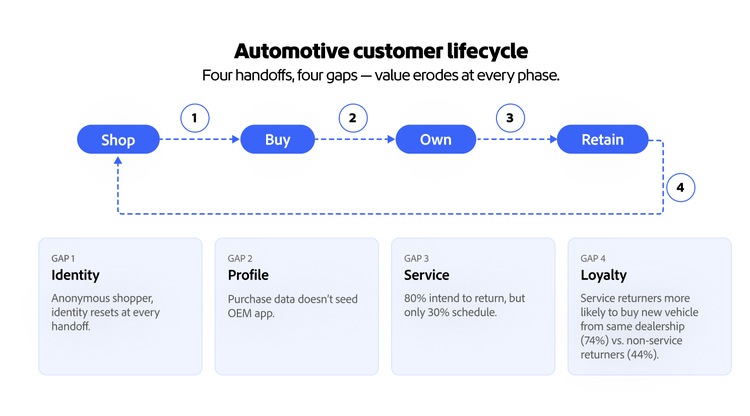
The automotive customer experience has four phases — Shop, Buy, Own, and Retain — and at each phase, the experience becomes more fragmented. This blog maps every gap to the Adobe capability that closes it. Most of those capabilities are already licensed by original equipment manufacturers (OEMs).
Here's what we'll answer for each phase:
Shop: Why 95% of your site traffic is invisible.
Buy: Where the OEM's systems lose the thread before a dealer is even involved.
Own: How to bridge the US$12,000 gap between service intent and service scheduling.
Retain: How to turn your best owners into your cheapest acquisition channel.
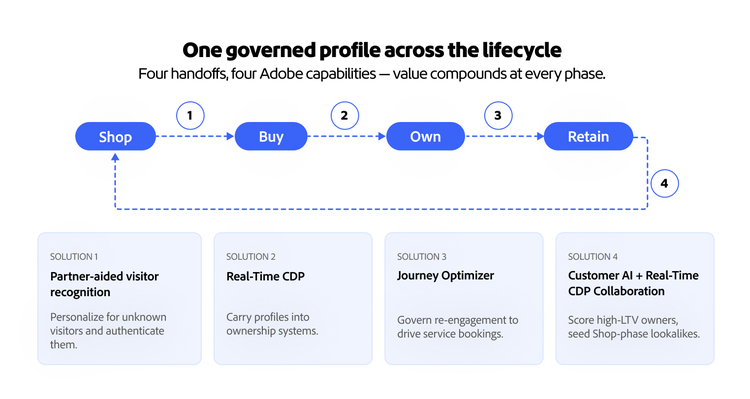
As highlighted in the solutions image, customer identity resets at the Shop-to-Buy handoff. In reality, however, the reset often happens much earlier, within the Shop phase itself, whenever a shopper switches devices. A customer may begin researching on a smartphone and later continue the journey using a Build and Price tool on a laptop. Although the intent and individual remain the same, each interaction is typically captured as a separate profile, creating disconnected customer records long before the buyer reaches the Buy phase.
This reset is invisible and relatively inexpensive to miss. However, the gap between the Own and Retain phases is hard to miss, as it amounts to US$12,000.
Service retention is the single biggest repurchase driver in the industry.
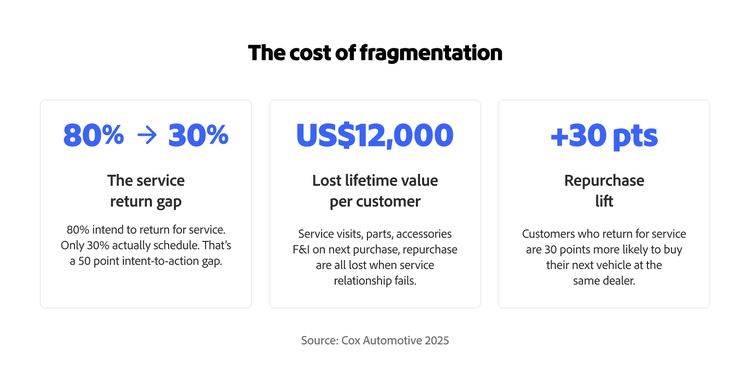
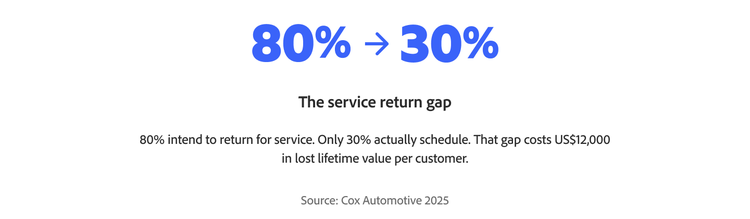
Among customers who just bought a vehicle, 8 out of 10 plan to return to that same dealer for service. However, only three actually schedule the service appointment. The dealer doesn’t know the customer is drifting, and the OEM can’t see it. Most OEMs do send some form of communication — a generic first-service reminder if the dealer passed the registration back. But it's usually the same message, whether it’s the customer’s first vehicle or their fourth, and it doesn't adapt as the window closes.
The US$12,000 loss isn’t due to one missed oil change. It’s the compounding loss when the service relationship breaks: service visits, parts purchases, the financing and insurance (F&I) opportunity on the next vehicle, and potentially the next vehicle sale itself. Multiply that across your customer base, and you’re looking at a billion-dollar opportunity among customers you already know, but aren’t effectively engaging.
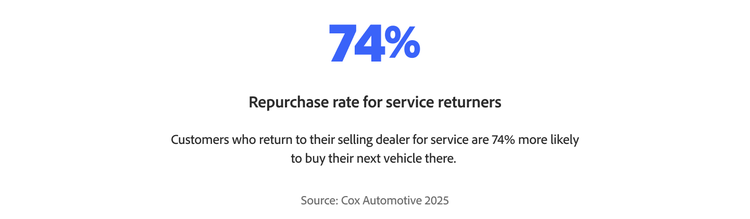
Customers who return to the dealership for service are much more likely to return when it’s time for their next vehicle. Cox Automotive found that 74% of customers who returned to the dealership for service said they were likely to buy their next vehicle from the same dealer. Among customers who did not return for service, that number was just 44%. That’s a 30-point difference. The service relationship isn’t just about the next oil change. It can help determine whether that customer comes back for their next vehicle.
How Adobe solves this.
Challenges arise because segmentation is still built on a patchwork of legacy tools — third-party data systems, data lakes, data management platforms (DMPs), CRM platforms, and email marketing tools that were never designed to share a profile. Some OEMs have already licensed Adobe Experience Platform, but could do so much more with it by connecting what they own to what it can do.
Legacy tools such as DMPs, data lakes, and standalone CRM segmentation tools were built for a different era, when customer data was cookie-based, processed in batches, and each system maintained a different view of the customer.
Here's why that matters: most vendors will tell you to fix this with another point solution — a customer data platform (CDP) here, journey orchestration over there, and analytics elsewhere — leaving your IT team to build and maintain the integrations between them. Adobe Real-Time CDP, Adobe Journey Optimizer, and Adobe Customer Journey Analytics run on the same customer profile, loaded once, not once per tool. This profile is the shared foundation for segmentation, decisioning, activation, and measurement. That's the difference between assembling a stack and running on a platform.
It’s not just an incremental upgrade, but a fundamentally different way of knowing who your customer is and reaching them before they drift away.
Dealer data is sensitive for a reason. It represents the dealer's customer relationship, operating model, and P&L. The goal is not to force dealers to surrender their DMS or lose control of their data. Any architecture that starts there won't get dealer buy-in. The better approach is signal-based collaboration: each side keeps its own data in its own environment, agrees on a shared identifier such as a hashed email, and gets back only an aggregate overlap — which of your shoppers already show up in your service records or which of your service customers match a high-intent buyer signal — never the underlying customer list itself. That's the difference between asking a dealer to hand over their DMS and asking them to run a match. Adobe Real-Time CDP Collaboration runs on the same clean-room mechanism Adobe already uses for brand-to-brand data collaboration. The architecture is agnostic to whether the two parties are two media brands or a manufacturer and its dealer network. The match-and-aggregate pattern works the same way.
None of this pays off without proof. Every phase covered in this blog produces a data point — but if you can't tie it to a repurchase, a service visit, or a retained customer, it's an assumption, not an outcome. In a margin environment where tariffs are already squeezing every dollar, “we improved engagement” isn't a budget defense. The companion piece to this series covers how Customer Journey Analytics and Data Mirror in Adobe Experience Platform connect engagement to business outcomes, so OEMs can see what’s working, what isn’t, and what’s actually driving value.
The four phases show exactly where the data gaps are across the Shop, Buy, Own, and Retain stages — and which Adobe capabilities close each one. If you’re already invested in Adobe, most of what you need is closer than you think.
Phase 1 — Shop
The purchase starts well before a customer ever visits your website. In addition to research tools such as Edmunds, Cars.com, YouTube, Autotrader, KBB, and Reddit, customers are increasingly using LLMs to research and aren’t visiting OEM properties at all.
Customers are asking ChatGPT, Perplexity, and Claude to compare trims and recommend a vehicle outright, getting answers without a single visit to a brand site.
McKinsey’s 2025 research found that a brand’s own website accounts for just 5–10% of what AI search draws from to generate an answer — the rest comes from publishers, forums, and third-party content the OEM doesn’t control.
Customers have already shortlisted models and formed opinions by the time they land on your site, following which, less than 5% will authenticate their information. The rest are invisible. You may end up investing heavily in media to drive a journey that doesn’t give you sufficient visibility or control.
At the same time, shoppers may also be researching topics such as how much they can sell their car for, trade-in values, similar sales, crash tests, reliability, total cost of ownership, and JD Power ratings. And all these third-party sites for new and used car comparisons have identity switches — each causing disconnected data points and incomplete profiles.
“For 20 years, digital strategy assumed the OEM website was the destination for customers to complete their buying journey. AI is breaking this. Customers now compare trims, narrow down options, and form preferences on LLM platforms based on what those systems synthesize from a brand's owned properties and the broader ecosystem. It changes a website's job: make the brand legible to AI, then give a more informed customer or agent a reason to go deeper, act, and return. When they do arrive, the direct channel is where anonymous intent has the chance to become a known relationship. Identity tools can then help brands build customer understanding and deepen that relationship.”
Loni Stark
VP, Strategy & Product, Adobe
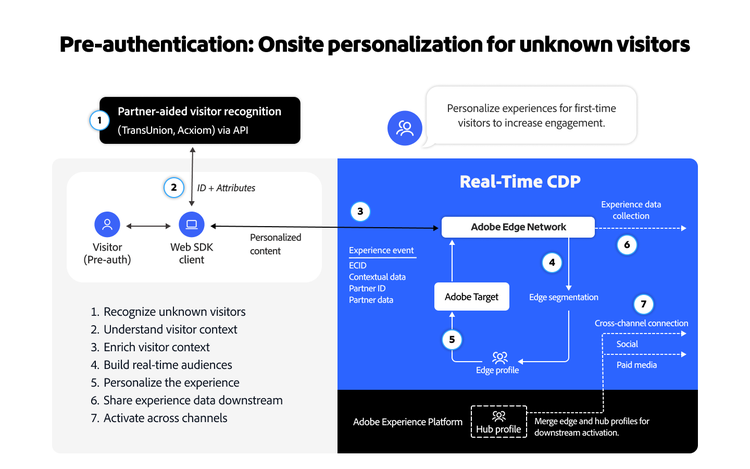
The immediate task at hand when a customer lands on your site is personalizing the page for anonymous visitors using partner-aided visitor recognition.
Partner-aided visitor recognition and Real-Time CDP for personalization.
Partner-aided visitor recognition solves the anonymous prospect problem. The OEM licenses real-time recognition from a data partner — TransUnion, Acxiom, or a similar service provider. When an unknown visitor lands on the OEM site, the Adobe Experience Platform Web SDK calls the partner API, which probabilistically recognizes the visitor and returns a partner ID and attributes. Real-Time CDP evaluates that signal at the edge using a dedicated partner namespace — keeping probabilistic identity clean and separate from first-party profiles — and Adobe Target, paid media, and social channels deliver a personalized experience before the visitor bounces. An anonymous visitor becomes a recognized prospect you can engage in real time.
Adobe Experience Platform Web SDK collects behavioral signals in real time across your website and mobile app. Adobe Real-Time CDP builds a unified profile from those signals, anonymous or known, and whether online or offline, and evaluates audiences at the edge before a page even finishes loading. That’s the foundation on which everything else runs.
Partner-aided visitor recognition is great for anonymous, on-site visitor personalization. However, it doesn’t create a visit that never happens. That’s a brand visibility problem, not an identity one. In the Blog 3 of the series, we go deeper into our latest product release, Adobe Brand Visibility, which incorporates capabilities from both Adobe LLM Optimizer and Semrush to help close that gap.
Phase 2 — Buy
By the time a customer is ready to buy, they've already spent some time comparing trims and narrowing down options elsewhere. When they land on an OEM site to get specific answers related to pricing, financing, and actual stock, among others, they touch at least three separate OEM-owned systems: a build-and-price configurator, a financing pre-qualification form, and a dealer-locator lead form. On top of that, the customer often has to navigate a similar journey on the dealer's own site: build-and-price tools, financing checks, and browsing inventory or location-specific deals.
This is a dealer problem too, not just an OEM one. Customers configure vehicles, check financing, and search inventory across both OEM and dealer sites, so the identity gap spans both sides of the relationship. But even before dealer systems enter the equation, the customer thread is already broken across the OEM’s own systems.
A customer builds a vehicle on the OEM site. Financing sits behind a separate login. The lead that reaches the dealer often carries no build context. Real-Time CDP connects data from these disparate OEM-owned touchpoints into a single profile the moment a real identifier appears — an email address on the financing form, a phone number on the lead form, or a CRM ID when a customer logs in.
Even though an email address is a fantastic identifier for confirming identity with third-party partners, shoppers may be reluctant to share their phone or email ID until later in the process, so OEMs and dealers need a reason for them to raise their hand earlier: save the build, unlock payment options, or compare accessories.
This simple value exchange gives the customer a reason to share an email address or phone number and signals to the OEM the context needed to carry into the next phase. This also helps with building a richer profile for downstream systems, including customer journey analysis, audience retargeting, and 1:1 journey orchestration.
Identity stitching at purchase.
Adobe Real-Time CDP doesn’t manufacture identity. It stitches the profile the moment a real identifier — email ID, phone number, or CRM ID — appears on the build-and-price, financing, or dealer-locator system. Capturing that identifier is the OEM's job. Unifying it into one profile and triggering Adobe Journey Optimizer to send the one message that matters before the session goes cold is where Real-Time CDP comes in. This closes the identity gap across an OEM's own systems, wherever a reliable identifier has been captured.
The signal doesn't just get stored, it’s acted upon. Once Real-Time CDP has stitched the identifier, something has to decide what happens next — which message, which offer, or which channel — and that decision has to be made in real time, not in the next scheduled send. That's a different job than identity resolution. Real-Time CDP tells you who the customer is. Something else has to tell you what to do about it in the moment.
Experience decisioning with Adobe Journey Optimizer.
Decisioning reads the same unified profile that Real-Time CDP just built and arbitrates across every eligible offer in real time. Not “send this message” but “of the 12 things we could say right now, which one wins.” When the customer re-engages, Journey Optimizer doesn't resume a static journey step. It recalculates the best action against the profile’s current state. This turns the unified profile from a record into a decision engine.
Phase 3 — Own
A familiar problem is that OEMs have telemetry and apps, while dealers have service history — and neither has the full picture. But the bigger problem starts before that data ever needs to cross the OEM-dealer divide. Even OEMs with large, connected fleets or cars typically see active subscribers running well below half that number. The signals exist in the vehicle, but they don’t make it into the customer profile when subscription and app engagement lapse.
Many systems touch the customer during ownership — the website, dealer DMS data, owner app, loyalty program, financing system, in-vehicle data (telemetry data can be separate from entertainment data), even the second key fob — and none of them share memory. Vehicle telemetry fails to enrich the customer profile even after two years of ownership.
Governance can't be an afterthought here. Telemetry only earns trust if the owner has knowingly opted in and understands what they will get in return — a warning before a battery fails in the cold, a heads-up before a tire failure, or a reminder for an oil change. Proper data collection and informed consent are critical components of a foundational architecture. Organizations should also incentivize customers to opt in to sharing their data for notifications and warnings.
Adobe Journey Optimizer for customer journey orchestration.
For ownership journeys, building the unified profile takes the same move as Phase 2. Real-Time CDP consolidates telemetry, app engagement, and subscription status into one profile once a real identifier ties them together. No dealer records involved, just what the OEM already owns.
Adobe Journey Optimizer is the orchestration layer that’s built natively on Adobe Experience Platform profiles. Journeys fire two ways. The first is a live signal in the moment, such as a telemetry alert, an app login, or a subscription cancellation. The second is when a customer moves into a new audience, as customer and vehicle data change.
Once the trigger fires, Journey Optimizer runs the coordinated journey across email, SMS, push notifications, and the app. For most owners, the trigger is disengagement: a lapsed app login or an expired subscription. Overdue service is less common. The goal is re-engagement, not batch emails. The message knows the vehicle, the mileage, the service history, and the right moment to send.
Phase 4 — Retain
Your best customers are your best media asset. The loyal owner is the most valuable person in your ecosystem. And most OEMs aren’t systematically building that relationship. They’re leaving their best Shop-phase asset unused.
Customer AI + lookalike audiences in Real-Time CDP.
Customer AI scores your owner base for repurchase likelihood, defection risk, and upsell potential. Your highest-LTV owners become the seed audience for net-new prospect targeting on Meta, Google, YouTube, Instagram, and LinkedIn. This is the loop that closes the lifecycle: Retain-phase owner data powers Shop-phase media efficiency.
Real-Time CDP Collaboration identifies shared audiences with media partners.
Your owner database is overlaid against media partners to help you understand what your best customers watch, so you can activate that insight before you spend a dollar. The OEM that runs this loop will likely outperform on cost per acquisition.
Your 90-day plan.
Adobe research found that 62% of automotive organizations feel ready for campaign planning, but only 20% can support full-journey orchestration. That gap reflects weaknesses in the underlying data foundation. Here’s how to approach closing it in 90 days without ripping out what you already have.
Step 1: Lay the foundation with Web SDK.
If you’re still running legacy tags, that’s the first thing to plan for and address. Web SDK is the foundation for modernizing your data collection. It opens the door to real-time, telemetry-based journeys — partner-aided visitor recognition, Real-Time CDP Collaboration, Customer AI, and the threshold-based triggers in Journey Optimizer described in Phase 3. You can't build a real-time profile on batch data.
Make standardizing data collection across web, mobile, and app a key initiative.
Step 2: Engage more with your known customers.
You already have known customers today — people who've shared an email ID or phone number through a build-and-price form, a financing application, or your CRM — whether or not the web SDK is live yet. Build a simple Journey Optimizer email and SMS sequence for that list: a build reminder, a financing follow-up, and an incentive nudge. It's a fast, parallel win that doesn't depend on the web SDK rollout and lets you validate Journey Optimizer before you tackle anything telemetry-related in Step 3.
Step 3: Pick one trigger in the Own phase.
Service-overdue notifications based on vehicle telemetry are one of the easiest wins. Build a Journey Optimizer pathway that uses email, SMS, or push notifications and is triggered when mileage or time since last service crosses a threshold. Measure the lift in service scheduling at 30, 60, and 90 days. This increase is usually sufficient to fund the next set of use cases without requesting additional budget.
Step 4: Run one Real-Time CDP Collaboration overlap.
Pick one media partner your customers already spend time with, such as a sports league, a streaming platform, or a publisher. Run the audience overlap analysis, but don't stop at interests.
Interests tell you what your best owners like. Behaviors tell you who's ready to act.
Are they reading about EV powertrains or drifting back to ICE vehicles? Researching fuel economy? Willing to fill out a lead form with more than an email address? That's the difference between an audience that looks like your best customers and one that's actually in market. Use it to brief your next media buy. That's how Retain becomes Shop.
Step 5: Mirror one OEM signal that proves Step 3 worked.
You don't need dealer data to defend this pilot in a budget review. This blog has already flagged the identity break at the dealership door as a separate, harder problem, and Step 5 shouldn't quietly assume it's solved. You need one number from the data you already own. Mirror your owner-app engagement data — a “schedule service” tap, an app open, a dealer-locator click — into Adobe Customer Journey Analytics via Data Mirror, join it against the Journey Optimizer trigger from Step 3, and you have row-level proof the message drove an OEM-side action. It's a proxy for the appointment, not the appointment record itself, but it's proof you can generate today, without waiting on dealer data-sharing to get solved.
Proving one trigger worked this way is different from proving the whole lifecycle worked, including what happens once the customer reaches the dealer. Full cross-channel attribution — dealer DMS, sales data, warehouse-triggered activation — requires the kind of controlled dealer cooperation this blog scoped out of Phase 2, and it's the subject of the fourth blog in the series.
Most OEMs systematically rebuild the customer profile at each phase transition: Shop to Buy, Buy to Own, and Own to Retain. Each rebuild throws away what the phase before it knew. The required data already exists within your ecosystem, the challenge is deploying an architecture that preserves continuity across every handoff.
What’s next?
Blog 2, Scaling marketing content in the automotive industry, focuses on the content supply chain. Once you know who your customer is, the next problem is producing content at the speed and scale required to engage them effectively. Adobe Workfront, Adobe Experience Manager Assets, Adobe Experience Manager Sites, and Adobe GenStudio turn one approved asset into every variant a launch needs — without five teams rebuilding it manually.
Blog 3, Shaping brand visibility in the automotive industry, focuses on brand visibility. Customers increasingly research vehicles on AI platforms rather than on your site. Adobe Brand Visibility ensures your brand is found and represented correctly when they ask.
Blog 4, Proving marketing impact in the automotive industry shows how Adobe Experience Platform Web SDK, Customer Journey Analytics, and Data Mirror connect online behaviors with offline sales, dealer service, and enterprise data. Automotive marketers see the full lifecycle, prove what drives revenue and loyalty, and invest with confidence.
Why work with Adobe’s automotive practice?
The usual market approach is to show up with a demo and a case study from a different industry. That's not what closes a gap like this — and it's not just a staffing difference, it's an architectural one.
Every phase explained in this blog runs on the same customer profile — the identity stitched at purchase, the segment that triggers a service reminder, the audience built from your own owner base — because Adobe Real-Time CDP, Adobe Journey Optimizer, and Adobe Customer Journey Analytics are part of one platform, not three separate solutions someone had to integrate. Most partners working with automotive firms are still focused on assembling that stack for you. Adobe, on the other hand, delivers a unified platform out of the box.
If the first half is the architecture, the team is the other half. Adobe's automotive practice puts three things in the same room that usually aren't:
An industry strategist who works on automotive full-time, not one vertical among several.
An integrated services architect who has implemented Real-Time CDP, Journey Optimizer, and Customer Journey Analytics inside OEM environments, not just presented a reference architecture.
An enterprise architect who stays on the account through implementation, rather than handing off to services once the contract is signed.
Traditional service providers give you one of these: industry depth, hands-on build experience, or continuity through delivery. You would rarely get all three on the same account. This practice puts all three in the room.