Improving marketing impact with Customer Journey Analytics
Consumers today are flooded with messages from email, SMS, apps, the web and social media. But despite improvements in marketing analytics, most of these messages still fall short. They’re too broad, too frequent or too disconnected from what customers actually care about. In this report, you’ll learn what frustrates consumers most, where brands lose trust and how customer journey analytics helps teams deliver relevance at scale.
We surveyed over 1,000 U.S. consumers to understand the true impact of these problems on daily life, brand trust and purchase behaviour. The results reveal a simple truth. Marketing isn’t failing because brands communicate too much — it's failing because too many messages lack relevance.
Modern customer analytics, behavioural analytics and real-time insights are now essential for delivering experiences customers actually want. And that’s where Customer Journey Analytics plays a transformative role. Keep reading to learn how you can use Customer Journey Analytics to solve this problem and unlock the insights needed to deliver personalised, high-impact experiences at scale.
Key findings: How irrelevant marketing impacts consumers and conversions.
- Our survey revealed how irrelevant marketing erodes trust and how analytics fixes it:
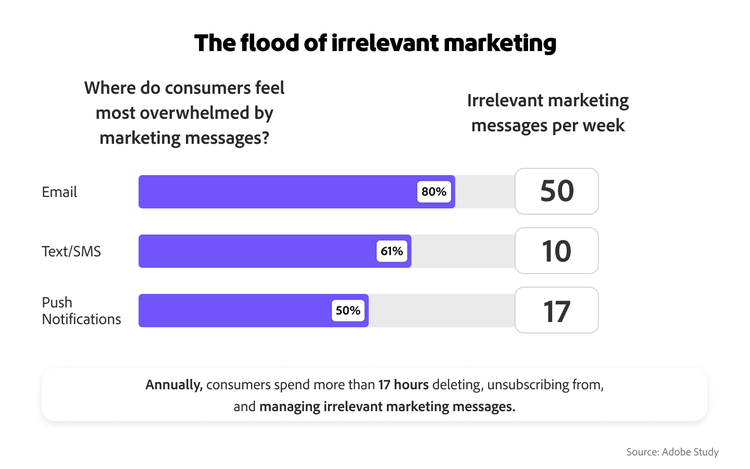
- Americans spend over 17 hours annually managing irrelevant marketing messages.
- Over four in five shoppers (80%) say they feel overwhelmed by marketing messages they receive via email, an estimated 50 messages weekly.
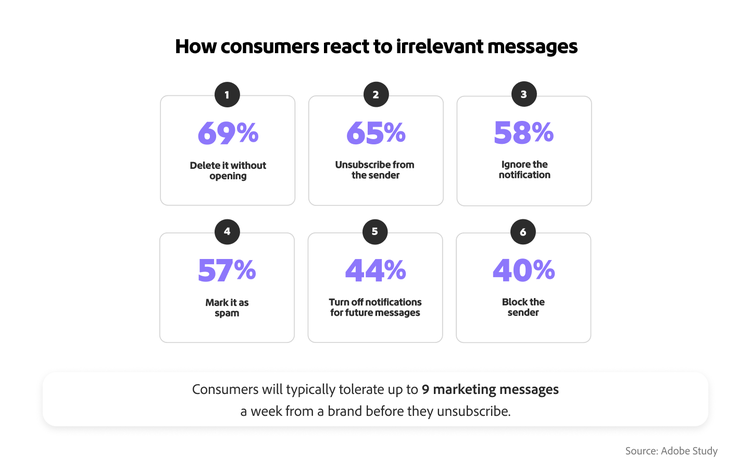
- The unsubscribe tipping point for most consumers is nine marketing messages a week.
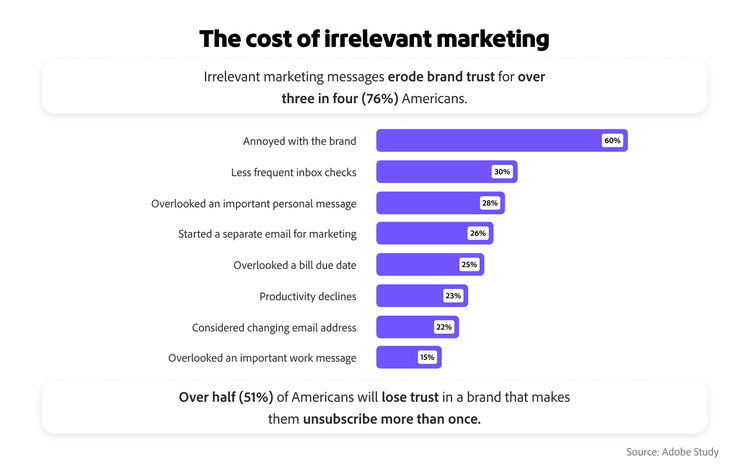
- Irrelevant marketing messages erode brand trust for over three in four (76%) Americans.
- A flooded inbox has led to one in four Americans missing a bill due date.
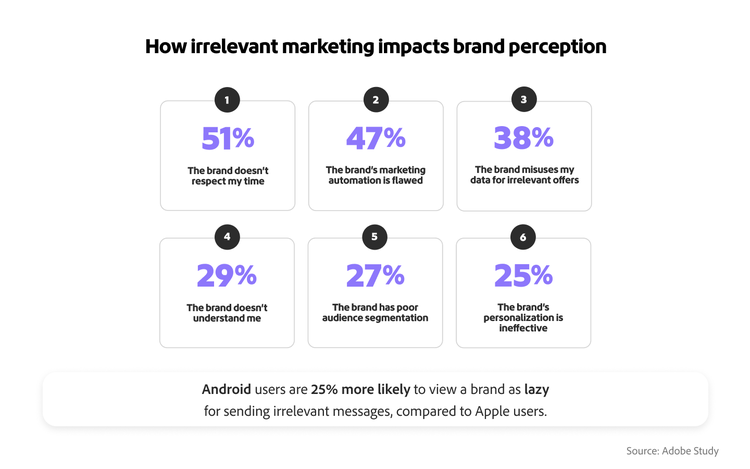
- Over half (51%) of consumers say brands don’t respect their time with irrelevant messages.
- Nearly two in five consumers (39%) say they are more likely to buy from brands that personalise effectively.
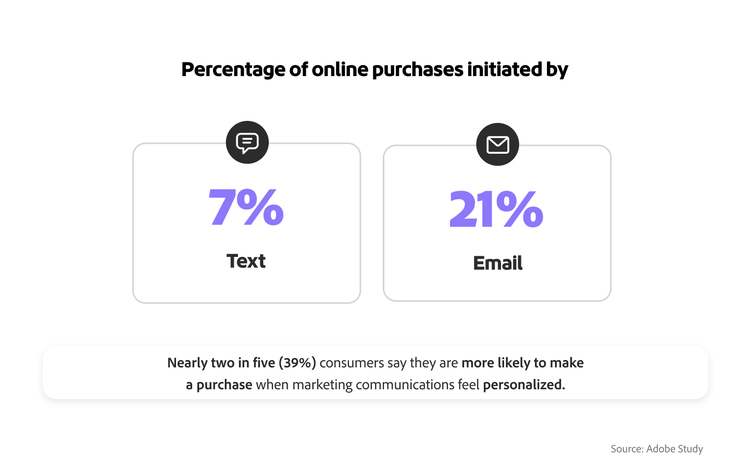
- When it comes to purchases, emails outperform texts by 200% among American shoppers.
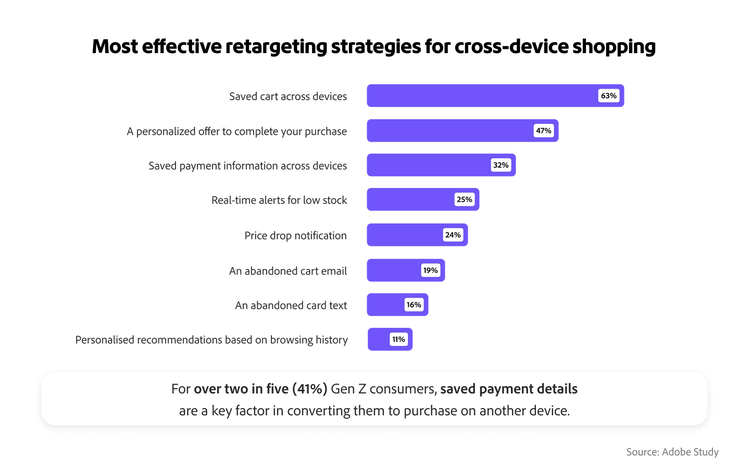
- The most effective strategies for retargeting cross-platform shoppers are cross-device basket synchronisation (63%), followed by personalised incentives (47%) and saved payment details (32%).
Why consumers opt-in, and what drives them to unsubscribe.
In today’s crowded omnichannel marketing landscape, consumers don’t subscribe at random. They opt in when they expect something useful and unsubscribe when that value never materialises. Understanding what feels worthwhile is the first step in closing the relevance gap.
When people subscribe to brand communications, they make a value-driven choice. Our study reveals the top reasons customers opt in:
- Exclusive deals - 61%
- Free delivery - 56%
- Loyalty programmes - 50%
- Early access to new products or sales - 31%
- Giveaways - 28%
- Updates on new products - 21%
Women are 28% more likely than men to subscribe to loyalty perks, illustrating the importance of understanding behavioural differences across customer groups. And while one in six consumers say hearing from their favourite brands makes them feel special, 96% say they’ve felt overwhelmed by marketing messages, an issue marketing analytics helps quantify and solve.
Understanding customer signals: How behavioural analytics improves relevance and engagement.
When a message feels irrelevant, people act fast:
- Delete without opening - 69%
- Unsubscribe - 65%
- Ignore notifications - 58%
- Mark messages as spam - 57%
- Turn off notifications - 44%
- Block the sender - 40%
Gen Z is most likely to unsubscribe (69%), while older generations are more likely to delete without opening. Android users are 13% more likely than Apple users to mark irrelevant content as spam. These behaviours signal frustration and they highlight the need for better personalisation rooted in connected customer analytics. These behaviours aren’t just preferences; they’re measurable signals. When brands fail to recognise them in real time, relevance breaks down.
How Customer Journey Analytics closes the relevance gap across channels.
Customer Journey Analytics unifies first-party data across channels, devices and time to deliver instant, accessible insights. This connected foundation allows marketers to move from high-volume outreach to high-value, highly targeted experiences — the kind consumers expect from modern omnichannel marketing.
With Customer Journey Analytics, marketers can:
- Identify high-intent audience segments using real customer behaviour across sessions, channels and devices — not static attributes — so teams can prioritise the moments that matter most.
- Unify first-party customer data into a single, continuously updating view that reflects how people engage over time, enabling more accurate personalisation and measurement across the entire journey.
- Activate insights instantly across Adobe Real-Time CDP and Adobe Journey Optimizer, then feed engagement and conversion results back into Customer Journey Analytics to continuously refine targeting, timing and messaging.
Because results flow back into Customer Journey Analytics, teams gain a continuous learning loop that drives stronger personalisation over time, elevating outcomes for both B2C and B2B marketing analytics use cases.
Mitigating unsubscribes and disengagement with journey optimisation.
High delete rates and unsubscribes indicate friction in the customer journey. Customer Journey Analytics helps teams identify and eliminate that friction using powerful behavioural marketing analytics software, such as:
- Customer journey visualisations - Show how customers move across channels and reveal friction points that most need improvement.
- Fallout analysis - Identifies where customers drop out of key flows, such as onboarding or checkout, so that teams can address the exact steps causing abandonment.
- Flow analysis - Maps the paths customers take before and after specific actions, uncovering patterns that help teams prevent disengagement.
Together, these digital analytics capabilities reveal where customers drop off and why, helping brands protect engagement and reduce churn.
Irrelevant marketing doesn't just annoy consumers; it creates measurable financial and operational risks. Our survey quantified those impacts and showed how overload weakens trust, performance and brand reputation.
Irrelevant marketing weakens the relationship between customers and brands. When customers lose trust or reduce inbox engagement, marketing performance declines across the entire funnel. Overload also moves beyond being just a customer experience issue to become a revenue issue. Our data shows how quickly those effects start to compound.
A crowded inbox can change how consumers interact with brands and even how they manage their personal lives. Sixty per cent say irrelevant messages make them feel annoyed with the sender and nearly a third now check their inbox less frequently because there’s too much noise. Among younger consumers, this shift is even more pronounced: 36% of Gen Z say they check their inboxes less often because of irrelevant marketing.
The clutter also has real-world consequences:
- Overlooked important personal emails - 28%
- Missed a bill payment - 25%
- Productivity declined - 23%
- Considered changing email address - 22%
How personalisation quality shapes customer trust and confidence.
Trust erodes just as quickly. More than half of consumers (51%) say that having to unsubscribe from the same brand more than once makes them lose confidence in that company. Others interpret irrelevant messages as a sign of flawed automation, poor segmentation or ineffective personalisation. In some regions, the reaction is even more pronounced. In Texas, for example, nearly nine in 10 consumers say irrelevant marketing damages their trust in a brand. And device preferences shape perceptions, too. Android users are 25% more likely than Apple users to consider a brand “lazy” when messages miss the mark.
These reactions have direct performance implications. Lower inbox engagement, rising spam reports and shrinking trust all weaken domain reputation, making future sends more complex and more expensive to deliver. What begins with a few irrelevant messages can quickly escalate into reduced conversions, higher acquisition costs and a decline in overall marketing effectiveness.
By giving marketers a modern, first-party customer intelligence foundation, Customer Journey Analytics helps teams understand behaviour with greater precision and activate those insights in real time. It connects data, decision-making and engagement across Adobe Real-Time CDP and Journey Optimizer, ensuring every message reflects the most current customer context — an essential function of advanced marketing analytics software.
Customer Journey Analytics also brings advanced AI, machine learning and GenAI capabilities to segmentation and predictive modelling, helping marketers anticipate intent rather than react to it. And with faster insight discovery and continuous optimisation built into the workflow, teams can quickly test, learn and refine their strategies, eliminating perceptions of flawed automation or lazy personalisation and driving measurable performance improvements.
Customer Journey Analytics helps brands replace irrelevant messages with experiences that customers value, rebuilding trust and lowering the cost of unsubscribes.
How seamless, personalised experiences drive future conversions.
Shoppers today move easily between channels and devices. When the experience feels connected and personal, they’re more likely to buy. Our study reveals what drives those cross-device decisions.
Email continues to outperform other channels: 21% of online purchases begin with an email, compared to 7% from text.
How purchase behaviour differs by generation.
Younger shoppers reward continuity and speed, while older generations value clarity and timing. Gen Z is especially distinctive, with more than one in seven reporting that creative content leads them to purchase. Forty-one per cent use saved payment details to complete cross-device transactions, reflecting how impulsive Gen Z’s online buying habits often are. These patterns highlight the role of connected customer analytics in driving conversion.
The most successful retargeting strategies are those that make it easy for customers to pick up where they left off. Reminders that reflect their recent activity or prompts that help them revisit items they showed interest in earlier, tend to create the strongest pull back into the buying journey. When these messages feel relevant and well-timed, they reinforce continuity across channels, demonstrating how effective omnichannel marketing drives higher conversion rates.
Once a message captures attention, several key factors determine whether it ultimately leads to a sale:
- The specific deal - 57%
- Actually needing the product or service - 50%
- Exclusive offer - 30%
- Reminder of a product already in mind - 29%
- Message personalised to interests - 19%
These insights reinforce the idea that relevance, timing and perceived value work together to turn interest into action.
How Customer Journey Analytics improves cross-device engagement and conversion.
Customer Journey Analytics strengthens cross-device performance by giving marketers the insight they need to act on customer behaviour in real time. Teams can activate insights instantly across Adobe Real-Time CDP and Journey Optimizer, measure A/B tests and optimisation strategies across the entire journey rather than isolated channels and feed activation results back into Customer Journey Analytics to continuously refine segmentation and personalisation. This creates a direct, measurable path from digital analytics to personalisation to revenue, where each message becomes more relevant and each interaction becomes more valuable.
From overload to growth: Why customer analytics is essential for relevance.
The era of generic mass marketing is over. Consumers expect brands to recognise them, respect their time and deliver experiences that feel relevant. Brands that rely on generic marketing lose trust, attention and revenue. The solution isn’t sending fewer messages; it’s sending smarter ones. Customer Journey Analytics turns disconnected data into unified insights, helping marketers target more precisely, optimise faster and deliver experiences that actually matter. With the right marketing analytics foundation, relevance becomes the default, not the exception.
See how Customer Journey Analytics helps teams turn customer signals into relevant, high-impact experiences: watch the overview video.
Research methodology.
This article is informed by proprietary research conducted by Adobe. The study surveyed 1,005 consumers across the United States, providing a 95% confidence level with a ±3% margin of error. Respondents were asked about irrelevant marketing. As with all self-reported data, results may reflect personal perceptions and experiences rather than actual behaviours.