USE CASE GUIDE
Invitations in Adobe Real-Time CDP Collaboration.
How in-product invitations help organisations activate and validate strategic partnerships faster.
Make data collaborations simple, effective and scalable.
Turning partnership ideas into measurable outcomes shouldn't be complicated. Invitations in Adobe Real-Time CDP Collaboration make data collaboration easy, so you can evaluate opportunities faster without getting bogged down by technical challenges and privacy concerns. Discover how it helps you to validate partnerships, make decisions with confidence and achieve stronger business results.
Today, brands unlock their most valuable customer insights through data collaboration. By teaming with trusted partners, in, publishers, media networks, agencies or data providers, they can reach new audiences, analyse marketing initiatives and better understand their existing customers. But getting started can be challenging because collaboration often involves complex set-up, significant investment and concerns around data privacy. In many cases, it also requires both organisations to have purchased the same clean room or data infrastructure. Adobe Real-Time Customer Data Platform Collaboration changes that.
To collaborate faster, brands and publishers no longer need to stitch together data warehouses, customer data platforms (CDPs), cloud platforms and identity solutions across partner ecosystems or navigate long sales cycles. Instead, they can take a much simpler approach.
Using invitations in Adobe Real-Time CDP Collaboration, they can easily invite any organisation they want to work with, regardless of their licence status with Adobe. The invited partner gets instant access to Adobe Real-Time CDP Collaboration Starter to begin collaborating with less effort and overhead.
For the inviting organisations, this means quickly connecting with new partners regardless of a compatible infrastructure. For the invited partners, it means access to a purpose-built solution that delivers joint value, even without any investment in Adobe.
Overall, it makes it easier for both parties to discover, activate and measure audiences across channels. With this capability, publishers and media networks can seamlessly build and grow advertiser ecosystems, while marketers can collaborate with other brands on data-driven initiatives and co-marketing campaigns — all within a secure, privacy-first environment.
In essence, it offers a more reliable way to explore high-value partnerships and uncover new paths to growth and revenue.
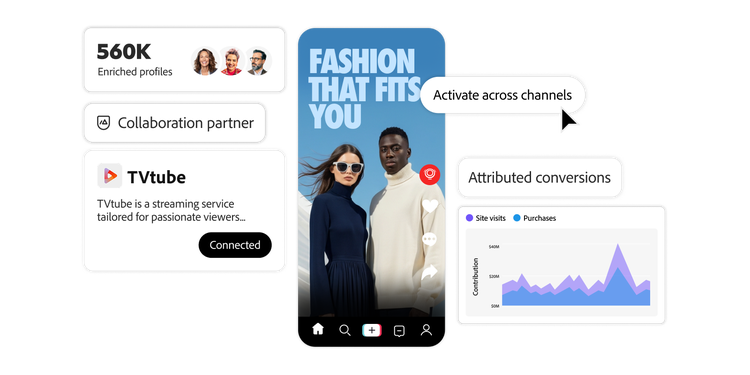
Reducing barriers to effective partnerships.
Invitations in Adobe Real-Time CDP Collaboration enable organisations to collaborate efficiently within a single, unified and easy-to-use platform. It simplifies and accelerates partner onboarding by removing common roadblocks, such as:
1. Budget and infrastructure constraints.
Organisations can work with partners regardless of their Adobe licence status. They can also avoid cumbersome technical implementations and collaborate seamlessly across clouds and ecosystems.
2. Privacy and data security concerns.
Both parties can protect their sensitive data with minimal data movement and innovative privacy techniques. This ensures compliance without sacrificing performance or scale.
3. Lack of governance and control.
Built-in guardrails, such as limits on audience size, activation scope and data refresh cadence, ensure collaborations remain controlled and compliant.
Invitations provide a structured yet flexible foundation to test use cases, unlock incremental value and manage first-, second- and third-party data collaboration and activation across paid and owned media channels.
How collaboration works with Starter invitations.
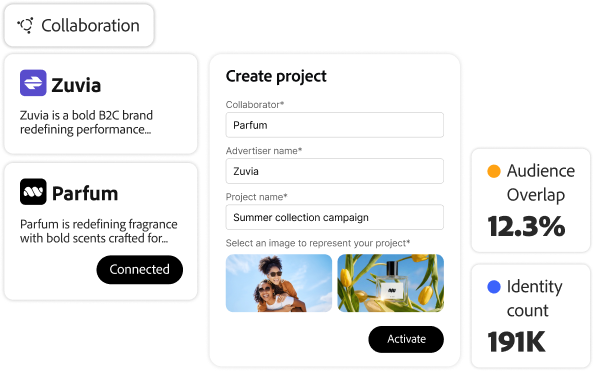
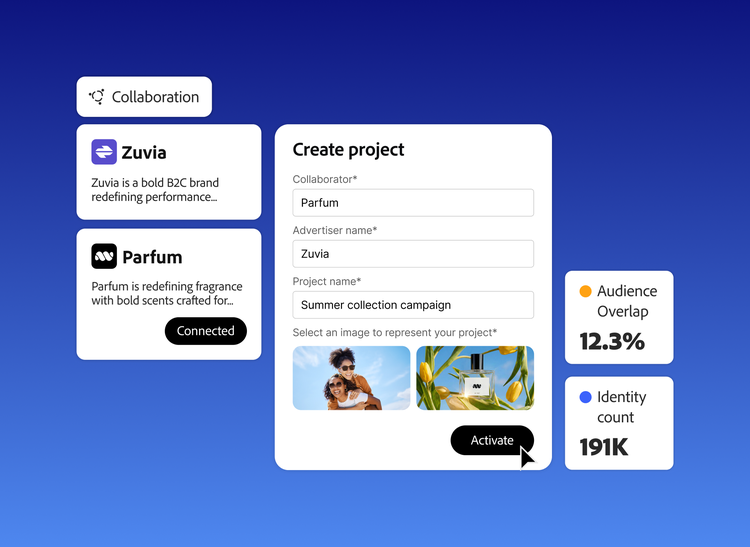
Using a simple, click-based workflow, Adobe Real-Time CDP Collaboration users can quickly invite a wide range of partners to collaborate through Starter. Both parties can derive unique benefits.
High-impact use cases for Adobe Real-Time CDP Collaboration Starter invitations.
Invitations in Adobe Real-Time CDP Collaboration remove the complexity that typically slows down partner collaborations. Instead of spending time resolving infrastructure and operational challenges, organisations can shift their focus to what matters most — achieving business outcomes faster across their partner ecosystem.
It delivers value across a variety of use cases, such as:
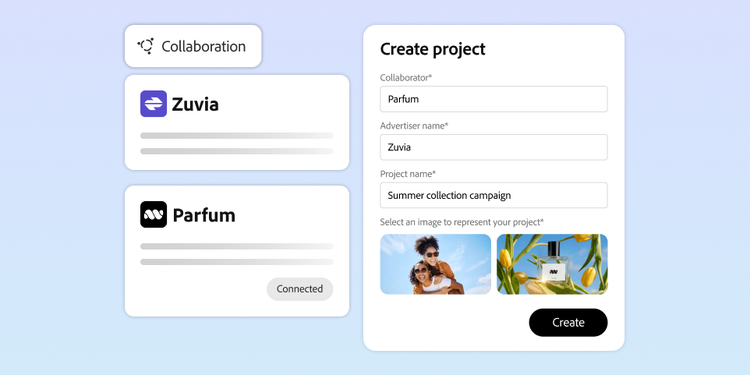
1. Onboarding brands into RMNs for joint campaigns.
A retailer or a retail media network (RMN) can invite a brand into Starter to run campaigns together. The brand can safely upload up to 50 million customer IDs, discover how much its audience overlaps with the retailer’s shoppers and create up to 10 shared audience groups. These audiences can then be activated back into the retailer’s owned channels, through their website, connected TV (CTV) or CRM, using the retailer’s credits.
Value: Retailers let brands get started quickly and validate RMN value, removing the need for an upfront product commitment. As a result, onboarding friction is reduced, creating an easy avenue to explore potential partnerships.
Example: A supermarket chain partners with a packaged food company to test collaboration by finding shared customers. The brand targets the right shoppers with ads, while the retailer earns ad revenue and improves shopper relevance.

2. Publisher invitations for advertisers to test inventory and audiences.
A publisher can invite an advertiser into Starter to explore its audience and inventory in a low-commitment environment. The advertiser can bring its own customer data, compare it against the publisher’s audience and activate a small set of campaigns to test performance, using the publisher’s ad stack.
Value: Publishers make it easy for advertisers to start small, so they can test audience fit and campaign performance with real data. This helps build confidence for both parties and naturally grows initial tests into larger, long-term paid collaborations.
Example: A streaming platform invites an automotive company to explore a partnership. The company matches its audience with viewers and runs pilot ads to measure performance before scaling.
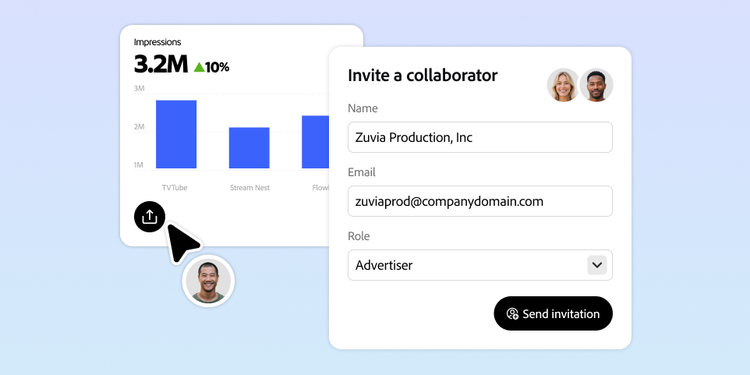
3. Brand-to-brand co-marketing with no upfront investment.
A brand can invite a strategic partner, such as a complementary brand with a similar audience, into Starter. Together, they can identify shared customers and build joint audience segments. These segments can then be sent to the inviting brand to activate campaigns. All of this can be managed by the inviting brand, including co-funding campaigns using credits.
Value: Brands can easily collaborate with partners to drive cross-sell programmes or co-branded promotions, without requiring both parties to invest in new technology or go through lengthy evaluations. This also makes it easier to demonstrate partnership success through real outcomes.
Example: An apparel brand teams up with a footwear brand to reach shoppers already engaging with both. Together, they launch coordinated offers that encourage customers to pair outfits with matching shoes.
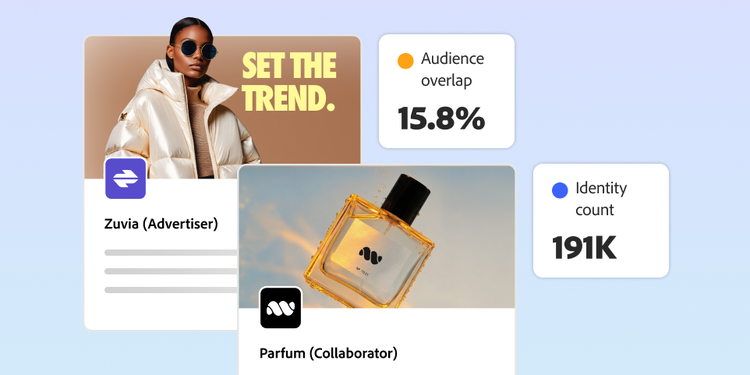
4. Data monetisation pilots for publishers and RMNs.
A publisher or an RMN can invite a select group of advertisers to prove the value of its audience data. Advertisers can analyse audience overlap and explore strategic segments, such as high lifetime value users, niche audiences or premium placements, to run initial campaigns. Based on the results, they can expand the partnership, increase investment or scale activation.
Value: Publishers and RMNs can monetise data or inventory through controlled, real-world use cases. By starting with focused pilots, they can build trust with advertisers and create a clear path for upselling.
Example: A leading digital news publisher partners with a beverage company to test targeted audience segments and premium ad placements through a pilot campaign. With strong engagement performance, the brand increases spend and expands into more placements and formats.
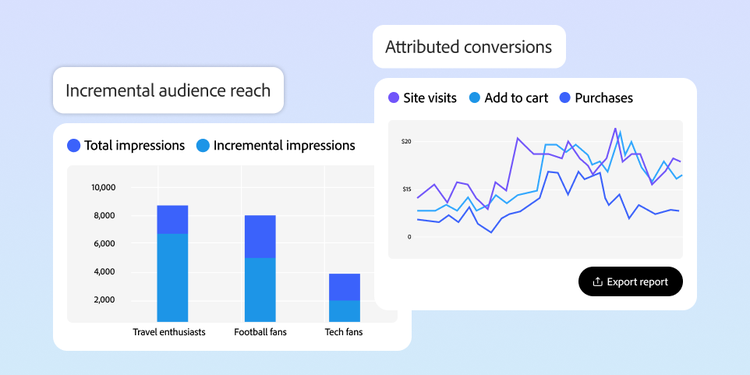
5. Measurement and incrementality projects with key partners.
An organisation can bring a partner into Starter for shared campaign performance evaluation. The invited partner contributes conversion or engagement data to the collaboration, enabling closed-loop measurement. This helps track results end-to-end and provides a clearer view of the campaign’s true impact, including what additional outcomes it drove.
Value: Teams can quickly validate whether their joint campaigns are truly driving results in a controlled, low-effort set-up. This makes it easy to demonstrate impact with a few partners first before they upgrade to full Adobe Real-Time CDP Collaboration for more advanced measurement and experimentation.
Example: A large streaming platform partners with a telecom provider to promote bundled subscriptions. They compare sign-up rates to understand the true impact of their campaign before scaling the partnership broadly.
6. ‘Try-before-you-buy' collaboration for new users.
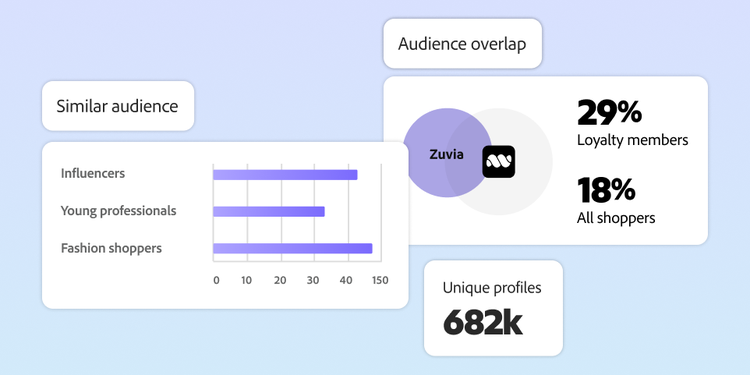
Adobe Real-Time CDP Collaboration users can invite a new prospect, one that has no existing licence, to experience the product firsthand. The prospect can learn how the workflows operate. They can onboard data, explore audience overlap and run initial activations within clear guardrails. This gives them a practical understanding of how the platform works.
Value: Users can bring new partners into their ecosystem faster, which shortens evaluation cycles. This helps build pipeline momentum and can lead to long-term partnerships more quickly.
Example: A large airline brings a global hotel chain into its partner network to trial select use cases. It helps both sides gain confidence in working together and move toward a broader commercial partnership.
Accelerating growth through effortless data collaboration.
In the age of generative and agentic AI, competitive advantage comes from accessing unique, trusted data, powered by partner ecosystems. Invitations in Adobe Real-Time CDP Collaboration help marketers, publishers, agencies and media networks move beyond their own walls and tap into a broader network of data collaboration. It also drives a shift in the collaboration framework — from complex, one-off integrations to a scalable, repeatable growth capability.
By enabling teams to securely activate partnerships in minutes, it removes traditional friction and accelerates go-to-market efforts. Furthermore, it introduces a new operating model that empowers teams to acquire and scale strategic partnerships more easily, expanding avenues for customer insights and monetisation. The future belongs to those who can collaborate at scale and Starter invitations make it practical, fast and fundamentally democratised.
Explore how Adobe Real-Time CDP Collaboration can help you scale your partner network.
Recommended for you
https://main--da-bacom--adobecom.aem.page/fragments/resources/cards/thank-you-collections/rtcdp