

Report
The state of AI readiness in the public sector.
The operating model decisions that support responsible, repeatable AI deployment across public services.

Turn promising AI pilots into lasting public value.
Public sector teams are already putting AI to work, with 62% of active respondents piloting or deploying it. Adobe's global report reveals what Leaders do differently and shares five practical moves to help your organisation scale AI responsibly across public services.
Foreword
Artificial intelligence (AI) is becoming part of how public sector respondents approach public information, digital experiences, service delivery and internal operations. The opportunity is clear, but readiness depends on more than access to technology. It also depends on whether leaders can connect AI activity to defined public-service goals, accountable decisions, appropriate oversight and evidence that shows where deployment is creating value.
That work rarely sits within one function. Communications and digital service teams may shape public-facing experiences, while programme, operations, data and technology teams provide the processes, information and infrastructure behind them. Policy, procurement, privacy, legal, accessibility, security, risk and governance partners also influence what can move forward and under what conditions. When these groups work through separate priorities and decision paths, promising use cases can remain isolated.
Responsible governance is not separate from readiness. Public sector AI must operate within obligations that protect people, public resources and institutional trust. Clear ownership, shared decision rights, early measurement and coordinated ways of working can help teams address those obligations sooner, learn from deployment and repeat what works without weakening accountability.
This report examines the public sector picture with the global cross-industry Leader benchmark. It identifies five operating model behaviours associated with more mature AI deployment and translates them into practical actions for executives moving from individual initiatives toward responsible, repeatable execution.

Brian Chidester
Head of Industry Strategy, Public Sector, Adobe
About the research.
This report draws on global research conducted by Incisiv on behalf of Adobe.


MARKETS COVERED
Australia and New Zealand, Central Europe, India, Japan, Latin America, the Middle East, North America, Southeast Asia, South Korea, the United Kingdom and Ireland and Western Europe.
How leaders were identified and scored.
The 342 Leaders come from the cross-industry sample of 5,633 executives across 12 industries. They form a global, cross-industry cohort rather than a public sector-specific group and provide the benchmark for public sector findings.
How maturity was measured.
Each respondent’s organisation was assessed across six operating model pillars, with each pillar scored on a scale of 1 to 5. The six scores were combined into an operating model maturity (OMM) composite.

Strategy
Clear AI vision with ownership and investment commitments.

Structure
Dedicated AI ownership with budget authority.

People
Roles and culture evolving for an AI-enabled environment.

Governance
Risk frameworks calibrated for AI velocity.

Technology
Infrastructure built for scale, not just pilots.

Workflows
AI embedded into how work is actually done.
How leaders were identified.
To qualify as a Leader, a respondent’s organisation had to meet both criteria: an OMM composite above 3.27 and operation at the expanding or transforming stage of AI deployment. Both criteria identified 342 Leaders, representing 6% of the 5,633 respondents. Unless otherwise stated, Leaders refers to this global, cross-industry cohort rather than a public sector-specific group.
Executive Summary
AI activity extends beyond exploration across the public sector respondent base, but repeatable execution remains limited. The findings point to an operating model challenge — responsibility is often distributed, cross-functional relationships remain sequential and measurement is rarely comprehensive. These conditions may make it harder to evaluate public value and extend successful approaches across services and functions. This report examines those structural gaps and the decisions the global AI Leader cohort made to address them.
“Responsible governance is not separate from readiness. Public sector AI must operate within obligations that protect people, public resources and institutional trust.”
Brian Chidester
Head of Industry Strategy, Public Sector, Adobe
The industry picture.
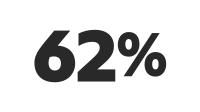
Of the active public sector respondent base is concentrated at the piloting or deploying stages.
This is the largest concentration across the five stages, indicating that respondents have moved beyond exploration without reaching expanding or transforming. The result does not show a stall — it highlights the need for ownership, governance, measurement and working relationships that support repeatable deployment. Moving further requires more than deploying tools within individual teams. It requires a repeatable way to assess value, coordinate oversight, share learning and decide which approaches should extend across service contexts.
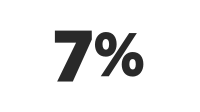
Of public sector respondents report a formal AI owner with a defined title and budget authority.
Elsewhere, responsibility may be part-time, shared, project-specific or absent. Clear ownership also requires decision rights when initiatives involve service, communications, data, technology, operations, policy, procurement, privacy, security, accessibility or governance partners. Without decision authority, accountability may not resolve competing priorities.

Of public sector respondents describe the relevant business and IT relationship as siloed, transactional or consultative.
These models depend on sequential requests and reviews. Responsible deployment still requires oversight, but earlier collaboration helps teams weigh service value, feasibility, data use, accessibility, security and governance together. Shared accountability preserves review while reducing avoidable rework and late-stage surprises.
What leaders do differently.
The 342 Leaders form a global, cross-industry cohort rather than a public sector-specific group. Five behaviours are more common among them and together provide a benchmark for repeatable deployment.

Real Ownership
Leaders are 13.8 times more likely than public sector respondents to report a formal AI owner with a title and budget authority. Effective ownership pairs accountability with decision rights and a mandate that reaches the functions responsible for delivery and oversight.

Day-One Measurement
Among Leaders, 44% report comprehensive measurement, compared with 4% of public sector respondents. Leaders define outcomes and measurement approaches early, which supports performance evaluation and future investment decisions.

Genuine Partnership
Among Leaders, 81% report collaborative or integrated relationships, compared with 8% of public sector respondents. These models involve functions in definition, delivery, governance and measurement rather than relying on handoffs.

Learning Culture
Among public sector respondents, 56% report destructive failure patterns, compared with under 1% of Leaders. Constructive review helps teams examine underperformance, preserve learning and apply it to work without weakening accountability.

Empowered Champions
Among Leaders, 42% identify finding and empowering internal champions as their most impactful culture action. Given support, appropriate authority and clear guardrails, champions can help colleagues evaluate and extend proven practises.
Part One
The industry picture.
Finding 01: The frozen middle.
Most active public sector respondents are piloting or deploying AI.
62% of the active public sector respondent base is concentrated at the piloting or deploying stages, showing that activity has advanced beyond exploration without yet reaching broader expansion.
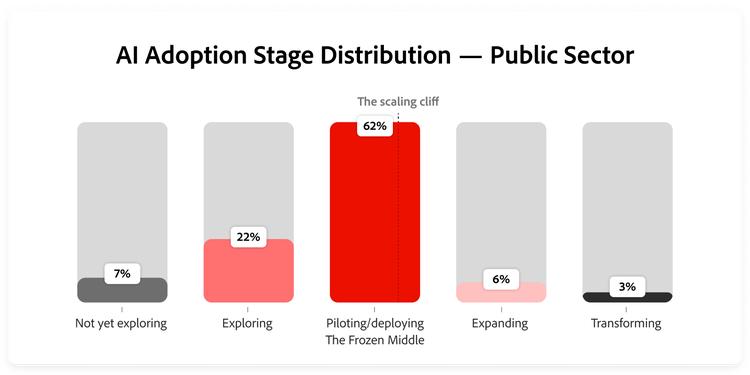
Share of public sector respondents at each adoption stage.
The active public sector respondent base spans five stages — from exploring through transforming. The largest share is in the middle stages as 62% are piloting or deploying. This distribution shows that AI activity has moved beyond investigation for many respondents but remains short of broader expansion.
This cross-sectional result does not show that progress has stalled. It indicates where activity is concentrated. Moving from pilots and deployments toward repeatable execution requires respondents’ organisations to connect use cases with service priorities, decision rights, evidence requirements and the partners responsible for delivery and oversight.
The next stage is an operating model challenge rather than a question of adding tools. Public service, communications, data, technology, operations, policy, procurement, privacy, security, accessibility and governance partners need a shared way to evaluate value, manage risk and apply learning. Coordination begins with clarity about who is accountable, what authority the role carries and how decisions are made when priorities cross boundaries.
Finding 02: The Ownership Vacuum
Only 7% of public sector respondents report a formal AI owner.
Formal ownership requires more than a title. It needs defined decision rights, a cross-functional mandate and the authority and budget to act.
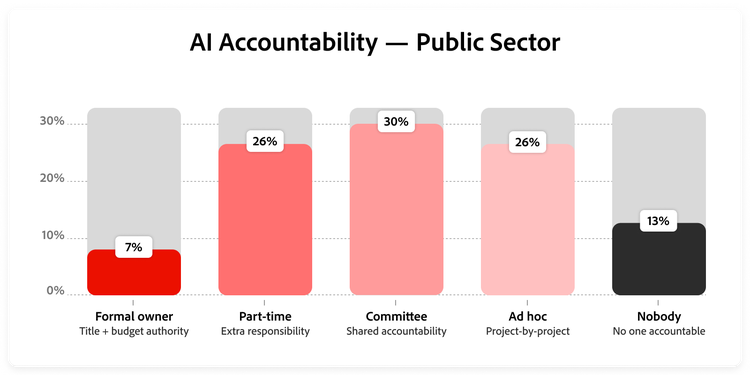
Distribution of AI ownership models in public sector.
AI initiatives in public sector settings can involve public service, communications, data, technology, operations, policy, procurement, privacy, legal, accessibility, security and governance partners. Responsibility is often distributed across these groups even when one team formally manages delivery. Without a clearly accountable owner, competing priorities and resourcing decisions can remain unresolved.
The finding concerns more than naming a coordinator. A formal owner needs defined decision rights, a mandate across the functions involved and access to resources. Otherwise, the role brings visibility without the authority to resolve issues across service, technical and oversight boundaries.
The appropriate role varies by jurisdiction and organisational structure. It may sit within service, digital, data, technology, operations, transformation or another executive function. What matters is explicit accountability supported by authority, governance and budget. Establishing that mandate early gives proposed use cases a clearer evaluation path, while preserving formal participation from the partners responsible for public value, feasibility and risk.
Finding 03: The approval barrier.
On average, 1 in 10 public sector AI use case requests reach production.
The funnel shows how requests progress through evaluation. It does not identify which types of use case ultimately launch.
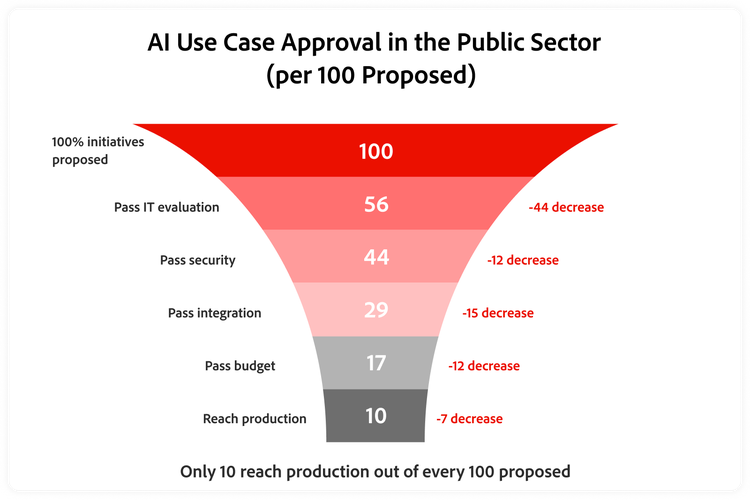
Mean approvals per 100 proposed AI initiatives in public sector. Global average: 15 per 100.
Moving an AI request from idea to production requires decisions across service, technology, security, governance, procurement and budget partners. The survey tracked requests through initial IT evaluation, security review, integration assessment, budget approval and production launch. On average, the figure falls from 100 requests to 10 reaching production.
The funnel measures progression through these stages, not the types of use case that launch and it does not show that review is the problem. Security, privacy, accessibility, legal, integration, procurement and funding checks help determine whether a proposal is feasible, responsible and aligned with public value.
The question is whether those requirements are considered early enough. When service, data, technology, operations, policy, procurement, privacy, security, accessibility and governance partners participate during ideation, teams can identify evidence needs, constraints and decision rights before formal review. This does not guarantee launch, but it helps distinguish the use cases that warrant investment from those that should be revised, deferred or stopped.
Finding 04: Business-IT Handoff
92% of public sector respondents rely on siloed, transactional or consultative relationships.
These relationship modes can support consultation and review, but they do not provide the shared accountability associated with collaborative or integrated ways of working.
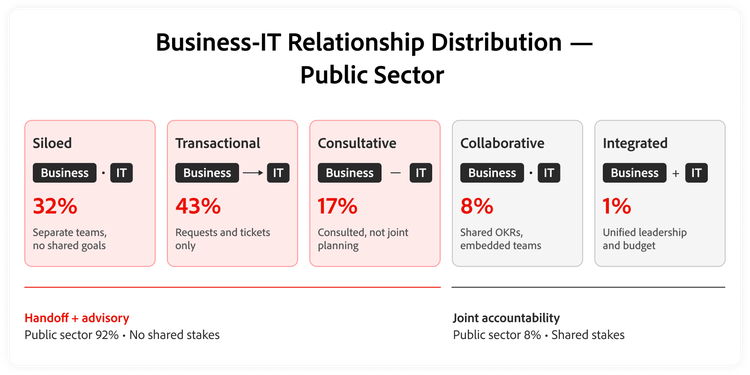
Distribution of business-IT operating relationships in public sector.
AI initiatives require information, infrastructure, knowledge and oversight from multiple functions. Yet 92% of public sector respondents describe the relationship between business functions and IT as siloed, transactional or consultative.
These relationship modes differ, but each relies on sequential engagement — one function defines or advances the request, while IT reviews, advises or delivers against it. This limits accountability when requirements, evidence needs or implementation conditions change as the work develops.
Collaborative and integrated relationships involve functions when a use case is defined, not only when approval or delivery is required. Public service, communications, data, technology, operations, policy, procurement, privacy, security, accessibility and governance partners can agree on intended value, decision rights, evidence and measures from the outset. This does not remove oversight or reassessment of responsibilities. It gives each partner earlier visibility and a shared basis for resolving issues, reducing avoidable rework while maintaining the controls responsible deployment requires.
Finding 05: The measurement gap.
Only 4% of public sector respondents report comprehensive AI measurement.
Activity and efficiency measures can show whether AI is being used. They do not establish whether it is improving public service or creating organisational value.
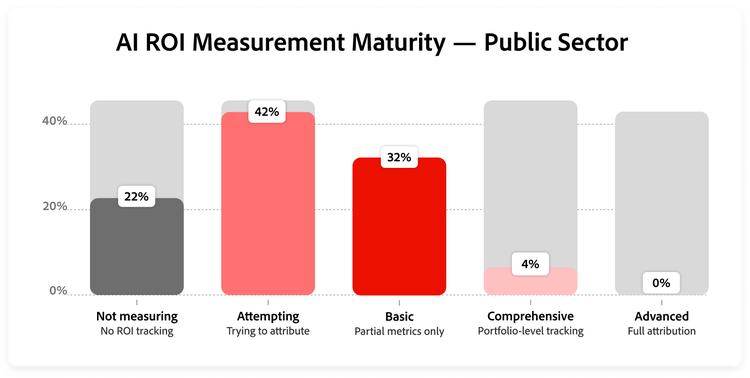
ROI maturity distribution in public sector.
As AI becomes part of public sector work, teams need to measure more than activity. Usage, output volume, processing time and cost show that a tool is being used and that a workflow is becoming more efficient. On their own, they do not show whether the initiative improved service quality, access, responsiveness, workforce effectiveness or another intended outcome.
Stronger measurement begins before deployment. Teams define the intended public-service or organisational outcome, record a baseline and agree how performance will be assessed. Once implementation changes a workflow or service environment, policy changes, demand patterns and staffing levels can make AI’s contribution harder to isolate. Measurement should reflect the context, risks and obligations of each use case.
Pre-deployment measurement gives leaders a basis for oversight, learning, funding and expansion decisions. It also helps teams distinguish technical performance and operational activity from the public or organisational value the initiative was intended to support.
Part Two
What leaders do differently.
Leader behaviour 01: Real ownership.
The difference concerns more than assigning responsibility. Effective ownership combines accountability with decision rights, cross-functional authority and control over resources.

In public sector, 7% of organisations have named one. Leaders are also 10x more likely to undertake business-IT collaboration and 12.3x more likely to measure ROI comprehensively.
AI can directly affect the people who rely on public services, as well as the public servants and operations that support them. Delivery may involve communications, programme, data, technology, policy, procurement, privacy, security, accessibility, risk and governance partners. As work crosses these boundaries, part-time owners, committees and project leads may coordinate activity without holding the authority to resolve competing priorities or allocate resources.
Formal ownership is more common among the global cross-industry Leaders, who are 13.8 times more likely than public sector respondents to report an AI owner with a defined title and budget authority. The research indicates an association rather than proving that formal ownership produced more mature deployment. What it does suggest is that ownership works effectively when the role carries both — a mandate and decision rights.
For public sector respondents, the right owner depends on structure and jurisdiction. The role may sit within service, digital, data, technology, operations or transformation, provided its authority reaches its delivery and oversight functions. Existing reporting lines and accountabilities can remain in place. The objective is a single, clear point of accountability for cross-functional AI decisions.
Leader behaviour 02: Day-one measurement.
Comprehensive measurement is reported by 4% of public sector respondents. The difference shows why defining outcomes, baselines and assessment methods before deployment matters.
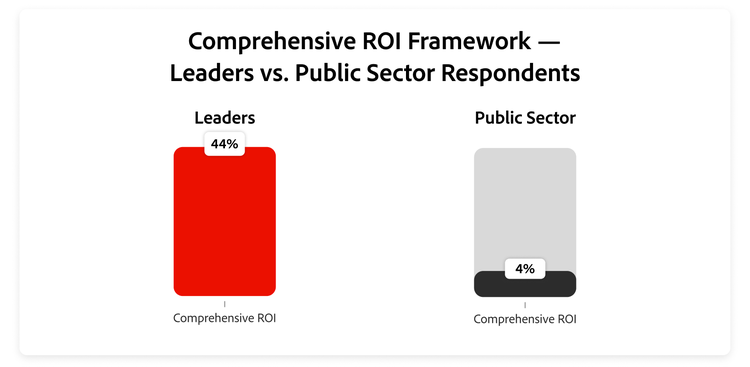
Share of comprehensive or advanced ROI framework. Leaders cohort: 342 organisations across 12 industries.
Leaders build measurement into the design of AI initiatives. Among leaders, 44% report comprehensive measurement, compared with 4% of public sector respondents. This shows that measurement is more established within the Leader cohort. It does not show that measurement alone produced their deployment maturity or that it guarantees an initiative will create value.
Day-one measurement begins by defining the intended public service or organisational outcome before deployment. Depending on the use case, appropriate measures may address service quality, access, responsiveness, efficiency, workforce effectiveness, risk or another objective. Service, programme, data, technology, operations, finance and oversight partners should agree on the baseline, evidence and assessment approach before implementation changes the environment.
Timing matters because baselines become harder to reconstruct once a workflow or service changes, as policy updates, demand, staffing levels all affect results. Recording performance from the outset gives leaders a basis for evaluation, learning, oversight and funding decisions, while avoiding claims that cannot be attributed to the AI initiative.
Leader behaviour 03: Genuine partnership.
The distinction is driven by shared accountability, not the removal of specialist oversight.
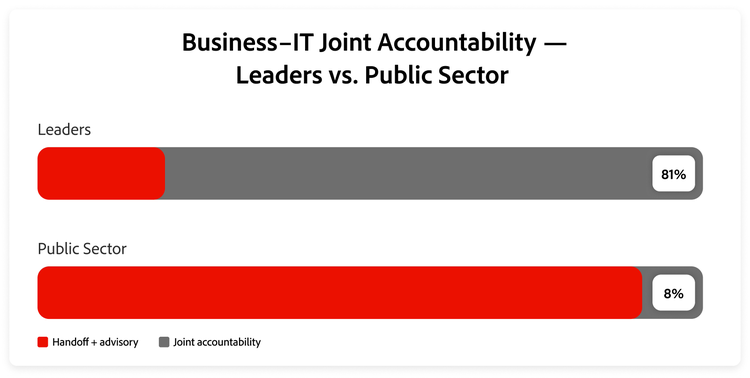
Joint accountability = Collaborative + integrated | Handoff + advisory = Siloed + transactional + consultative
AI initiatives can depend on service knowledge, operational processes, data, infrastructure and specialist oversight. Sequential handoffs can make it harder to resolve issues when requirements change or when several functions must make connected decisions. Among public sector respondents, 92% describe the relationship between business functions and IT as siloed, transactional or consultative.
Across the 342 global cross-industry Leaders, 81% report collaborative or integrated relationships, compared with 8% of public sector respondents. Shared working is clearly more common among Leaders, though this association does not show that collaboration produced maturity, nor does it remove the need for independent review.
Genuine partnership begins while the work is being defined. Public service, communications, data, technology, operations, policy, procurement, privacy, security, accessibility and governance partners agree on value, responsibilities, evidence and measures before delivery. Shared accountability then continues through implementation, while each function retains its duties. This works within existing structures. It requires shared outcomes and clear decision processes, not reorganisation or the removal of necessary controls.
Leader behaviour 04: Learning culture.
Destructive failure patterns are reported by 56% of public sector respondents. Constructive learning requires openness about underperformance without weakening accountability for errors, risks or public outcomes.
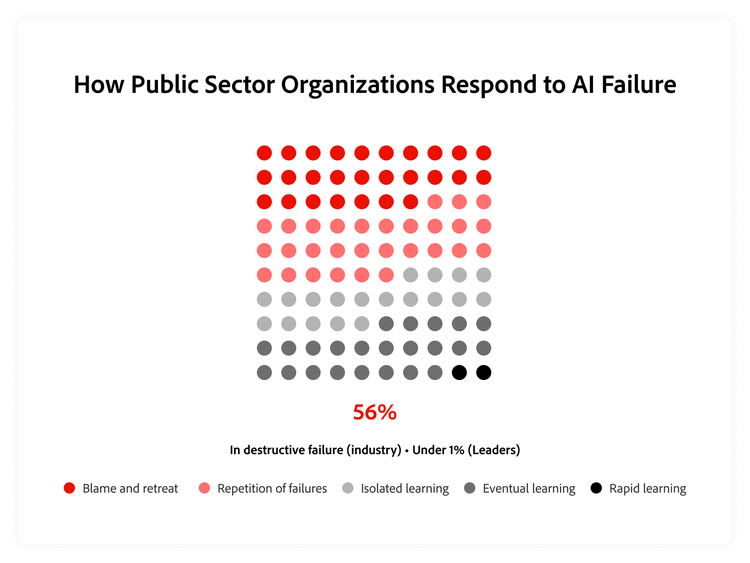
Each dot represents one of every 100 public sector organisations. Destructive = Blame and retreat + repetition of failures.
Public sector AI operates in environments where errors can affect services, rights, resources, trust and institutional accountability. That makes careful review essential, but it can also make teams reluctant to discuss underperformance openly. When responsibility is assigned defensively or lessons remain within one project, other teams may repeat the same assumptions, controls or implementation mistakes.
Among public sector respondents, 56% report destructive failure patterns involving blame or repetition. Among the 342 global cross-industry Leaders, the figure is under 1%. The difference shows that constructive responses to underperformance are more common among Leaders. It does not mean that Leaders avoid failure or that their approach produced their deployment maturity.
A learning culture combines openness with accountability. Teams document outcomes, examine the decisions and conditions behind them, correct risks and share lessons with the functions that need them. Leaders make this practice visible through operating and governance reviews. The purpose is not to normalise preventable errors. It is to improve controls, decisions and future deployments while preserving responsibility for public outcomes.
Leader behaviour 05: Empowered champions.
Champions make adoption tangible by demonstrating how AI can support familiar work within clear, operational, ethical and governance boundaries.
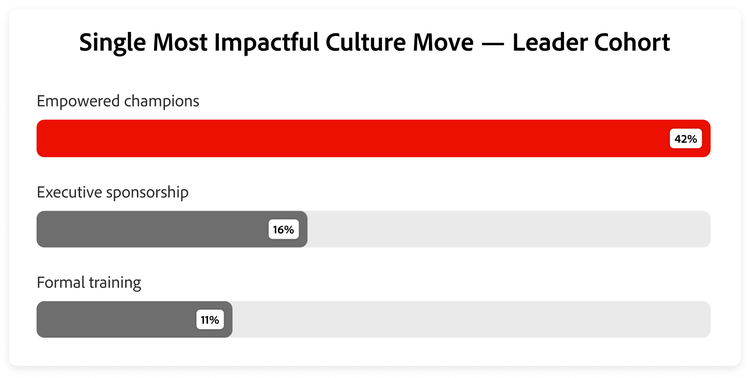
Top-cited culture lever by Leaders. n = 342 Leaders across 12 industries.
Practitioners can make AI adoption more tangible by showing how it works within real responsibilities and constraints. Their experience helps colleagues understand where a workflow creates value, where human judgement remains essential and which risks or limitations require attention. That evidence complements formal training, executive sponsorship and change programmes.
Among the global cross-industry Leaders, 42% identify finding and empowering internal champions as their most impactful culture action, ahead of every other action measured in the study. The result shows that champions are valued within the Leader cohort. It does not establish that champions alone produced wider adoption or more mature deployment.
Empowered champions need more than recognition. They need time, support, authority and governance to extend proven work responsibly. Their role is to document results, identify the conditions those results depend on and help others evaluate whether the practice can be adapted responsibly. Data, technology, governance, accessibility, privacy and security guidance support consistency, while champions preserve the service context that implementation requires.
5 moves that build the operating model in the public sector.
These actions translate Leader behaviours into steps for public sector executives. They build on existing service, communications, data, technology, operations and governance capabilities rather than requiring organisational redesign.
- Name one accountable AI owner with authority across functions.
Appoint one accountable executive with a mandate, defined decision rights and budget authority across the functions involved in AI delivery and oversight. The role may sit within service, digital, data, technology, operations or transformation leadership, depending on the organisation. Existing reporting lines can remain in place, but the owner must be able to resolve competing priorities, allocate resources and convene policy, procurement, privacy, legal, accessibility, security, risk and governance partners when decisions cross boundaries. - Define the intended value before deployment.
Define the public-service or organisational outcome before an AI use case moves forward. Record a baseline and decide how performance will be assessed. Service, programme, operations, data, technology, finance and oversight partners should align on evidence and attribution before launch. Measures should reflect the use case and may address quality, access, responsiveness, efficiency, workforce effectiveness, risk or another objective. - Establish shared accountability from the outset.
Bring the functions responsible for value, delivery and oversight into the work while the use case is being defined. Public service, communications, data, technology, operations, policy, procurement, privacy, legal, accessibility, security, risk and governance partners should agree on responsibilities, decision paths, evidence requirements and measures. Shared accountability should complement independent review, not replace it. Coordinating earlier helps teams identify constraints and resolve issues within working cycles, rather than through handoffs and late-stage escalation. - Turn underperformance into structured learning.
Create a structured process for examining underperformance, correcting immediate risks and sharing lessons. The accountable AI owner and the relevant service, operational, technical and governance leaders should make this a standing part of formal cross-functional operating reviews. Document what happened, which assumptions or controls failed, what changed and who needs the learning. The objective is not to normalise preventable errors or reduce accountability. It is to strengthen decisions, controls and future deployments while preserving responsibility for public outcomes and obligations. - Give proven practitioners the support to lead.
Identify practitioners who have already applied AI responsibly in their work. Give them recognition, time, authority and support to document their approach and help an adjacent team evaluate it. Data, technology, privacy, security, accessibility and governance teams should provide reusable guidance. Champions extend proven practises most effectively when they preserve service context, explain limitations and work within clear human-judgement and oversight requirements.
Conclusion
Turn AI readiness into responsible public value.
AI is changing how public sector organisations communicate, deliver services, manage information and support their workforces. Capturing that potential takes more than models and tools. It requires trusted data, accessible experiences, strong governance and robust security. It also requires an operating model that connects innovation with public value and accountability.
The research shows the starting point. Public sector respondents are concentrated at the piloting and deploying stages, while formal ownership, collaborative working relationships and comprehensive measurement remain limited. The global cross-industry benchmark indicates that accountable ownership, early measurement, genuine partnership, constructive learning and empowered champions are more common among Leaders. Together, these behaviours provide a framework for moving from isolated initiatives to repeatable execution without treating governance as an obstacle.
Apply this framework first to one priority use case. Define its outcome, name the accountable owner, record a baseline and involve delivery and oversight partners before implementation. That creates a basis for deciding what should advance, what must change and where deployment can responsibly create public value.
About Adobe
Adobe empowers organisations to create impactful digital experiences. Our portfolio of customer-experience products and services helps businesses put every interaction in context, understand what each customer needs right now and design and deliver digital experiences that build loyalty and drive growth. Visit adobe.com to know more.
About Incisiv
Incisiv is an industry insights and strategy firm combining close to a decade of industry trend data with primary research, messaging architecture and content development to help enterprises navigate transformation, evaluate solutions and unlock growth. Visit incisiv.com to know more.
Recommended for you
https://main--da-bacom--adobecom.aem.page/fragments/resources/cards/thank-you-collections/government