

Report
The State of AI Readiness in Retail.
The operating model decisions that help retail organisations scale AI across marketing, commerce and customer experience.

Bridging the Retail AI Scale Gap
Most retailers remain stuck between AI experimentation and scale. Adobe’s State of AI Readiness in Retail report reveals how industry leaders build accountability, strengthen tech partnerships and turn AI investments into measurable, lasting value.
Foreword
Deployment is Moving Faster Than the Operating Model
Retailers are applying artificial intelligence (AI) across a growing range of marketing and customer experience workflows, from product discovery, to personalisation and content production. The opportunity is significant: faster decisions and time to market, more relevant engagement, increased revenue and more efficient execution across digital and physical touchpoints. But increasing the number of AI use cases does not, by itself, make a retail organisation ready to scale.
The research shows substantial AI activity across the retail respondent base, but much of it remains concentrated in the piloting and deploying stages. Progress becomes harder when an initiative moves beyond one function to encompass shared data, connected systems, coordinated funding and decisions spanning marketing, commerce, shop operations, technology, legal and compliance.
The central challenge is therefore the operating model itself. AI requires clearer authority, earlier collaboration and measurement designed before deployment. Without those foundations, individual initiatives may reach the market while remaining difficult to connect, evaluate or extend across the customer journey.
This report examines where retail AI progress stalls and what the cross-industry Leader benchmark reveals about moving forward. It gives marketing and customer experience executives a practical framework for strengthening the operating conditions around AI investments already underway.

Marta Frattini
Global Industry Strategy Director, Retail, Adobe
About the Research
This report draws on global research conducted by Incisiv on behalf of Adobe.



MARKETS COVERED
Australia and New Zealand, Central Europe, India, Japan, Latin America, the Middle East, North America, Southeast Asia, South Korea, the United Kingdom and Ireland and Western Europe.
How Leaders Were Identified and Scored
The 342 AI Leaders referenced throughout this report are drawn from the full study population of 5,633 senior executives across 12 industries. They are not retail-specific. They represent a global cross-industry benchmark of respondents that met both the operating model maturity and deployment-stage criteria described below.
How Maturity Was Measured
Each organisation was assessed across six operating-model pillars, with every pillar scored on a scale of 1 to 5. The six scores were combined into an operating model maturity (OMM) composite.

Strategy
Clear AI vision with ownership and investment commitments.

Structure
Dedicated AI ownership with budget authority.

People
Roles and culture evolving for an AI-enabled environment.

Governance
Risk frameworks calibrated for AI velocity.

Technology
Infrastructure built for scale, not just pilots.

Workflows
AI embedded into how work is actually done.
How Leaders Were Identified
To qualify as a Leader, an organisation had to meet two criteria: achieve an OMM composite above the top-quartile threshold of 3.27 and operate at the expanding or transforming stage of AI deployment. Applying both criteria identified 342 Leaders across the 12 industries, equivalent to 6% of the 5,323 active respondents.
These respondents demonstrate greater maturity across the ownership, governance, measurement, technology foundations, talent and ways-of-working dimensions associated with repeatable and sustainable AI deployment.
Executive Summary
What the Data Shows about Retail
Retail has no shortage of AI initiatives across marketing and customer experience. What most organisations still lack is the operating model to move a successful pilot into repeatable deployment. Ownership remains unclear, measurement is limited and coordination between business teams and information technology (IT) teams is inconsistent. This report examines those gaps and the operating model behaviours more common among the cross-industry Leader cohort.
The Industry Picture

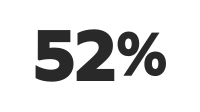
of the active retail respondent base is in the Frozen Middle. These respondents have moved beyond early experimentation and reached the Piloting or Deploying stage, but the coordination required to scale successful use cases across functions remains limited.
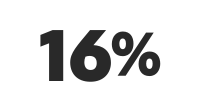
of AI ideas proposed in retail reach production. Promising use cases lose momentum as they move through technical evaluation, security, integration and budget reviews, limiting the number of cases that progress from initial proposal to production.
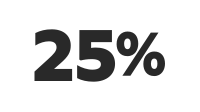
of retail respondents report a formal AI owner with a defined title and budget authority. Elsewhere, accountability may be part-time, shared across a committee or managed project by project, leaving cross-functional priorities and resourcing decisions unresolved.
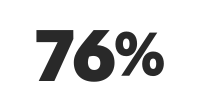
of retail respondents manage the relationship between business and IT through siloed, transactional or consultative ways of working. These models depend on requests, reviews and sequential handoffs rather than the shared accountability and frequent iteration AI deployment requires.
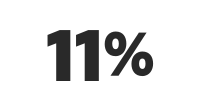
of retail respondents report a comprehensive return on investment framework. Most teams can track activity or efficiency, but they cannot consistently isolate AI’s contribution to customer and commercial outcomes or use comparable evidence to guide continued investment.
What Leaders Do Differently
The 342 AI Leaders identified across all industries have established the ownership, measurement, working relationships and culture needed to scale AI initiatives. They share five connected operating-model behaviours.

Real Ownership
Leaders are 3.6 times more likely to have a formal AI owner with the title, mandate and budget authority to work across functions.

Day-One Measurement
Leaders define the return on investment (ROI) framework before deployment. Among Leaders, 44% measure ROI comprehensively, compared with 11% of retail respondents.

Genuine Partnership
Business and IT teams share objectives and accountability for outcomes. A significant 81% of Leaders operate at the collaborative or integrated level, compared with 24% of retail respondents.

Learning Culture
Leaders use failure to improve the next deployment. Just 23% of retail respondents report destructive failure patterns involving blame and repetition. Among Leaders, the figure is under 1%.

Empowered Champions
Leaders identify practitioners already using AI effectively and give them the authority and support to extend their work. It was found that 42% name finding and empowering internal champions as their most effective culture action.
Part One
The Industry Picture
The Frozen Middle — Most Retail Organisations Stall at the Piloting and Deploying Stages
Among retail organisations, 56% are in the Frozen Middle, which means AI is active within individual functions or projects, while the coordination needed to scale it remains limited.
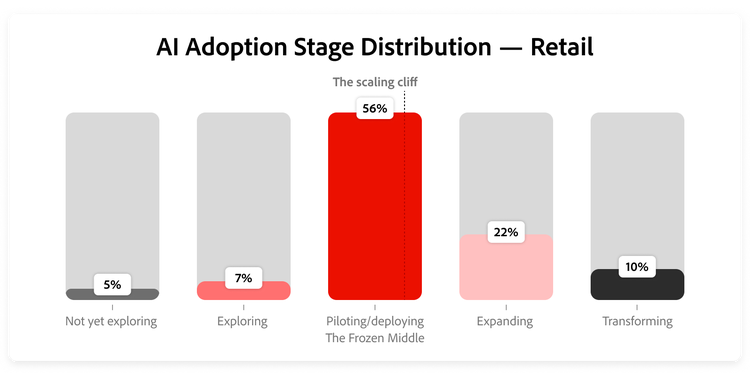
Share of Retail respondents at each adoption stage.
Retail marketing teams adopt AI one use case at a time. Audience segmentation may sit with digital marketing, recommendation models with ecommerce and content production with creative teams. Each moves on its own timeline, creating pockets of activity that are difficult to connect.
The Frozen Middle describes respondents at piloting or deploying, whose organisations have not built the coordination needed to scale. Data, learning and results can remain within individual systems or functions, limiting the ability to compare outcomes, demonstrate return on investment and extend successful workflows across customer touchpoints.
Moving beyond this stage requires clearer ownership, shared data access, agreed decision rights and closer collaboration across marketing, commerce, shop operations and technology partners. It also requires teams to design and run AI workflows together, end to end, rather than each function building and optimising its own piece in isolation. When that collaboration is deferred, disconnected deployments accumulate and become harder to align around shared outcomes.
The Ownership Vacuum — Only 1 in 4 Retail Respondents Reports a Formal AI Owner
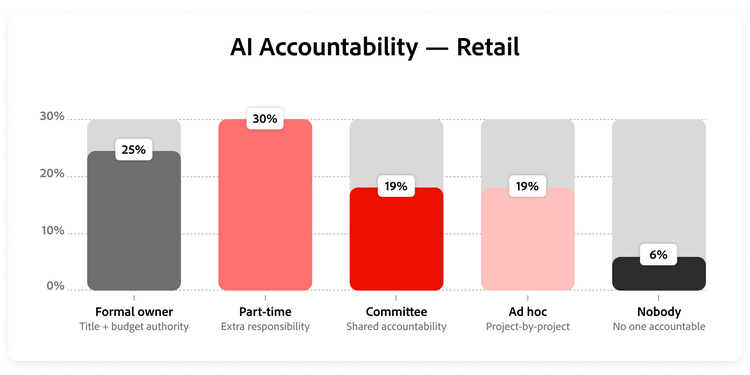
Distribution of AI ownership models in Retail.
Within retail organisations, AI accountability may be distributed across digital marketing, ecommerce, loyalty, merchandising and shop operations. Delivery can also depend on data, information technology, legal, risk, security and compliance teams. When responsibility is spread across these groups, it can be difficult to resolve competing priorities or make binding decisions about resources and sequencing.
A personalisation roadmap for a particular quarter, for example, might call for marketing to prioritise a real-time offer engine, while loyalty advances retention modelling and shop operations considers AI-assisted staffing. Each initiative has merit, but they are not independent. They may compete for shared data, technology support, funding and executive attention. Without an owner accountable for the roadmap as a whole, no one is positioned to identify those connections, decide which initiative should come first or determine how one deployment should inform the next. Decisions can then stall or follow the priorities of whichever function is best placed to move, rather than the value of the portfolio as a whole.
Part-time ownership and committee-led accountability can leave these decisions unresolved even after individual teams have moved ahead. A CMO or head of customer experience can fill the role when the appointment includes authority across the AI roadmap, customer communications, digital experience, loyalty and supporting data relationships. The requirement is a mandate that extends beyond one function or initiative.
The Approval Gauntlet — Out of Every 100 AI Ideas Proposed in Retail, 16 Reach Production
IT evaluation removes the largest number of proposed initiatives, with 28 of every 100 dropping at the first gate.
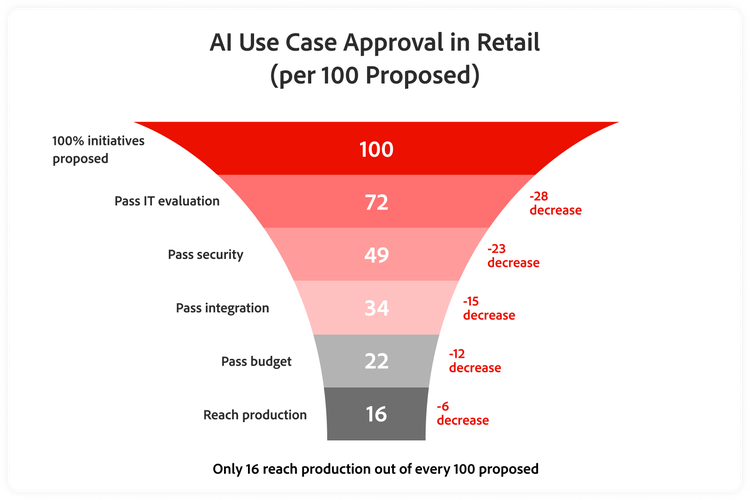
Mean survivors per 100 proposed AI initiatives in Retail. Global average: 15 per 100.
Moving an AI use case from proposal to production requires decisions across marketing, commerce, shop operations and technology partners. The survey follows initiatives through IT evaluation, security review, integration assessment, budget approval and production launch. Attrition occurs at every stage, leaving only 16 of the original 100 proposals to reach production. This is broadly in line with the cross-industry average of 15.
The largest absolute loss occurs at IT evaluation, where 28 initiatives drop out. Security removes another 23, integration removes 15, budget approval removes 12 and 6 more are lost before production. Budget approval has the highest proportional loss among initiatives entering a stage, with 12 of 34 or approximately 35%, failing to progress.
These reviews test technical feasibility, security, privacy, integration, governance, vendor approval, cost, timing and funding. They should preserve sight of the customer or commercial outcome. Surfacing data rights, system ownership, integration dependencies and the business case during ideation gives business and technology teams a basis for evaluating feasibility and value.
Business-IT Handoff — 76% of Retail Organisations Still Operate Without Joint Accountability
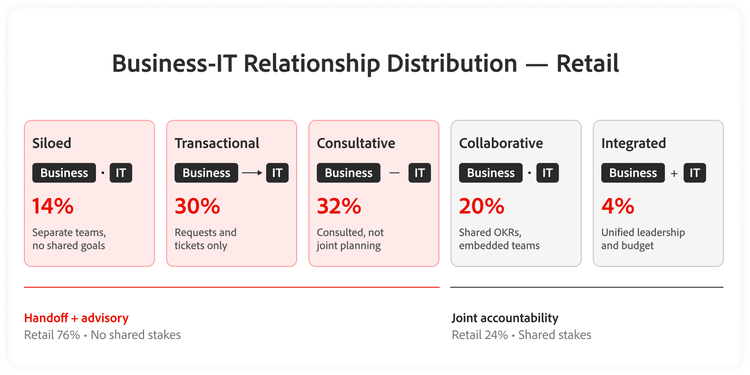
Distribution of Business-IT operating relationships in Retail.
Retail marketing teams already adjust audiences, offers, content and campaigns as customer behaviour and performance data change. AI can increase the pace at which those decisions need to be made. Yet many retail organisations still manage business-IT collaboration through sequential handoffs.
Whether the relationship is Siloed, Transactional or Consultative, the pattern is similar: business teams submit a requests and technology teams respond. This approach reflects annual planning cycles, platform roadmaps and fixed campaign calendars. It does not support the faster testing, adjustment and shared decision-making that AI requires.
Collaborative and integrated relationships bring marketing and technology partners together when the work is defined. Shared objectives and key results give both teams responsibility for delivery and the business outcome. When customer marketing, ecommerce, marketing operations and data engineering agree on the goal, briefing, build decisions and measurement follow the same direction. Teams can then resolve data, integration and timing issues as the work progresses.
The Measurement Gap — Only 11% Measure ROI Comprehensively
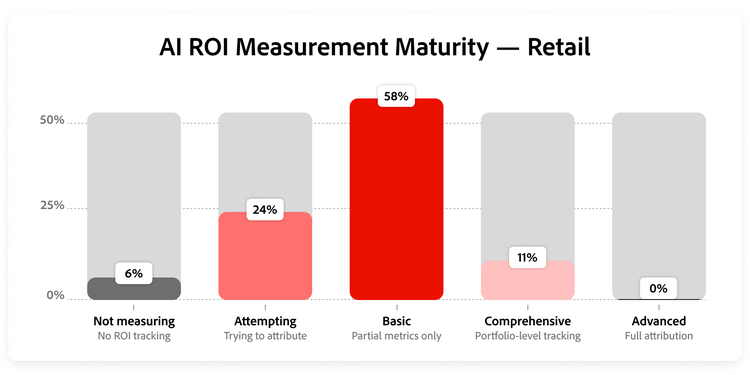
ROI maturity distribution in Retail.
As AI becomes part of everyday retail marketing, teams need to measure more than output. They may track recommendations served, audiences segmented, creative variations produced or hours saved. These measures confirm activity and efficiency, but they do not consistently show whether AI improved engagement, conversion, basket size, repeat-purchase rates or customer retention.
Stronger measurement begins before launch. Teams define the intended customer or commercial outcome, record a baseline and agree on how incremental impact will be assessed. Once a campaign is in market, promotional activity, seasonal demand, inventory availability and media investment can make AI’s contribution difficult to separate. The same applies when assessing whether a personalised experience reached the customer at the right point.
Clear pre-deployment measurement gives marketing leaders credible evidence for planning and budget discussions. It also allows teams to compare use cases, improve weaker workflows and decide which initiatives warrant continued funding or wider deployment.
Part Two
What Leaders Do Differently
Real Ownership — AI Scales When a Named Leader Is Accountable for It

Leaders are 3.6x more likely to have a formal AI owner with a title and budget authority. In retail, 25% of organisations have named one. Leaders are also 3.3x more likely to undertake business-IT collaboration, as well as 4.0x more likely to measure ROI comprehensively.
AI can touch many parts of retail marketing and customer experience. Examples include digital marketing, ecommerce, loyalty, creative and the data and technology teams that support them. As work crosses these boundaries, part-time owners, committees and project-based leads may lack the authority to resolve competing priorities.
Leaders address this by appointing a named AI leader with a formal title, clear mandate and budget authority. That person can make decisions across functions when personalisation, loyalty, promotional or customer-experience priorities conflict. Formal ownership also creates a point of accountability for portfolio choices, measurement expectations and cross-functional escalation.
The named AI leader’s mandate needs to extend across marketing, commerce, shop operations, data, technology and customer experience rather than stopping at the boundary of the function where the role originated. Organisations can establish that authority within existing structures without replacing reporting lines or governance.
Day-One Measurement — Leaders Define Success Before an AI Use Case Launches
Leaders treat measurement as a condition of deployment, giving marketing a clearer basis for investment decisions.
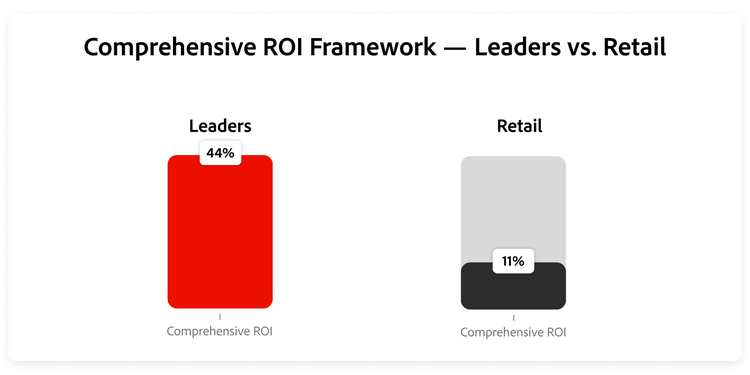
Share with Comprehensive or Advanced ROI framework. Leaders cohort: 342 organisations across all 12 industries.
Retail marketing leaders need more than evidence that an individual initiative worked. They also need to know whether the organisation is getting better at deploying AI and have a consistent basis for funding and scaling decisions. Leaders build measurement into the design of each AI use case. The data showed that 44% of Leaders have a comprehensive return on investment framework, compared with 11% of retail respondents.
A comprehensive framework considers two dimensions. The first is incrementality. This may involve a holdout group, geographic test or another comparison that helps isolate causation. Without it, an increase in conversion, basket size or retention may reflect seasonality, promotional activity, media investment or a market that was already moving. The second dimension is improvement in ways of working. Teams can track whether the time from idea to production is shrinking, whether more initiatives are surviving the approval process and whether Business and technology are resolving decisions faster. One dimension shows whether the use case created value. The other shows whether the organisation is improving its ability to deploy AI.
Timing is especially important for use cases linked to changing customer behaviour. Once a campaign, offer or personalised experience influences that behaviour, the original baseline becomes difficult to reconstruct. Leaders record current performance, agree on key performance indicators and define the comparison method before launch. They then assess the same measures after deployment, giving decision-makers a clearer basis for continued investment and wider adoption.
Genuine Partnership — Business and IT Share Accountability Outcomes
Among Leaders, 81% operate at the collaborative or integrated level, compared with 24% of retail respondents.
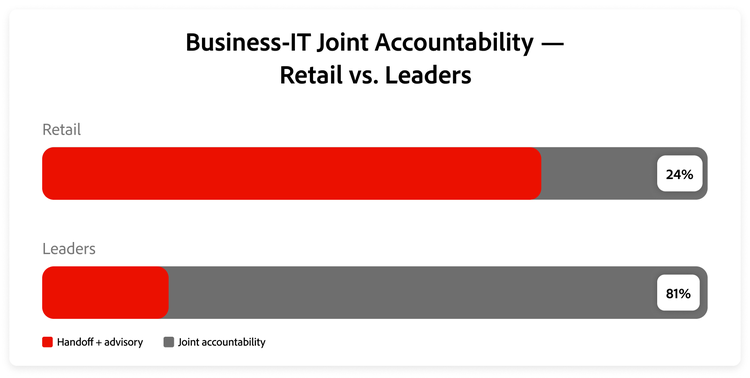
Joint accountability = Collaborative + Integrated. Handoff + Advisory = Siloed + Transactional + Consultative.
AI-supported retail marketing depends on customer data platforms, loyalty systems, point-of-sale data and ecommerce platforms. A sequential handoff creates friction whenever data, technical support or measurement must move between teams. Many retail respondents remain siloed or transactional; others are consultative, meaning IT advises business teams without sharing accountability for the outcome.
Across the 342 Leaders, collaborative and integrated relationships are the norm. Marketing and technology partners are involved when the brief is created. Customer marketing, ecommerce and loyalty teams develop the scope with data engineering or IT rather than handing over a completed request.
Shared accountability continues through delivery and measurement. When marketing and data engineering leaders share the same conversion or repeat-purchase goal, the brief, build decisions and measurement follow one direction. When both are also accountable for how the work moves from idea to production, collaboration becomes part of the operating model. Leaders establish this partnership through shared objectives and key results within existing reporting lines, allowing teams to work together without requiring a reorganisation.
Learning Culture — Leaders Turn Underperformance into Shared Learning
Among the respondents, 23% report destructive failure patterns, including blame or repetition. Among the 342 Leaders, the figure is under 1%. Failure response is closely associated with whether an organisation scales.
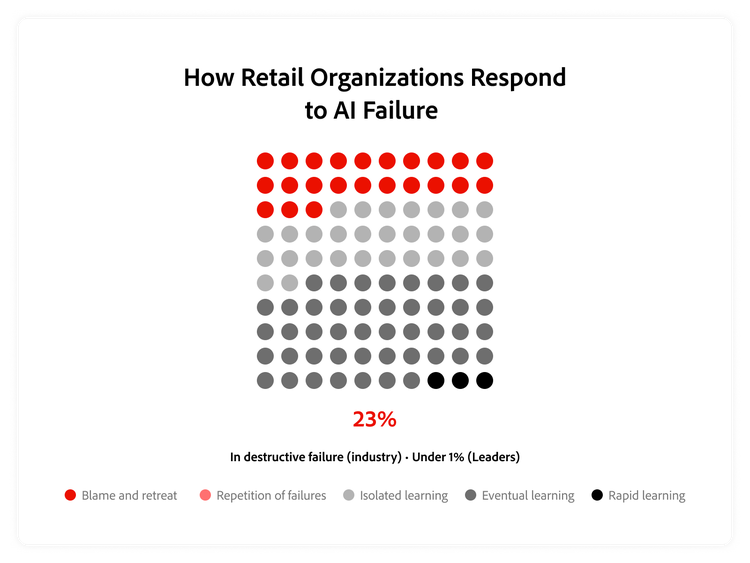
Each dot represents one of every 100 Retail organisations. Destructive = Blame and retreat + Repetition of failures.
Retail marketing operates on compressed timelines. Seasonal campaigns are planned around promotional calendars, while personalisation programmes depend on inventory availability. When an AI initiative underperforms within that cycle, teams may move quickly to the next campaign. The work continues, while the failure remains unexamined.
That decision affects other teams. Shop operations, loyalty and digital marketing may carry the same flawed assumptions into the next initiative. A recommendation model that underperforms or a loyalty trigger that misfires contains information the wider organisation needs. Without a shared learning process, another team may repeat the mistake.
A learning culture becomes visible in operating reviews. The named AI leader creates time for discussion, allowing teams to examine what underperformed, why it happened and what should change. When senior marketing leaders make this part of campaign and seasonal performance reviews, lessons can be shared across functions and applied to future work.
Empowered Champions — Give Proven AI Practitioners the Support to Lead by Example
Among Leaders, 42% identify empowering internal champions as their most effective culture action, ahead of executive sponsorship at 16% and formal training at 11%.
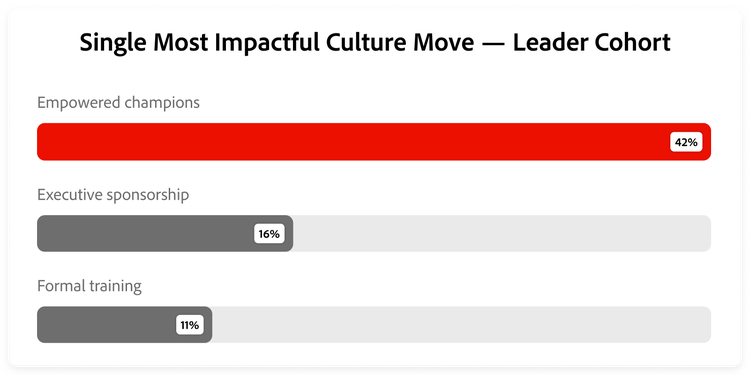
Leaders' top-cited culture lever. n = 342 Leaders across all 12 industries.
People are more likely to adopt AI when they see a colleague use it in familiar work. In retail, that may be a campaign manager using audience segmentation to sharpen a seasonal brief, a loyalty manager applying lifecycle modelling to retention offers or a creative producer using AI to generate on-brand variants of a hero asset across regional campaigns.
Leaders identify these practitioners as champions and give them a small budget, recognition and permission to experiment and extend their approach to an adjacent team. Evidence from a market, channel or workflow carries more weight than centralised training alone. Champions build influence by showing business results and improved ways of working.
Embedded AI leads within business units or functions can help practitioners extend proven approaches. Centres of excellence can support them through evaluation methods, governance guidance and tools. Stronger relationships between marketing and technology partners can then make it easier to adapt effective practices across teams.
5 Moves to Build an Operating Model that Scales AI
These actions translate the Leader behaviours into practical steps for retail marketing and customer experience leaders. None of them require a full reorganisation. What they do require is new authority and new ways of working layered onto that structure.
Appoint an executive with a clear mandate and budget authority across marketing and customer experience. This may be the chief marketing officer, head of customer experience, a new AI leader or another senior leader positioned to work across functions. Existing reporting lines can remain, but the AI leader must be able to resolve priorities and make decisions when work crosses teams.
A before-and-after comparison may not be sufficient on its own. Build in a holdout or control wherever feasible so that any lift can be attributed more confidently to the AI use case. Teams should align on the attribution method and test design before launch. Depending on the use case, the target may include engagement, conversion, revenue, retention, cost efficiency or time-to-value.
Give marketing and its technology partners shared objectives and key results. AI initiatives succeed when teams are working the same innovation roadmap, prioritising the use cases that move shared business goals and aligning on the same definition of success. Shared goals let teams resolve data, integration and prioritisation decisions together - advancing a common agenda rather than through sequential handoffs.
Make underperformance visible in campaign and operating reviews. Examine what the model got wrong, which assumptions failed and what should change in the data, workflow or controls. When senior leaders discuss setbacks openly and preserve accountability, teams learn to treat failure as diagnostic evidence that can improve the next deployment.
Identify practitioners already applying AI effectively in loyalty and campaign execution, ecommerce, content creation or customer experience. Give them recognition, a small budget and permission to extend their approach to one adjacent team. Document the workflow, conditions, controls and results as a practical playbook that others can evaluate and adapt without bypassing established governance or measurement requirements.
Conclusion
Turn AI Vision into Operating Value
AI is redefining how retailers understand customers, create content and orchestrate experiences across digital and physical channels. Capturing that potential takes more than access to models. It takes a unified data foundation, a connected content supply chain and the governance and operating disciplines needed to put AI to work with confidence.
That is what Adobe is built for. Adobe Experience Platform brings customer data together as the intelligence layer for AI, powering over a trillion experiences a year. Adobe CX Enterprise extends that foundation into an end-to-end agentic system that orchestrates the full customer lifecycle, from first interaction to lasting loyalty, while an integrated content supply chain embeds AI directly into creative and production workflows, grounded in brand standards and shared governance.
The result is a path beyond AI experimentation and into value realisation, on an open ecosystem that works across the tools teams already use. When you are ready to scale, Adobe brings the technology and expertise to help retail organisations turn AI into a lasting competitive advantage.
About Adobe
Adobe empowers organisations to create impactful digital experiences. Our portfolio of customer experience products and services helps businesses put every interaction in context, understand what each customer needs right now and design and deliver digital experiences that build loyalty and drive growth. Visit adobe.com to know more.
About Incisiv
Incisiv is an industry insights and strategy firm combining close to a decade of industry trend data with primary research, messaging architecture and content development to help enterprises navigate transformation, evaluate solutions and unlock growth.
Recommended for you
https://main--da-bacom--adobecom.aem.page/fragments/resources/cards/thank-you-collections/retail