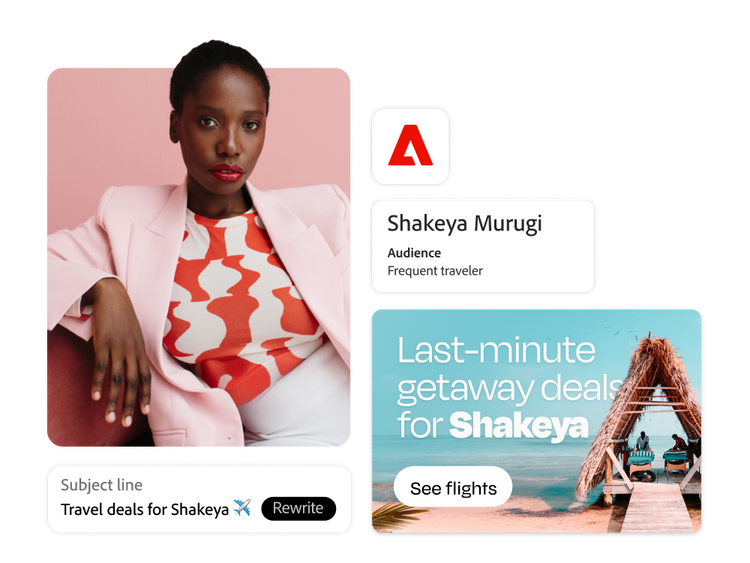
If you shop online, you’re familiar with product recommendations. Every time you visit your favourite brand’s website, you’ll see a list of products recommended just for you based on your search history, your past purchases and countless other data points. Artificial intelligence (AI) and machine learning algorithms synthesise search and purchasing behaviour, trying to determine exactly what you want to see in real-time.
Product recommendations play a large role in ecommerce adoption. Static or manually built lists can’t keep up with how people shop today. Customers expect product suggestions that respond to what they’re looking for in the moment. AI and machine learning algorithms power automated recommendations to ease the customer journey based on previous search and purchasing behaviour.
This article will cover:
- What are product recommendations and why are they important
- Adding product recommendations to your online store
- Strategies for product recommendations that sell
- Getting started with product recommendations
What are product recommendations and why are they important?
Product recommendations are product listings that are customised for individual website visitors based on data about them, their behaviour, their preferences or the behaviour and preferences of similar shoppers. You can provide product recommendations even for customers who haven't got a profile or an account with your business. Common types of recommendations include:
- Bestsellers
- Hot right now
- Recommendations for you
- You might also like
- Trending
- Products like this
Product recommendations help connect large product catalogues with a customer’s specific interests, making their shopping experience more intuitive and seamless. By surfacing the right items at the right moment, you can naturally improve key metrics such as conversion rates and average order value while building deeper customer loyalty through a more personalised experience.
Adding product recommendations to your online store.
In the past, implementing AI-driven recommendations usually meant a choice between a large, customised-coded development project or high-priced third-party service fees. Today, the barrier to entry is much lower.
Many ecommerce platforms now include recommendation engines as part of their core features. If you already run an online store, it’s worth exploring the recommendation tools your platform may already provide. And if you’re choosing a new platform, make sure personalised recommendations or easy integration with a recommendation engine, are part of your requirements.
Here’s a simple way to choose the right ecommerce platform or extension:
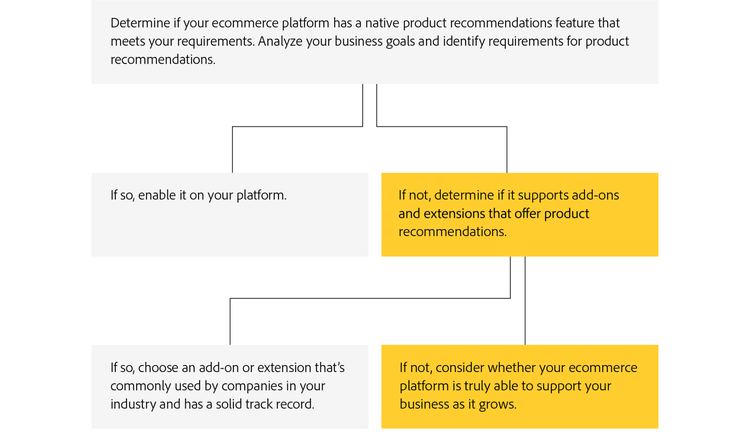
Source: Product Recommendations for Beginners (Adobe eBook)
Adobe Commerce provides AI-powered product recommendations that help merchants surface relevant products across the shop front. Using aggregated shopper behaviour and catalogue data, Adobe Commerce can identify patterns such as products often viewed, bought together or likely to interest a shopper based on behaviour signals. This makes it easier to deliver relevant recommendations without manually organising your catalogue.
Strategies for product recommendations that sell.
Product recommendations can be used in almost any location on your site to connect with customers and encourage them to buy. Here are the most effective strategies used by leading brands today:
1. Leveraging social validation.
Promoting your best-selling products is one of the simplest and most effective forms of product recommendations. If many other customers like them, chances are your new customers will too. Customers also like to see that other people are buying a product, so a “bestseller” or “top seller” label is enticing.
Social proof further builds this trust. By recommending products with the highest view-to-purchase conversion rates or displaying star ratings and review snippets, you prove value to the customer. This encourages them not to miss out on a great item that others are already happy with.
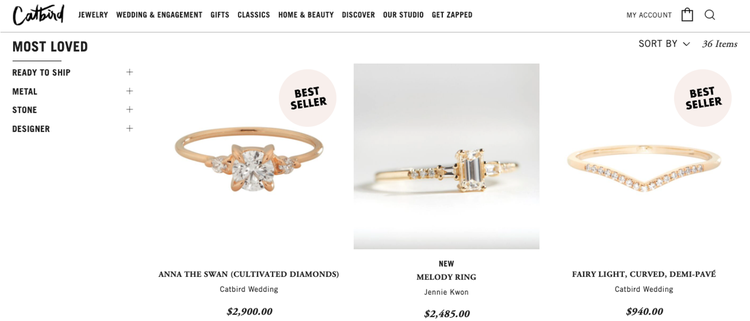
Catbird uses product recommendations in Adobe Commerce to connect customers with their most-loved jewellery.
2. Driving urgency and discovery.
Highlighting products customers are already searching for during certain seasons or holidays can be highly effective. AI analyses browsing and purchase data to identify which products are gaining momentum. Pairing these trending items with sales or discounts gives customers a compelling reason to buy straightaway.
3. Contextual and behavioural targeting.
Powerful personalisation is based on transactional and behavioural data. This includes location-based recommendations (like local weather or trending items in a specific postcode) and browsing history. Shoppers see recommendations based on their current and previous onsite behaviour, which is most effective on the home page where the journey begins.
You can also use similar products, upselling and cross-selling. These strategies help shoppers discover alternatives, upgraded versions or complementary items without navigating multiple pages. This lowers the burden on shoppers and can make a difference in their shopping journey. Similar product recommendations show comparable options, upselling highlights premium versions of a product and cross-selling suggests items that pair naturally with a purchase. In visually driven categories like fashion or home room, surfacing visually similar products can be especially powerful because images often drive purchasing decisions.
To help your recommendations stand out, use clear, action-orientated labels. Here is a summary of labels used by retailers:
- Best sellers - Most popular, bestsellers and top sellers
- Trending Products - Trending now, recently trending and hot products
- Social Proof - Highest rated, most loved and popular products
- Browsing History - Just for you, recommended for you, take another look and recently viewed
- Purchase History - Inspired by your shopping trends, frequently bought together and customers like you also bought
- Similar Products - More products like this, similar to this and inspired by this style
- Cross-selling - Customers who viewed this also viewed and customers ultimately purchased
- Upselling - Get everything you need and don't forget these
- Basket & Checkout - Still interested in these, customers also bought and frequently purchased together
4. Conversational discovery and generative AI.
The way people find products is shifting from "search" to "conversation." By integrating AI shopping assistants, your site can understand natural language intent. Instead of a customer searching for "waterproof boots," they can ask, "What should I wear for a rainy hike in the Pacific Northwest?" AI-powered recommendations then curate a complete look based on the specific context of their request.
5. Post-purchase and replenishment.
The customer journey doesn’t end after a purchase. Confirmation pages, follow-up emails and mobile notifications are valuable opportunities to recommend products that complement what the customer has already bought.
For consumable goods, timing is critical. AI can analyse purchase patterns to predict when a customer may be running low and trigger timely refill reminders through email, SMS or push notifications.
For durable goods, recommendation strategies should shift accordingly. A recommendation engine should recognise when a customer has already purchased a high-value item and avoid recommending it again. Instead, it can surface accessories, protection plans or related categories that enhance the original purchase.
6. Social commerce integration.
Don’t limit your recommendations to your own website. By syncing your product catalogue with social platforms like Instagram, TikTok and Pinterest, you can promote relevant products directly within social experiences. This helps connect discovery and purchase by allowing shoppers to find products where they already spend their time.
7. Omnichannel placement and user experience (UX) optimisation.
To be successful, recommendations must be easy to locate and visually appealing. The best locations include the home page, category pages, individual product details, the basket and even search queries via Natural Language Processing (NLP).
- Email Campaigns: Use customer profiles to send relevant recommendations directly to their inbox.
- Basket & Checkout: This is a final opportunity to cross-sell "frequently bought together" items.
- Visual Design: Use hero banners or carousels that activate based on conditions, such as weather or inventory levels. Further down the page, include 3-6 individualised recommendations; any more is too many.
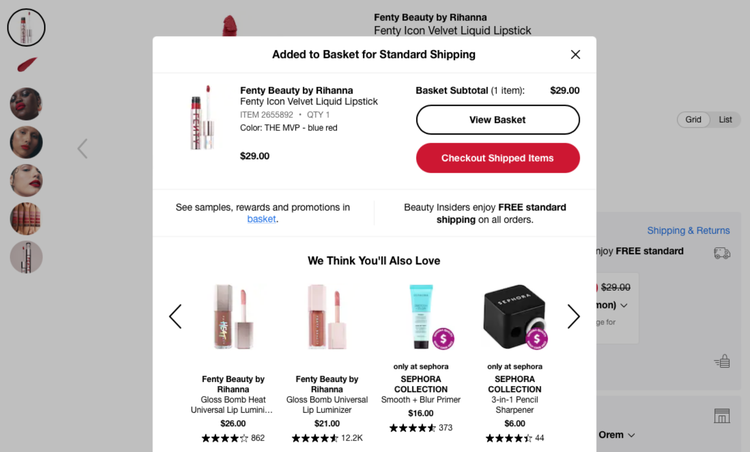
Sephora gets great results by including product recommendations on the checkout page.
8. Test and experiment with your recommendations.
You won’t know which product recommendation strategies will perform best until you test them. Once you’ve added product recommendations to your web store, tracking their performance over time and adjusting recommendations is critical.
Here are some key metrics to track for each recommendation:
- Impressions - The number of times a suggestion is loaded and rendered on a web page.
- Viewable impressions - The number of times a recommendation is shown to a shopper and is visible.
- Click-through rate - The percentage of a recommendation’s viewers who click it.
- Viewable click-through rate - The percentage of those shoppers who’ve seen a viewable suggestion and then click it.
- Conversion rate - The percentage of shoppers who buy a product after interacting with a recommendation.
- Revenue - Revenue driven by a product recommendation, equal to the total value of products that were clicked in a recommendation and were ultimately purchased.
- Lifetime revenue - Lifetime revenue driven by a product recommendation, equal to the total revenue generated by a suggestion from the time it was created.
Besides monitoring performance, use A/B testing to experiment with different product recommendation methods to see which strategies perform best in each page category.
Getting started with product recommendations.
Personalised product recommendations must be part of the customer experience. Ecommerce platforms now put them within reach for virtually any business, including yours.
Book an Adobe Commerce demo to find out how to increase your conversion and average order value with AI‑powered discovery now.