Adobe is sharing new e-commerce data today for October 2025, with early deals enticing some consumers to get a head start on holiday shopping. The month also saw a shift in generative AI usage, with rising traffic to U.S. retail sites that now coverts better than non-AI traffic sources.
Based on Adobe Analytics data, Adobe provides the most comprehensive view into U.S. e-commerce by analyzing commerce transactions online, covering over 1 trillion visits to U.S. retail sites, 100 million SKUs and 18 product categories. Adobe Analytics is relied upon by the majority of the top 100 internet retailers in the U.S.* to deliver and measure shopping experiences online.
Strong growth online, propelled by Prime Day event.
Consumers spent $88.7 billion online in the month of October, up 8.2% year-over-year (YoY). Mobile continued to drive the majority of online spend, at 51.4% share ($45.6 billion, up 11.6% YoY) vs. desktop shopping. Additionally, 'Buy Now Pay Later’ drove $7.1 billion in spend (up 7.6% YoY), as consumers looked for greater flexibility in managing their budgets.
Online spend spiked on Oct. 7 and Oct. 8 during the Prime Day event, where discounts happened broadly across U.S. retailers. Across those 2 days, consumers spent a total of $9.1 billion online (up 7.3% YoY), driven in part by competitive discounts that peaked at 18% off listed price.
In October, holiday décor was a popular purchase with online sales rising 130% (vs. average spend levels in September), as well as items for the home—with consumers taking advantage of deals to upgrade their living spaces. Online sales rose 83% for hand tools and 62% for power tools, an indication of more DIY projects; Sales of refrigerators & freezers were up by 55%. Other categories with strong growth included e-readers (up 81%), headphones & speakers (up 52%), phone accessories (up 51%), and video games (up 41%). Outerwear was another popular category (up 38%) as consumers prepped for the upcoming winter season.
AI-powered shopping hits an inflection point.
During the 2024 holiday shopping season, Adobe observed the first material surge in generative AI traffic to U.S. retail sites (measured by shoppers clicking on a link). Between Nov. 1 and Dec. 31, 2024, traffic from generative AI sources increased by 1,300% YoY. On Cyber Monday, generative AI traffic was up 1,950% YoY. And while generative AI traffic remains modest compared to other channels, such as paid search or email, the uptick has been notable.
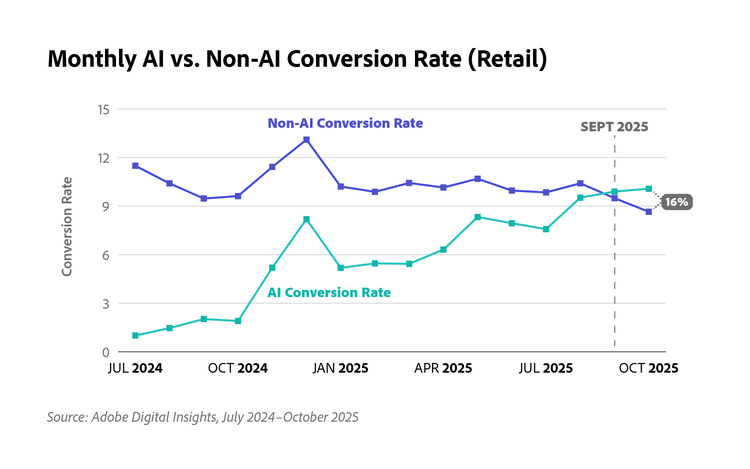
New data from Adobe shows that generative AI traffic is not only rising—but also driving higher conversion (visits that become purchases) than non-AI traffic. In October, traffic from generative AI sources increased by 1,200% YoY. And once these consumers landed on a retail site, they were 16% more likely to convert. This is compared to non-AI traffic sources such as paid search, affiliates & partners, email, organic search, and social media. This is the second month in a row where conversion has been higher for AI traffic (5% more likely in Sept).