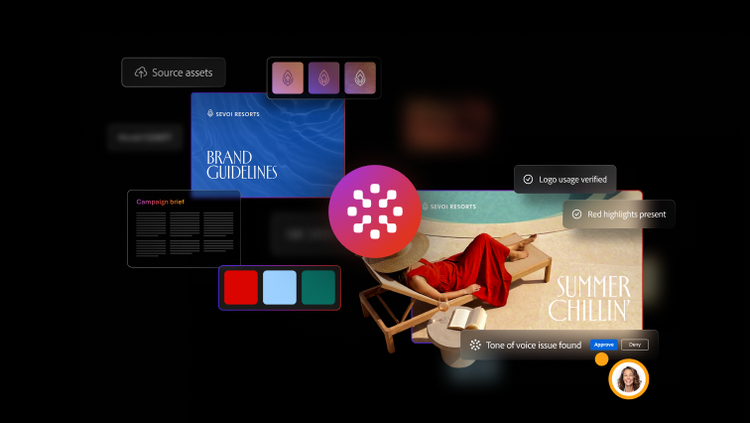
Brand intelligence that detects, interprets, and learns.
Claudia de Lavalle and Navjot Matharu
11-10-2026
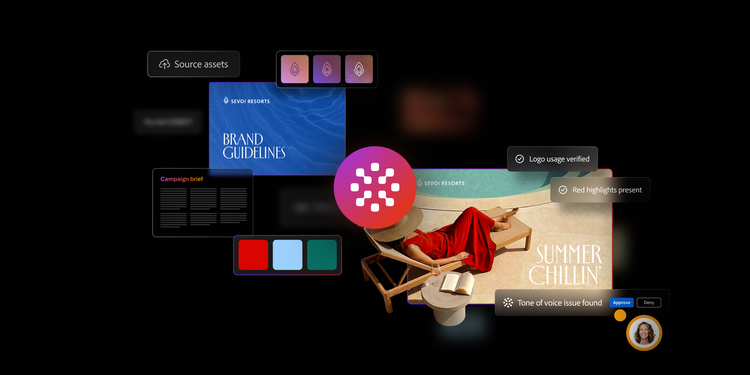
Brand guidelines were written for people, and that is the problem.
Every enterprise brand runs on documents written by people, for people. Open any brand book and the instructions read like advice from a colleague.
Give the logo room to breathe. Use the secondary palette sparingly, for accent rather than emphasis. Our voice is confident, never arrogant.
This advice isn’t meant to be vague, but rather efficient, because it has historically only needed to provide a mere reference point. The brand reviewer’s judgment, expertise, and institutional knowledge supply the rest.
That judgment is what holds a brand together, and it is the first thing to break when volume grows. As content expands across new channels, audiences, and markets, human bandwidth runs out and the permutations of every guideline multiply at the same time.
A reasonable solution might be to convert those documents into machine-checkable rules and let automation handle the production and scale, but eventually that creates more work than it saves. A machine cannot act on the rule "give the logo room to breathe," so someone must restate it as “25 points of clear space,” then specify what that means for every format the logo appears in. When the human-facing guidance changes, someone has to go find the matching rule and change it too. The brand team ends up maintaining two rulebooks, which is avoidable if the system can work from the guidelines you already have.
There’s also a bigger question: What is brand governance actually for? Creative directors know that great work sometimes means intentionally pushing beyond established brand conventions to make a campaign stand out. A system that can only flag what’s off-brand risks becoming the brand police — something teams work around rather than rely on. Enterprises don’t need a stricter brand checker. They need a system that understands their brand deeply enough to distinguish a creative choice from a genuine mistake.
Brand checkers enforce rules. Adobe Brand Intelligence understands intent.
Adobe Brand Intelligence was built around a simple idea — a system that governs a brand should learn the way an experienced brand expert does. It needs to see what’s actually in front of it, understand what the brand means in context, and learn from the decisions made over time.
That distinction matters because many tools on the market treat brand governance as a collection of features: upload a brand kit to check logos and colors, define a voice to guide copy, or lock a template to keep layouts consistent. Those capabilities can be useful, but they apply fixed rules to something that is constantly evolving.
Brand knowledge isn’t a file you upload once. It’s the accumulated judgment of a team — captured partly in guidelines, but also in years of approvals, corrections, exceptions, and creative decisions.
What separates true brand intelligence from feature-level brand checkers is the combination of three capabilities: vision, reasoning, and continuous learning.
Vision reviews what’s in the creative, reasoning understands which brand guidance applies in context, and continuous learning incorporates the decisions and feedback that shape how the brand evolves.
Together, they allow brand review to move beyond checking fixed rules and toward recognizing and applying brand judgment at scale. Each capability solves a different part of that challenge, so it’s worth looking more closely at how each one works — and why all three are necessary.
Vision purpose-built for content.
General-purpose vision models answer a broad question: What’s in this image? They can identify and roughly locate people, products, or logos, but brand review demands far greater precision. Is the logo the correct variant with sufficient clear space? Does the gradient hold the approved color ratio? Does the typeface hold the correct weight, case and spacing?
For enterprise use, being mostly right isn’t enough. At 70% accuracy, every finding still requires human verification, undermining the efficiency these systems promise. False negatives miss real violations, while false positives flag issues that don’t exist, which wastes time to correct. Over time, repeated false alarms erode trust in the system altogether.
That’s why Adobe uses proprietary vision models purpose-built for creative and brand content. Backed by more than a decade of Adobe research, these models analyze the complete creative — visual and textual elements, their boundaries, and spatial relationships — rather than simply describing what’s in an image. This gives Adobe Brand Intelligence the precision to evaluate exact typefaces, font weights, logo variants, distortion, approved colors, gradients, clear space, alignment, text overflow, and image focal points. It’s brand-level intelligence, not a general-purpose model with a checklist of brand rules. Reasoning instead of rules.
A rules engine needs an explicit condition for every scenario. A reasoning engine works differently — it considers brand guidance, campaign context, and the asset itself to determine which principles apply and how to evaluate them.
Consider a guideline requiring clear space around a logo. A rules-based system applies a fixed measurement unless someone creates separate rules for different formats. A reasoning system interprets the intent behind the guidance and evaluates it in context. It can also decode implicit expectations, such as avoiding headlines across faces, even when those requirements aren't explicitly documented.
Adobe Brand Intelligence takes this further by turning brand guidance into structured knowledge that captures what a guideline means, when it applies, known exceptions, and visual examples of correct execution. Rather than simply translating written instructions into rigid rules, it preserves both the principle and the context needed to apply it intelligently.
Crucially, this intelligence is grounded in an organization's own brand expertise. As reviewers provide feedback, approve assets, and make exceptions, their judgment helps inform how guidance is applied.
Instead of requiring experts to anticipate and write rules for every possible scenario, Adobe Brand Intelligence enables their expertise to travel and scale with the work.
Continuous learning: accuracy that compounds.
Even the most advanced vision and reasoning models cannot deliver true brand intelligence at scale without continuous learning. Adobe Brand Intelligence is designed to work as an extension of your team, building on documented guidelines and growing smarter through reviewer feedback, campaign context, and local brand guidance.
The goal isn't simply to accumulate more rules or exceptions. It's to learn the principles behind expert decisions so they can be applied across future assets, formats, and markets. For example, if reviewers consistently reject product photos that crop off a key feature but accept ones that crop the background, the system can learn the principle behind it: protect what defines the product, flex on the rest. That lets it make the right call on a new product, format, or market, without anyone having to write a rule for every possible scenario.
Importantly, human oversight remains central. Brand experts control which learnings are adopted, refined, or rejected, ensuring that individual feedback doesn't inadvertently redefine brand standards.
The result is a system that evolves alongside your brand, capturing institutional knowledge and scaling expert judgment rather than simply adding rules. Continuous learning doesn't replace your people — it makes their expertise more valuable over time.
Brand as an accelerant instead of a brake.
Vision, reasoning, and continuous learning deliver the most value when they work together. Vision establishes what the asset consists of. Reasoning determines what guidance applies based on the context. Continuous learning closes the loop, using what reviewers approve, correct, or override to improve how the system approaches future work.
Together, those capabilities can change the role of brand governance. Brand review has historically acted as a brake, which is why creative teams so often end up at odds with it.
Adobe Brand Intelligence creates the opportunity for governance to become an accelerant instead. A system that can review precisely, apply reason to context, and learn from your experts is better equipped to distinguish an intentional creative departure from a genuine mistake — all while keeping brand teams in control of the principles that guide those decisions.
The result is less rework and earlier guidance. Instead of waiting until the end of the creative process to discover a problem, teams can apply brand intelligence while content is being developed. Expertise that once sat with a handful of experts now travels with the work, so a designer creating an asset, a regional marketer adapting a campaign, and an agent producing variations all work from the same evolving understanding of the brand.
Learn more about how Adobe Brand Intelligence helps ensure your content remains true to your brand.
Recommended for you
https://business.adobe.com/fragments/resources/cards/thank-you-collections/brand-intelligence