Most enterprises deploying AI can tell you how many people are using it. Far fewer can tell you whether it's working.
Total usage volume is visible, but that's the easy part. The operational layer underneath it where workflows succeed or fail, where users experience friction, what's driving costs largely isn't.
That gap showed up consistently in our research with enterprise AI governance leaders, center of excellence (COE) stakeholders, and operational teams. Organizations could track surface-level signals like active users, prompt volume, and feature adoption. What they couldn't see was whether any of it was actually improving outcomes, or quietly introducing friction at scale.
The leaders we spoke with didn't frame this as an access problem. They framed it as an accountability problem, shifting from asking, "who has AI?" to, "is it delivering value, and how do we know?"
Building an operational visibility layer.
Addressing this gap requires moving beyond usage reporting toward genuine operational visibility, the same way enterprises have built observability layers for analytics platforms, cloud infrastructure, and customer journey systems. AI now needs its own observability foundation that answers questions like: who is using AI and how, where are users experiencing friction, and how does AI activity connect to business outcomes? Adobe's agentic AI monitoring dashboard can help.
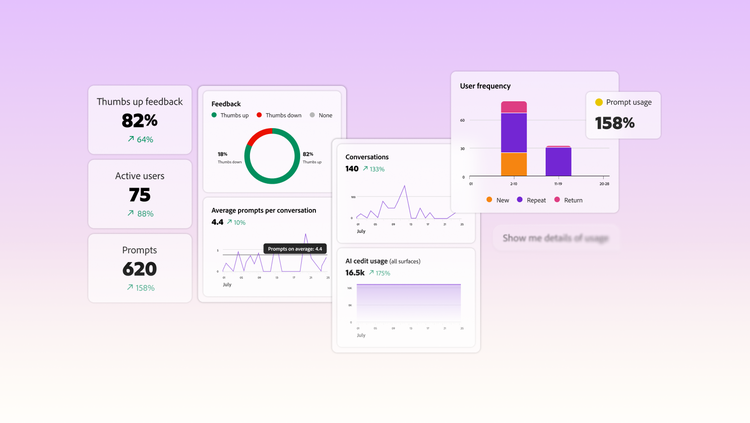
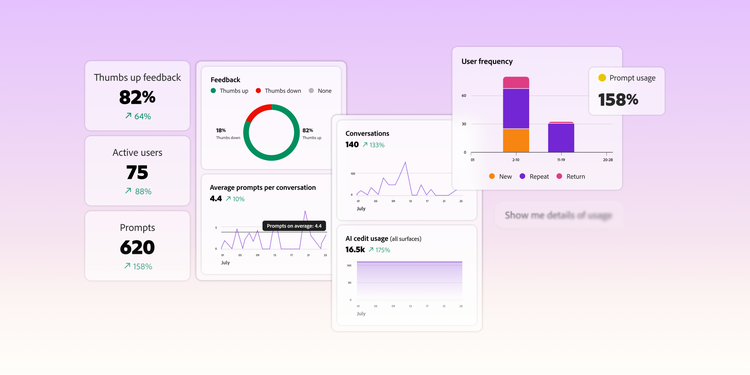
The agentic AI monitoring dashboard is a new operational visibility tool designed for enterprise AI governance teams, bringing together adoption signals, workflow performance, user feedback, and cost consumption in one place. Accessible from the Adobe CX Enterprise application homepage to users who have been granted permission from their organizations, it includes four capabilities:
- Overview dashboard: provides adoption trends, prompt volume, and feedback signals at a glance
- Users dashboard: classifies users as new, repeat, return, or inactive to distinguish experimentation from sustained adoption
- Feedback dashboard: surfaces which interactions users rated positively or negatively, and why
- AI Credits dashboard: tracks consumption trends and remaining entitlements for proactive planning
Together, these four views give enterprise teams a single place to move from signal to understanding, not just what's happening, but why.
The building blocks of enterprise AI observability.
Each of the capabilities mentioned above addresses a distinct layer of the visibility problem. Here's how they work in practice.
Adoption and engagement visibility.
Organizations need visibility into how AI is being adopted across teams and workflows, active users, conversation trends, engagement patterns, and signals over time. These help COE teams identify where adoption is growing, where enablement is needed, and which workflows drive the highest value.
Our research found that enterprises increasingly distinguish between initial experimentation and sustained operational adoption. Long-term adoption was tied most closely to whether AI consistently reduced effort, integrated naturally into workflows, and produced reliable outcomes not to early curiosity or trial usage.
The Users dashboard addresses this directly, classifying users as new, repeat, return, or inactive, so COE teams can track whether adoption is deepening or plateauing after the initial rollout.
Workflow and interaction visibility.
Understanding adoption is only part of the picture. Organizations also need to see how users interact with AI throughout a workflow, where prompts get retried, where workflows fail or go incomplete, and where friction builds before it becomes a trust problem. This matters especially as AI moves beyond simple Q&A into multi-step, agentic workflows.
Teams in our research consistently emphasized that they needed to understand why workflows fail, not just where. Observability systems that surfaced drop-offs without context into the underlying cause, unclear system reasoning, missing business context, orchestration breakdowns, left COE teams without enough to act on. Repeated retries and workflow abandonment often signaled friction long before traditional satisfaction metrics caught it.
Conversation replay across different dashboards is built for exactly this. Rather than surfacing aggregate failure counts, it lets COE teams drill from high-level trends into individual interactions, reviewing the actual prompt, the response generated, and any positive or negative feedback submitted, so friction can be understood in context, not just counted.
Cost and consumption transparency.
As AI usage scales, cost visibility becomes a governance requirement. Enterprise teams need to understand credit consumption trends, identify high-usage workflows, track spikes across business units, and align AI activity with budget planning. Without this layer, scaling AI responsibly is difficult, and getting procurement and finance aligned is harder still.
The AI Credits dashboard tracks daily and monthly consumption trends, surfaces spikes, and shows remaining entitlements so organizations can plan proactively rather than react to overages.
Governance and operational oversight.
As AI becomes more deeply embedded in customer experience workflows, COE teams need a consolidated view of how AI is being used across the organization. Our research found governance teams rapidly evolving from policy reviewers into operational stewards, needing continuous visibility into workflow health, behavioral patterns, escalation signals, and emerging risks.
A recurring theme was that operational visibility is foundational to enterprise trust. Organizations are more willing to scale AI when they can monitor behavior continuously, investigate failures in context, and maintain confidence that governance mechanisms keep pace with the systems they oversee.
The Feedback dashboard supports this by surfacing not just thumbs up and thumbs down signals, but the categories and detailed user-submitted notes behind each one, giving COE teams the behavioral pattern visibility they need to act, not just observe. Access to the dashboard is also permission-based and scoped to authorized users, so the visibility layer reinforces the governance model rather than creating new exposure.
The path ahead.
Enterprise AI observability is still early. Today the focus is on visibility: understanding adoption, monitoring usage, and analyzing workflow performance. The agentic AI monitoring dashboard is that first layer, connecting adoption signals, interaction detail, feedback quality, and credit consumption in one place, so organizations have a foundation to build upon.
Over time, observability will evolve from passive reporting toward more intelligent operational systems that help organizations identify friction earlier, surface optimization opportunities, and continuously improve how AI performs in production. The monitoring layer will become as foundational to enterprise AI as the agents themselves.
There's more to explore here, how observability connects to governance frameworks, how COE teams use these signals to drive enablement, and how organizations can start connecting AI activity to measurable business outcomes. Each deserves its own deep dive in subsequent posts.
The future of enterprise AI won't be defined solely by how capable agents are. It will be defined by how well organizations understand, govern, and continuously improve the systems they build around them.