AI-powered brand visibility is having a moment, and for good reason. As generative search reshapes how customers discover brands, earning a citation, recommendation, or mention in an AI-generated answer has become its own discipline, with real stakes involved. Brands that fall behind or ignore this have plenty of reasons to worry.
But the race to improve brand discovery only solves one side of the problem that brands face. It gets a customer to notice you and maybe try or buy your goods and services. What it doesn’t do is answer the much harder question: Will they come back and stay? This is a significant challenge that Adobe is helping brands tackle with today’s release of Adobe Journey Optimizer Loyalty, which was announced in April at Adobe Summit.
The challenges and rewards of building loyalty.
Like trust, loyalty is much harder to earn than it is to lose. Most customers need more than six good experiences to meaningfully grow their share of wallet with a brand, but only two or three bad ones to walk away entirely. Getting someone's attention isn’t the hardest part. Keeping it is. Unfortunately, that asymmetry is becoming more severe now because the next best alternative solution to yours is just one AI-generated summary away. Which means the next time that same customer needs a hotel, a pair of running shoes, or a refill, they only need to open an AI search assistant to run the exact same evaluation from scratch, with every brand, including yours, competing from zero for that next prompt.
This easy search habit is forming fastest with exactly those customers that brands can least afford to lose. A third of Gen Z shoppers and a quarter of millennials already say they prefer asking an AI search assistant what to buy over searching the web, scrolling their social feeds, or following preferred influencers. For that growing share of customers, discovery isn't a moment a brand has to win once. It's a default starting point for each purchase, which means being found is a battle you risk fighting each time. The only way to stop fighting it is to give customers reasons to come back that have nothing to do with what an AI search assistant surfaces next time — a relationship your brand built directly that doesn't need rediscovering.
That relationship requires loyalty, but this isn’t how most brands are approaching it today.
Loyalty is a strategy focused on behavior, not a program built on membership.
Loyalty has been scoped down to an end-of-the-journey "program" when it should be much broader to include any moment a brand wants to shape behavior. Take a close look at almost any diagram of a customer journey map or marketing funnel to find any loyalty initiatives. If you do find it, it’s usually a single box near the bottom, disconnected from how the customer was acquired, how they were nurtured, or what made them choose the brand in the first place. Somewhere along the way, "loyalty" stopped meaning the discipline of recognizing and rewarding the behavior a brand wants more of, and started meaning a specific artifact, i.e., a named rewards program with a sign-up flow and a points balance that only shows up once a purchase is made. If a brand doesn't have a loyalty program, then most marketing teams often don’t think of loyalty as their problem to solve.
Unfortunately, that positioning and mindset can have real consequences. A program that only switches on after checkout has nothing to offer a customer who's still comparing, deciding, or being influenced by whatever an AI search assistant tells them in the meantime. By the time loyalty enters the picture, the moments that actually impacted the relationship have come and gone, along with the valuable information about what led to that decision.
This pre-purchase window is closing faster than most loyalty teams expect. In a recent study, 81% of retail executives worldwide believe that by 2027, generative AI will weaken brand loyalty by shifting customer choice toward whatever fits the moment — price, availability, specs — rather than the brand a customer already recognizes. A loyalty program that only shows up at checkout will never reach a customer in time to change that outcome, because by the time the program reaches those customers, an AI search assistant has already made most of the decisions for them.
Shaping loyal behavior is the goal, not adding members to the loyalty program. Treating a named, enrolled program as the prerequisite for loyalty work has kept a lot of valuable engagement strategies bottled up inside marketing teams who assume it isn't in their lane — when the real opportunity is recognizing and rewarding the right behavior wherever and whenever it happens, with or without a program attached.
Loyalty is built as a ledger when it needs to be a living system.
Most loyalty technology — regardless of how well a brand runs it — is built to do one thing well: keep score. Point balances, tier rules, redemption catalogs. A ledger's entire job is recording what has already happened. It has nothing to say about what should happen next.
That's not a knock on the ledger. Brands need an accurate, well-governed system of record for points and rewards, and most brands with loyalty programs already have one. The problem is what's missing above it: a layer that can look at a member's behavior in the moment and decide what to do about it. A brand’s loyalty experience will deliver much better results by surfacing the right challenge, sending the right nudge, or recognizing the right milestone rather than simply tallying all the activity after the fact and waiting for the next campaign cycle to react.
Even strong, well-funded programs are feeling this gap. Today, existing loyalty platforms are mature at managing points, tiers, and redemption rules, but lack dynamic orchestration capabilities. Few can personalize in real time, across channels, based on what a customer is doing right now. Most loyalty programs still run on static, one-size-fits-all benefit structures and personalization that's rule-based rather than context-aware. Brands collect enormous volumes of behavioral data, yet most of it goes unused, which means loyalty efforts remain reactive and misguided instead of getting smarter and more relevant on their own.
Loyalty is too manual and reliant on slow-moving services.
The third mistake brands make in loyalty is operational, and it's the one that compounds the first two. Even brands that want to reposition loyalty earlier in the journey or expand it past a single named program run into the same wall — the work required to make anything happen is largely manual, and much of it is done externally. In a study by Everest Group, an estimated 66% of loyalty management spend will go to services in 2026 to fund analysts and agencies to interpret data, recommend the next campaign, and manually stitch together what a ledger alone can't tell them.
Loyalty teams aren't slow to react because they lack ideas. They're slow because so much of their budget and time goes toward analyzing what happened, deciding what to do next, building the tactic, then waiting for someone outside the team to come back with a recommendation. By the time that loop closes, the moment has passed, which leaves little room for the strategic thinking that actually grows and strengthens the program.
Reaping the rewards of positioning, building, and executing loyalty well.
When teams put these fixes together, the answer becomes clear. Loyalty must be present earlier and be capable of recognizing and engaging high-potential customers before they ever formally join anything. It needs to run on a system that’s built to act on real-time signals rather than just record a balance. And it needs those signals to automatically drive actions without requiring an army of analysts and agencies to get there.
That's a different kind of infrastructure than most brands have today. It’s an intelligent experience and orchestration layer that sits on top of however the points, tiers, and rewards are managed. For loyalty and retention experiences to truly work, they must run continuously rather than getting refreshed once or twice a year.
Introducing Adobe Journey Optimizer Loyalty.
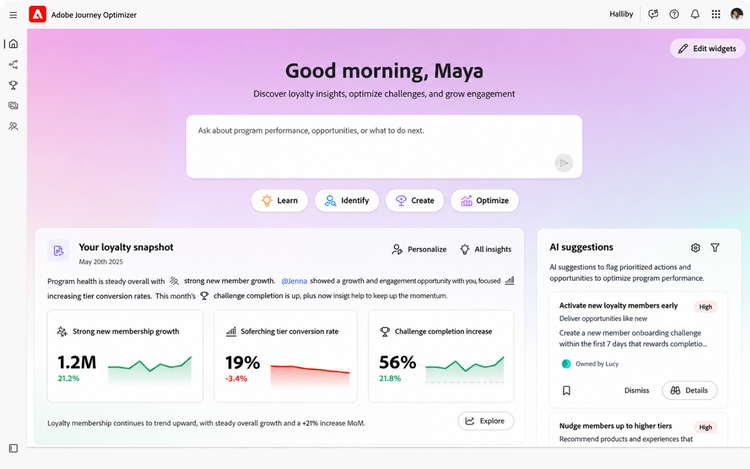
Journey Optimizer Loyalty is designed and built to add this missing layer. Rather than replacing the systems that already manage a brand's loyalty ledger, Journey Optimizer Loyalty unifies loyalty data with the rest of the customer experience, so a member's tier, transaction history, and engagement patterns become part of one connected view instead of a separate silo.
On top of the comprehensive insights and view, marketers can design adaptive, gamified challenges that drive desired behaviors, whether they are related to formal loyalty programs or not. Whether your challenges are for onboarding, retention, re-engagement, or tier progression, they can be surfaced to consumers in real time across whichever channel is most relevant to them in that moment. Running underneath all of it is powerful agentic AI that continuously analyzes what's driving engagement and churn to surface the risks and opportunities that a team might miss and recommends and builds the right tactics to act on.
The result isn't a better points engine. It's loyalty that shows up earlier and gets smarter the longer it runs. The brands that pull ahead over the next decade won't be the ones that only focus on brand visibility. They'll be the ones whose customers continuously discover good reasons to stay with them.
Learn more about Adobe Journey Optimizer Loyalty or book a demo to see how its AI-powered capabilities are redefining what loyalty and retention experiences can do for organizations and their business.