The Evolution of the DAM Librarian.

For years, organizations viewed the DAM librarian as the person responsible for keeping the repository organized. They managed metadata, maintained folder structures, defined tagging standards, supported users, and helped teams find assets.

Those responsibilities still matter.

As a Principal Business Consultant for Adobe, I work with organizations modernizing their content supply chains, and I'm seeing something interesting. The DAM Librarian isn't disappearing. The role is expanding.

The problems organizations are trying to solve today have very little to do with managing files. They're trying to answer questions like:

  • Why does content take so long to get to market?
  • Why can't teams find approved assets?
  • Why are we recreating content that already exists?
  • Why is the search producing inconsistent results?
  • Why don't our planning tools, workflow tools, and DAM platforms work together?

Those aren't DAM questions.

They're content supply chain questions.

And solving them requires a different type of leader.

Most organizations don't have a DAM problem.

They have a governance problem.

Across nearly every engagement I've supported — whether it's Adobe Experience Manager Assets, Adobe Workfront, or a broader content supply chain transformation — organizations often assume technology is the root cause of their challenges.

Search isn't working.

Metadata is inconsistent.

Users don't trust the repository.

Teams are storing content in multiple locations.

Assets are being recreated instead of reused.

But when you start tracing those issues upstream, the technology is rarely the problem.

The issue is usually a lack of governance.

No one owns metadata.

No one owns taxonomy.

No one defines how content should move through the organization.

No one is accountable for user adoption.

No one manages the relationships between planning systems, workflow systems, repositories, search experiences, and activation channels.

Eventually, the DAM becomes a reflection of organizational complexity rather than an enabler of operational efficiency. That's why governance has become one of the most important disciplines within the content supply chain.

Governance starts before content exists.

One of the biggest misconceptions I see is the idea that governance begins when content enters the DAM.

It doesn't.

Governance starts long before an asset is uploaded.

It starts when somebody submits a request.

It continues through planning, intake, prioritization, creation, review, approval, publication, reuse, archival, and eventual retirement.

This is why I often challenge organizations to stop thinking about DAM governance and start thinking about content supply chain governance.

The DAM is one component of the ecosystem.

The repository doesn't determine whether content is successful. The operating model does.

The organizations generating the most value from their content investments are governing the entire journey:

  • How work enters the organization
  • How priorities are established
  • How content is created
  • How approvals occur
  • How assets are managed
  • How users discover content
  • How reuse is encouraged
  • How performance is measured

Governance should connect all these activities into a single cohesive process.

The evolution of the DAM Librarian.

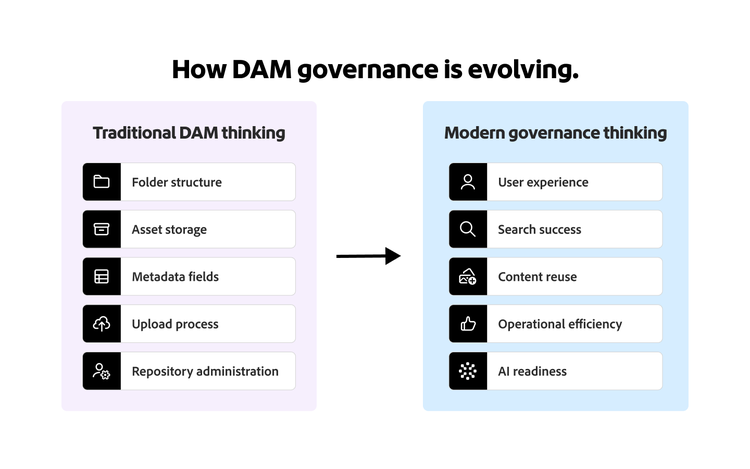
How DAM governance is evolving.

How DAM governance is evolving from managing aspects like asset storage and folder structure to user experience and AI readiness.

Historically, the DAM librarian was accountable for maintaining order within the repository.

Tomorrow's leader is accountable for maintaining order across the content supply chain.

That requires a broader set of responsibilities.

Today's governance leaders must understand:

  1. User experience

Governance isn't just about compliance.

It's about making the right behavior the easiest behavior.

If users can't find assets, governance failed.

If metadata is difficult to maintain, governance has failed.

If teams avoid the system because the process is too complicated, governance failed.

  1. Search and discovery

Search has become the front door of the content experience.

Most users don't care where an asset lives.

They care whether they can find it.

Some of the strongest governance programs begin with search use cases and then design taxonomy, metadata, and information architecture to support those outcomes. This aligns with the search-first and user experience governance approach outlined in the Adobe Customer Solutions team’s DAM governance planning work.

  1. Cross-platform governance

Content supply chains are rarely powered by a single platform.

Workfront supports planning and execution.

Adobe Experience Manager Assets manages approved content.

Search connects users to information.

Activation systems distribute content to channels.

Governance leaders must understand how those systems interact and where ownership resides across the ecosystem. Adobe’s Customer Solutions team creates governance materials that explicitly position Workfront and Adobe Experience Manager Assets as serving distinct but connected purposes within the content lifecycle.

  1. Adoption and change management

One of the most overlooked aspects of governance is adoption.

The best governance framework in the world has no value if nobody follows it.

Governance leaders spend as much time educating stakeholders and influencing behavior as they do defining standards.

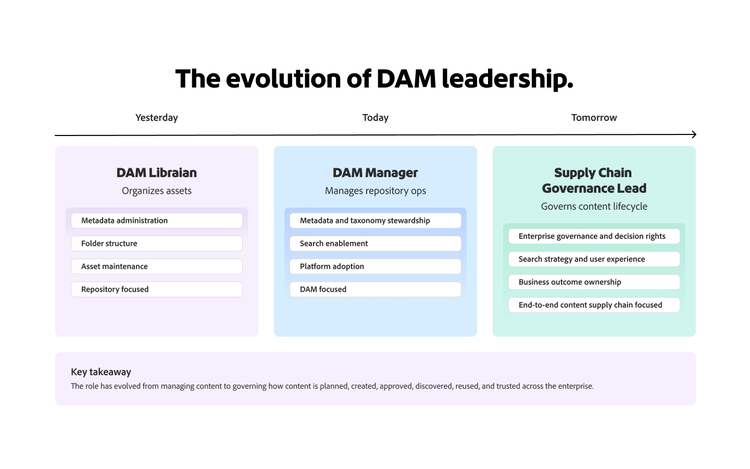
The evolution of DAM leadership.

A DAM leader’s responsibilities are evolving from asset maintenance and metadata administration to include governance and business outcomes.

Why AI makes governance more important.

AI is rapidly changing how organizations create and discover content.

But AI isn't reducing the need for governance.

It's increasing it.

AI-powered search, automated tagging, content generation, and knowledge discovery all rely on high-quality metadata, trusted taxonomies, and clearly defined ownership models.

In many ways, AI exposes governance weaknesses that organizations could previously ignore.

Poor metadata creates poor search experiences.

Inconsistent taxonomy creates unreliable results.

Unclear ownership creates confusion.

Strong governance creates trust.

And trust is ultimately what enables organizations to scale both content operations and AI capabilities.

The future role: Content Supply Chain Governance Lead.

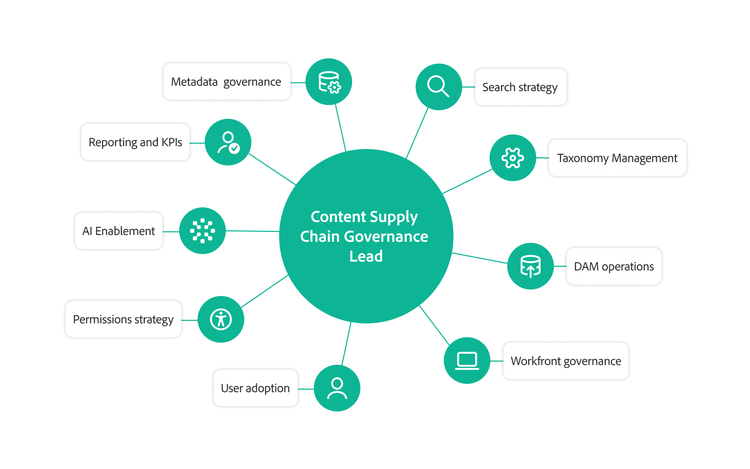
Content Supply Chain Governance Lead

The roles and responsibilities of a Content Supply Chain Governance Lead include metadata governance, DAM operations, and search strategy.

The title may vary by organization.

Some will call the role a DAM Governance Lead.

Others may use Information Architect, Metadata Manager, Content Operations Lead, or Content Supply Chain Strategist.

The title matters less than the outcome.

The future leader will sit at the intersection of:

  • Content strategy
  • Content operations
  • DAM governance
  • Metadata governance
  • Search strategy
  • User experience
  • Change management
  • AI readiness
  • Measurement and analytics

Their responsibility won't simply be maintaining a repository.

Their responsibility will be ensuring that content can move efficiently through the enterprise and deliver value at every stage of its lifecycle. That's the evolution we're seeing across the industry.

The DAM Librarian isn't becoming obsolete. They're becoming one of the most important governance roles in the modern content supply chain.

The future of DAM isn't really about managing digital assets. It's about governing how content is planned, created, discovered, reused, and trusted across the enterprise.

Let’s talk about what Adobe can do for your business.

Get started