How Leading Enterprises Drive ROI From Generative AI

What winning enterprises get right on creative AI ROI.

Every time I talk with customers about AI, I'm struck by how quickly the landscape is changing.

Generative AI is redefining how creative work gets done and unlocking tremendous possibilities. The question now isn't whether enterprises should invest in creative AI, but how to make that investment pay off.

Adobe partnered with Futurum Group to find out what it takes. The result is a new report, Redefining Creative Workflows in the AI Era.

The report makes clear that this is no longer just a creative team concern. As content demand continues to grow across channels and formats, the pressure to produce more output faster has become a business-wide challenge. Creative, marketing, operations, and IT are all feeling it. Generative AI has emerged as a powerful response, but the returns depend on more than the tools themselves.

Futurum's 2026 Enterprise Applications Decision Maker survey found that 33% of enterprise buyers now rank generative AI as their number one technology priority, above predictive AI, data integration, and agentic automation. The investment is substantial. But the results don't always match expectations.

Why ROI remains elusive.

The report identifies fragmentation as a primary barrier to realizing the full value of AI investments. When AI gets layered into disconnected tools and siloed processes, individual teams move faster, but the gains rarely compound into business outcomes. Creative AI delivers stronger returns when tools, workflows, governance, and financial controls are centralized within a unified platform.
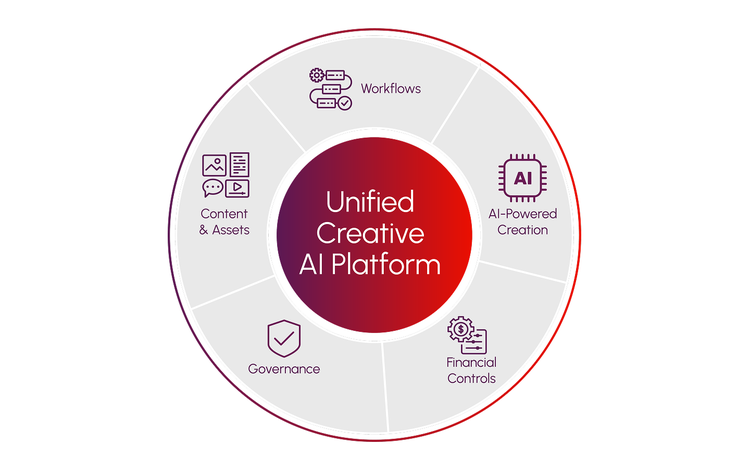
Unified creative AI platform connecting content, workflows, governance, and AI-powered creation.

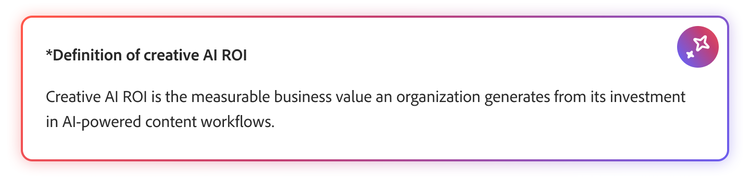
The report also challenges the way enterprises measure creative AI ROI*. The metrics that matter now go beyond time saved on individual tasks. Production throughput, cycle time reduction, cost savings, and scalable governance are where the greatest returns are realized.

The organizations seeing the strongest results aren't just adding AI to existing processes. They're using it to transform how creative work gets done from start to finish.

What this looks like in practice.

The report highlights Stagwell as an example of what this transformation looks like in the real world. Faced with a tight deadline for a new business pitch, the company used generative AI in Adobe Creative Cloud for enterprise to create fully narrated content in-house — work that would typically be outsourced to a production agency. The project was completed in three days rather than several weeks and saved $50,000 in the process. That meant real dollars back in the business, and their creative talent freed up to focus on new work.

The report points to a clear takeaway: fragmented AI adoption creates a ceiling on what’s possible. Leading organizations operate on a unified creative platform where AI, workflows, and governance work together. Adobe Creative Cloud for enterprise helps organizations put this principle into practice.

Read the report to learn how winning enterprises are redefining creative workflows in the AI era.

Definition of creative AI ROI

Let’s talk about what Adobe can do for your business.

Get started