For state and local governments, delivering seamless digital experiences is essential to serving constituents effectively. While agencies continue preparing for upcoming Web Content Accessibility Guidelines (WCAG) compliance deadlines for public websites and mobile applications in 2027 and 2028, digital transformation now extends well beyond accessibility alone. Government services are expected to be easy to find, navigate, and complete — regardless of whether they’re accessed through a traditional search engine, an AI platform, or a government website.
Adobe's 2026 Digital Government Index (DGI) for the United States examines how states are progressing across the digital constituent experience and identifies opportunities to improve service delivery. This year's report highlights that although digital government continues to mature, progress is becoming more uneven as agencies work to modernize fragmented systems, meet evolving accessibility requirements, and adapt to a new era of AI-driven discovery. The findings demonstrate how connected digital experiences and outcomes-focused service delivery are becoming increasingly important in helping governments better serve constituents.
Why digital service delivery matters.
Government websites have typically been the first place residents turn to when they need to apply for benefits, renew licenses, pay taxes, or access critical public services. But with AI search emerging as a primary resource for finding government services, it is vital for agencies to consider how to optimize their website content so it appears in LLM search results. Even when residents make it to the site, if the experiences are difficult to navigate or require unnecessary steps, they face frustration, longer wait times, and additional barriers to accessing services. In fact, agencies that failed to modernize digital service delivery experienced a 28% higher rate of stalled applications and a 40% increase in help desk calls — underscoring the impact disconnected digital experiences can have on both residents and government operations.
Accessibility remains a foundational component of effective digital government. Designing websites and applications that meet the needs of individuals with visual, auditory, cognitive, and physical disabilities helps ensure government services are available to all. As expectations continue to rise, agencies have an opportunity to improve both user satisfaction and operational efficiency by creating digital experiences that are intuitive, connected, and designed around successful task completion.
What the 2026 Digital Government Index reveals.
Adobe’s Digital Government Index (DGI) evaluates how state governments deliver digital experiences across the complete constituent journey. The Index measures capabilities including User Experience, Site Performance, Digital Self Service, Personalization, and AI Readiness, enabling agencies to benchmark their digital maturity and identify opportunities for improvement.
The 2026 findings show continued progress across U.S. digital government, but they also suggest many agencies are at the point where incremental improvements alone are no longer enough. While overall digital maturity continues to rise, momentum is becoming uneven as agencies shift from initial modernization to integration and optimization.
Key findings include:
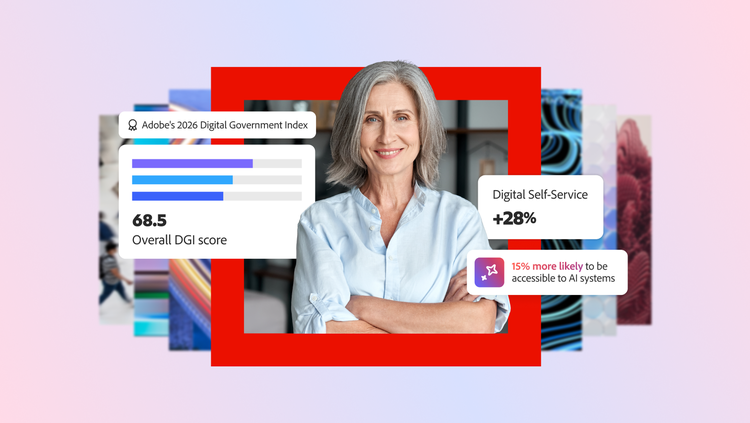
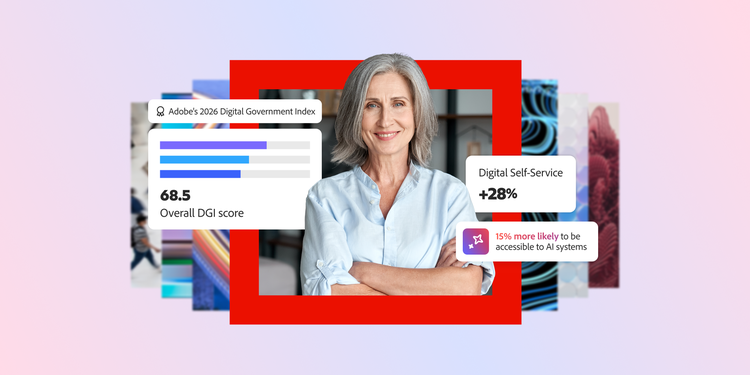
- The overall DGI score increased to 68.5 in 2026, up from 68.0 in 2025, though gains are slowing as states mature and face more complex modernization challenges.
- Customer Experience improved to 68.3 in 2026, up from 66.6 in 2025, while Digital Self Service increased to 73.7 from 72.1 — largely driven by an increase in the Homepage Accessibility Score due to agencies preparing to meet the federal mandate guidelines.
- Site Performance declined to 63.5 in 2026 from 65.1 in 2025, reflecting the growing complexity of legacy technology environments.
- 87% of the agency sites evaluated have content that can be read by LLMs, but only 74% have content likely to be mentioned or cited in AI search results — indicating the potential for misinformation in LLM search results.
It is worth noting that Site Performance decreased while Digital Self Service increased, indicating that agencies may be experiencing trade-offs when implementing new technologies and tools to meet accessibility mandates. For governments to provide a truly seamless citizen experience while meeting federal mandates, they will need to optimize for increasing both Site Performance and Digital Self Service. The 2026 report also examines whether residents can successfully move from discovery to completion. This year saw a decrease in service velocity, or how easily a resident can complete a task, by 5%, even as Customer Experience increased since last year. This indicates that governments continue to improve the ease of delivering services to citizens to further advance their mission outcomes.
Success story: State Health Benefits Exchange
The impact of connected digital service delivery is clear. By modernizing communications, strengthening digital platforms, and using audience insights to improve the user experience, a State Health Benefits Exchange achieved measurable results, including:
- A 62% decline in uninsured residents over time
- A 64% increase in website traffic across three years
- More than 6 million monthly page views
Designing digital services to guide residents through the entire journey, rather than simply providing online access, helps improve both citizen outcomes and operational performance.
How governments can continue improving digital experiences.
As agencies continue modernizing digital services, Adobe recommends several steps to improve constituent experiences and long-term digital maturity:
- Assess current digital capabilities: Audit your platform portfolio to identify opportunities to consolidate technology and deliver more efficient outcomes.
- Design services around complete constituent journeys: Supplement your compliance testing with real user feedback to ensure residents can easily get to their outcome.
- Prepare content for AI-powered discovery: Improve your website’s content structure, authority, and information architecture to be recognized in AI search results.
- Expand personalization and connected experiences: Test and evaluate features — such as dynamic search and tailored messaging — to reduce friction and help residents leverage services more efficiently.
By continuing to invest in connected digital experiences, AI readiness, and constituent-centered design, governments can better meet constituent expectations while improving operational efficiency. To learn more about the Adobe Digital Government Index or schedule an assessment, contact Brian Chidester.