Assign a single owner before the next deployment.
Choose one senior leader with authority over AI outcomes across functions, a dedicated budget separate from adjacent allocations, and a performance evaluation tied to scaling outcomes.





Most organizations are investing in AI, but only a small minority are scaling it successfully. Adobe's global study finds that the difference is not access to better technology, but the operating model built around it. This report examines where organizations stall, what Leaders do differently, and the steps required to turn AI investment into business success.
AI readiness is no longer a question of access to models or the number of pilots underway. Many organizations have already invested in AI and put early use cases into production, yet those with similar technology, investment, and ambition are still seeing very different results. The real differentiator is the operating model around AI: who owns it, how decisions are made, how outcomes are measured, and how AI is embedded into everyday work.
To understand what separates organizations that scale AI from those that remain stuck in experimentation, Adobe commissioned Incisiv to survey 5,633 senior executives across 12 industries and 11 global markets, supported by more than 50 in-depth executive interviews. The findings reveal a clear structural divide.
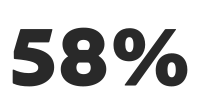
of organizations are stalled at the piloting or deploying stage.
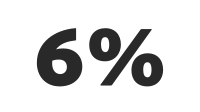
are Leaders that combine scaled AI deployment with a mature operating model.

“The leaders treat the operating model itself as the AI capability — the thing that turns model output into business outcomes. What they do differently is structural. They build ownership, measurement, and decision rights before they scale their AI bets.”
Christopher Young
Senior Director, Global Industry Strategy, Adobe
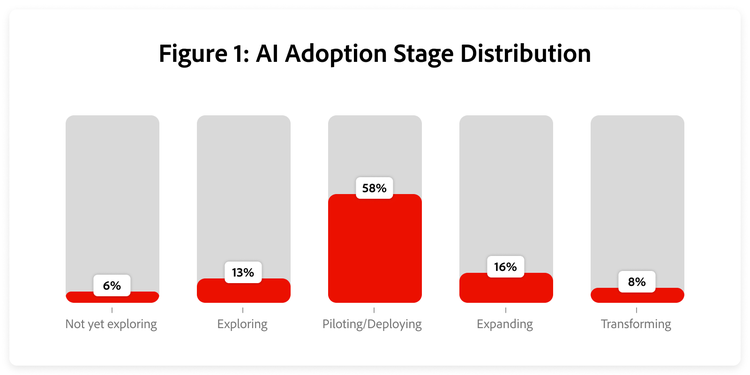
Most organizations don’t have an AI problem. They have a scaling problem and nowhere is that clearer than in the frozen middle. This group comprises 58% of organizations in the study. They are stalled at piloting or deploying stages, even though they have AI use cases in production and early results to show. What they lack is an enterprise operating model. Individual functions deploy AI use cases on their own, but without shared ownership and coordination, those successes remain isolated rather than scaling across the enterprise.
“Leadership wanted to know how fast we were moving on AI. We had a really good answer: lots of launches, lots of activity, and a very full roadmap. Things changed when we were asked how many had changed things. When we finally ran that count, the number was bad.”
Chief Strategy and Transformation Officer,
Consumer Goods Organization
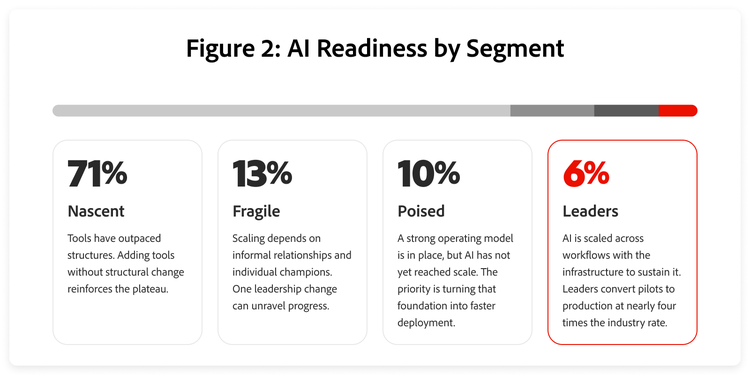
Mapping deployment against operating model maturity reveals four segments: Nascent, Fragile, Poised, and Leaders. Each has a distinct trajectory and set of risks. Adoption stage alone can be misleading, because organizations at the same deployment level may differ significantly in whether they have the foundation needed to sustain scale.
The distribution is heavily weighted toward organizations that are not yet equipped to scale. A large majority, 71%, are Nascent, while another 13% are Fragile. That means 84% are either still building the foundations for scale or advancing on structures that may not hold. Only 6% qualify as Leaders and demonstrate the capability to scale AI workflows (Figure 2).
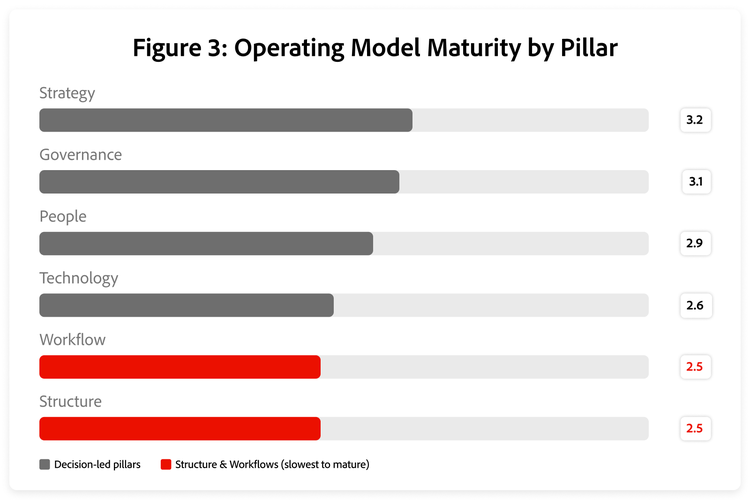
Across all 12 industries we surveyed, organizations are further ahead on defining AI strategy than on changing how the business operates around it. Strategy and governance sit at the top of the maturity tier, while structure, technology, and workflows remain the least mature pillars (Figure 3). The pattern suggests that organizations have made more progress on decisions they can authorize than on structural changes that teams must sustain in daily work.
KEY TAKEAWAY
Moving from the deploying to the expanding stage is the defining test of AI maturity. Organizations need to build structures and workflows in parallel with strategy and governance from day one instead of waiting for plans and policies to be finalized.
Scaling AI requires more than promising use cases. Progress depends on how ideas are prioritized, funded, measured, reviewed, and integrated into work. Gaps across these areas prevent AI pilots from becoming repeatable enterprise capability.
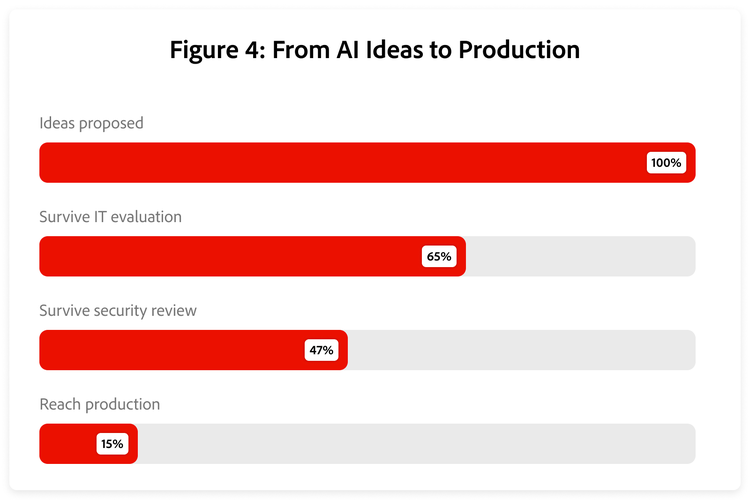
The path from an AI-driven use case idea to production remains narrow because many organizations lack the capacity to evaluate proposals efficiently. Of every 100 ideas proposed, only about 15 reach production, and the ones that get rejected are not necessarily the wrong ones.
Many stall because organizations lack pre-cleared pathways built around approved integration architectures, standardized security reviews for common use cases, and pre-aligned budget categories. As a result, each proposal must be assessed from scratch. The steepest decline occurs during IT evaluation, the funnel’s largest point of attrition, followed by security review (Figure 4).
The same four structural gaps show up the same way across industries, geographies, and organization sizes. Each one reflects an enterprise system that has not kept pace to support AI at scale.

The ownership vacuum.
AI structures exist without AI owners. Leaders are 4.7 times more likely to have a formal owner with budget authority, while committees and part-time roles stall decisions and progress.
The business-IT divide.
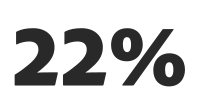
Only 22% of organizations collaborate closely enough between business and IT to support AI. The rest run on tickets and briefs built for transactional work, not for evolving AI use cases.
The measurement gap.
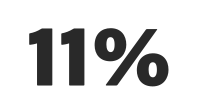
Only 11% of organizations measure AI ROI comprehensively, whereas 10% don’t measure it at all. Activity tracking catches volume, but misses output quality, rework, and the downstream cost of review.
The skills gap.
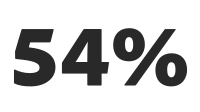
Skills and talent rank as the top barrier, cited by 54% of organizations. The largest gaps sit in architecture, strategic AI thinking, and workflow design, not in prompt-writing.
KEY TAKEAWAY
Executives who have managed AI deployments share the same regret: structural work started too late. Treat operating model design as the first phase of AI deployment. Define metrics, secure budget, assign ownership, align business and IT, and invest in change management before deployments begin.
Leaders do more than deploy AI. They assign accountability, measure outcomes before launch, plan jointly across business and IT, learn from failure, and champion practitioners who prove value in real workflows. Together, these behaviors turn isolated success into repeatable scale.
Leaders stand apart most clearly in the areas that organizations typically struggle to mature: structure and workflows. While many companies have advanced their AI strategy and governance, Leaders have also made the harder organizational changes needed to embed AI into how work gets done. This is the shift from running an AI program to building the conditions for scale. Five behaviors make that shift possible.
The five Leader behaviors reinforce one another. Ownership creates accountability, measurement establishes shared evidence, partnership connects functions, and culture and champions help new ways of working spread. The sequence starts with real ownership: without a dedicated owner who holds budget authority and performance accountability, the other behaviors are difficult to establish and sustain.
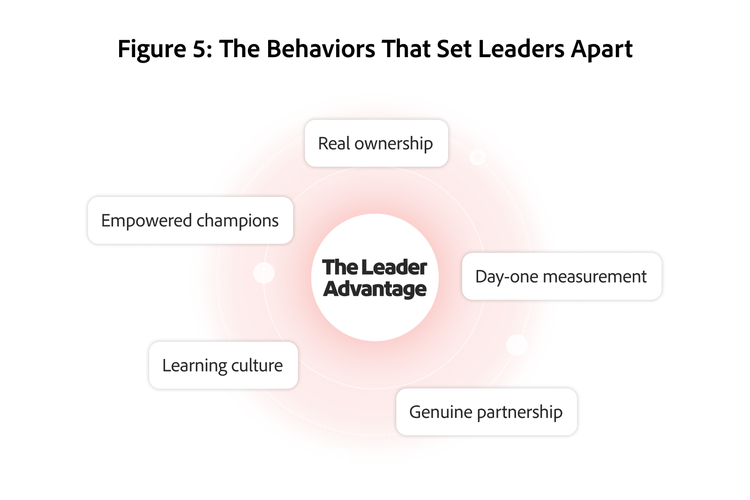
These behaviors translate into five practical lessons for organizations looking to turn isolated AI success into sustained enterprise value.
“Models are commodities. Everyone uses the same GPT-4, Gemini, Kimi, Llama. There is no difference. The advantage isn't the model. It's how we use it, how quickly we know if it's working or not. That makes all the difference.”
Chief Technology Officer,
Financial Services Organization
KEY TAKEAWAY
Treat the five behaviors as a connected system, beginning with one accountable owner. The operating model is the part of AI that compounds. Build it deliberately, and the value gap widens with every deployment cycle.
Assign a single owner before the next deployment.
Choose one senior leader with authority over AI outcomes across functions, a dedicated budget separate from adjacent allocations, and a performance evaluation tied to scaling outcomes.

Build measurement before the model goes live.
Define the outcome metric, establish a pre-deployment baseline, and agree on the attribution method with every affected stakeholder. The baseline cannot be recreated after the model reaches production.

Put business and IT in the same room before the brief is written.
Convene both sides before drafting requirements. Define the problem together and agree on what success means for both, replacing sequential handoffs with joint planning.

Make failure analytical before it becomes organizational.
When an AI program underperforms, begin with analytical questions at the senior level. Signal that failure should produce evidence and learning, not blame or retreat.

Find the AI leaders and amplify them.
Identify the practitioners already making AI work. Give them recognition and a small budget to extend their workflow to one adjacent team and protect them from organizational friction.
AI is redefining how businesses discover customers, create content, and orchestrate experiences across every channel. Realizing that potential takes more than access to models. It requires unified data, connected content workflows, and the governance to put AI to work with confidence.
Adobe provides that foundation. Adobe Experience Platform brings customer data together as the intelligence layer for AI, powering more than a trillion experiences every year. Adobe CX Enterprise extends that foundation into an end-to-end agentic system that orchestrates the full customer lifecycle, from first interaction to lasting loyalty. An integrated content supply chain embeds AI directly into creative and production workflows, while maintaining brand standards and shared governance.
The result is a path beyond AI experimentation and into value realization, on an open ecosystem that works across the tools teams already use. When you are ready to scale, Adobe brings the technology and the expertise to help organizations turn AI into a lasting competitive advantage.
This report is based on global research conducted by Incisiv on behalf of Adobe. The study surveyed 5,633 senior executives across 12 industries and 11 global markets and included more than 50 in-depth interviews. All respondents held formal decision-making authority over AI investment, and 52% held positions at the VP level or above. They worked for organizations with at least $100 million in annual revenue, with 60% representing organizations with more than $1 billion in annual revenue.
The analysis identified 342 organizations as Leaders, representing 6% of the 5,323 active respondents. These organizations combine high deployment velocity with high operating model maturity. Organizational structure was a meaningful predictor of leader status, while company size, industry, and reported AI spend were not.