



Adobe CX AI Maturity Index: Benchmark Your CX AI Readiness

Summary

Enterprises are investing heavily in AI, but most haven't built the infrastructure to run it at scale. The Adobe Customer Experience AI Maturity Index benchmarks where your organization stands across two dimensions, customer experience orchestration (CXO) execution and enterprise-grade control, based on 501 enterprise assessments and 6,885 responses.

AI investment is outpacing CX maturity.

Enterprises are moving from AI experimentation to execution, but customer experience outcomes aren’t keeping pace. Only 12% of organizations have fully orchestrated AI-driven customer journeys, and just 9% report real-time AI personalization in production, even as AI investment grows. The gap isn't ambition or capability. It's operationalization: AI is deployed in isolated use cases instead of scaling as one connected customer experience system across content, data, journeys, and governance.

For many enterprises, execution and control aren’t working together.

21% of enterprises have fully developed responsible AI priorities and initiatives
of enterprises have fully developed responsible AI priorities and initiatives.
1 in 3 teams agree on how AI should be rolled out across their organization
teams agree on how AI should be rolled out across their organization.
1 in 5 organizations have risk and compliance partners equipped to approve AI use at speed
organizations have risk and compliance partners equipped to approve AI use at speed.

Two dimensions determine your AI CX readiness.

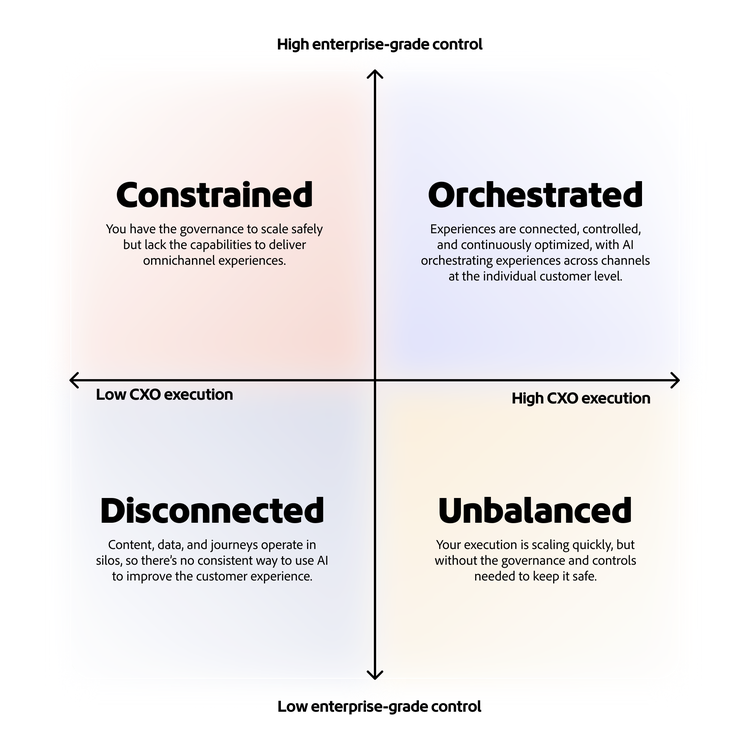
AI maturity is the ability to scale customer experiences with control. The CX AI Maturity Index measures that ability across two dimensions:

CXO execution. The horizontal axis measures how effectively you run customer experiences across content, journeys, and brand visibility — at speed, at scale, and repeatedly.

Enterprise-grade control. The vertical axis measures how confidently you execute with the controls required to scale safely, including privacy, governance, brand integrity, and decision accountability.

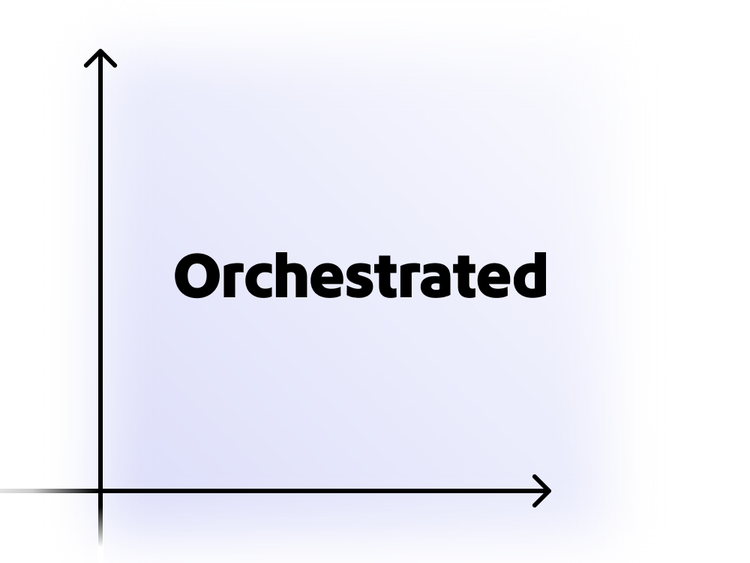
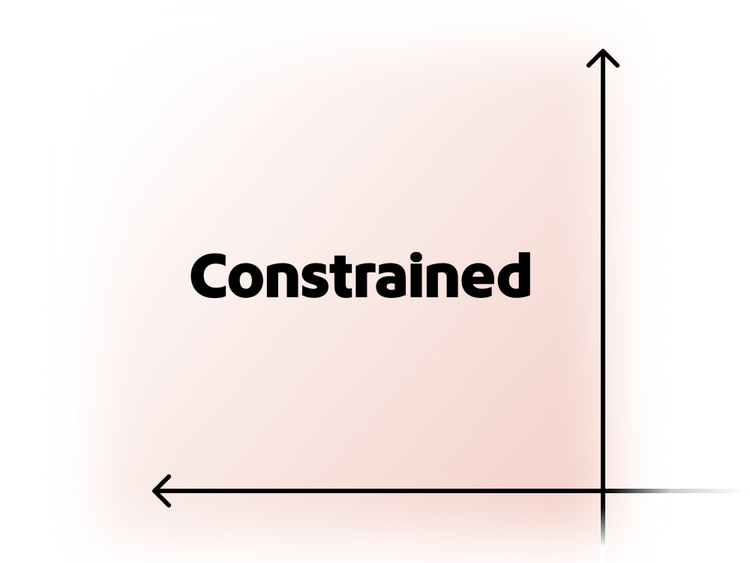
Quadrant chart with enterprise-grade control on the vertical axis, from low at the bottom to high at the top, and CXO execution on the horizontal axis, from low on the left to high on the right. Top left, low CXO execution and high enterprise-grade control: Constrained. You have the governance to scale safely but lack the capabilities to deliver omnichannel experiences. Top right, high CXO execution and high enterprise-grade control: Orchestrated. Experiences are connected, controlled, and continuously optimized, with AI orchestrating experiences across channels at the individual customer level. Bottom left, low CXO execution and low enterprise-grade control: Disconnected. Content, data, and journeys operate in silos, so there's no consistent way to use AI to improve the customer experience. Bottom right, high CXO execution and low enterprise-grade control: Unbalanced. Your execution is scaling quickly, but without the governance and controls needed to keep it safe.

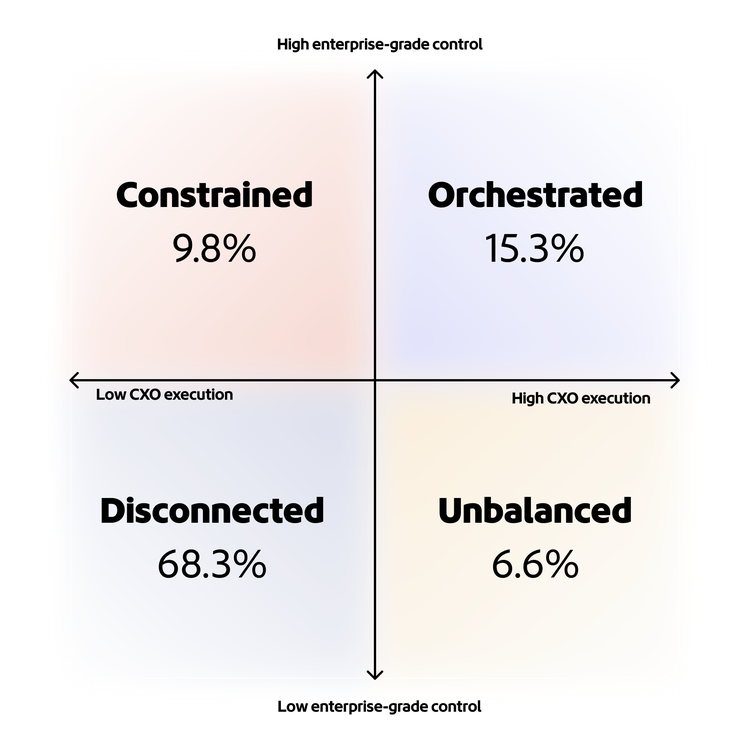
More than two-thirds of organizations (68.3%) landed in “disconnected,” making it the most common state in the diagnostic.

Assess your readiness in 12 questions.

Answer 12 questions about how you deliver customer experiences today and get a clear read on where your business stands in 3–4 minutes. The diagnostic evaluates both CXO execution and enterprise-grade control, identifies the specific constraints limiting your ability to scale, and translates the results into personalized next steps you can act on immediately.

Take the assessment

What 500-plus enterprise leaders told us.

You’re not the only one working through AI implementation challenges. The Adobe CX AI Maturity Index draws on 501 completed enterprise assessments and 6,885 responses across 12 questions. Here’s where organizations land:

Quadrant chart with enterprise-grade control on the vertical axis, from low at the bottom to high at the top, and CXO execution on the horizontal axis, from low on the left to high on the right. Clockwise from top left: 9.8% of organizations are constrained, 15.3% are orchestrated, 6.6% are unbalanced, and 68.3% are disconnected.

Clearly, “disconnected” is the default, not the outlier. Disconnected respondents were also more likely to request a detailed follow-up (73.3%), suggesting the lowest-maturity organizations are the ones most actively seeking a path forward.

Key findings in the data.

Operational AI, not yet systemic.

While 58% of organizations report mid-stage AI maturity, only 11–15% operate AI-native execution models. Most enterprises have folded AI into existing workflows, but few have redesigned the operating system around it.

CX orchestration lags AI investment.

Just 12% report fully orchestrated, AI-driven customer journeys, and only 9% report real-time AI personalization in production. Enterprises are scaling AI capability faster than they’re scaling customer experience maturity.

Governance frameworks, not governance systems.

The majority of respondents (59–67%) say governance policies and workflows exist but are only partially operationalized. Awareness of what good governance looks like has outpaced the ability to execute it.

Human dependency remains structurally embedded.

Only 11% report fully automated governance and approval systems. Most of the work still gets done by hand — someone reviewing, someone approving, case by case.

Demand for clear maturity models.

Advanced maturity states were selected infrequently in the diagnostic, yet users consistently navigated toward them to understand what they looked like. What's missing is a clear model for how mature AI execution actually operates at scale.

Response patterns across all 12 questions, grouped by dimension, with the most common answer for each:

CXO execution

1. Testing and optimizing CX: Occasionally (35%)

2. Content production capacity: Growing, with some efficiency gains (41.7%)

3. Speed to market: 1–3 weeks (47.4%)

4. Journey orchestration: Coordinated across some channels (40.7%)

5. Real-time personalization: Limited, periodic updates only (39.8%)

6. Brand presence in AI discovery: Limited, fragmented insight (40.3%)


Enterprise-grade control

7. Governance and approvals: Partially streamlined (37.2%)

8. Data policies for AI: Defined but inconsistently applied (34.1%)

9. Roles and responsibilities: Ad hoc and informal (31%)

10. Traceability of decisions: Partially documented (47.7%)

11. Brand integrity at scale: Moderate, inconsistently applied (41.7%)

12. Ownership across workflows: Partially defined, varies by team (41.3%)

Across all these questions, the same conclusion holds: Enterprises need a clearer operating model for scaling AI across customer experience, not simply more AI capability. What that model looks like depends on where you’re starting.

Know your state. Know your next step.

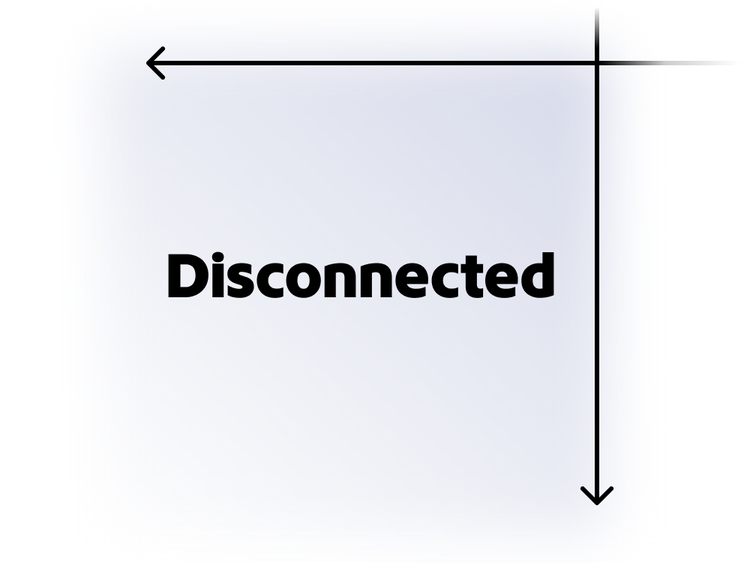
Quadrant chart showing bottom-left disconnected state.

Disconnected (low execution, low control)

Diagnosis: You're producing content and launching experiences, but they aren't connected to a repeatable system. AI exists, but only in isolated pockets.
What's breaking: No shared governance model across teams. Risk and compliance are reactive, not integrated into decision-making. Ownership across content, data, and journeys is unclear.
Why it matters: Without a repeatable system and shared ownership across teams, AI insights never translate into scalable, standardized experiences. Every use case starts from zero.
Next step: Get marketing, tech, and risk teams into a room to agree on who owns what before adding more AI use cases on top of a system nobody’s steering.
Frequently asked questions about AI maturity.

Let’s talk about what Adobe can do for your business.

Get started

I'm the Adobe Assistant. How can I help you today?

1