Accelerate ideation and production with top AI models, unlocked with new enterprise controls in Adobe Creative Cloud.
As generative AI becomes a foundational layer of modern creativity, the question most often asked by creative and IT leaders is not whether to adopt AI, it’s how to scale it responsibly without slowing innovation. The future of creative work depends on trust — trust that the right tools are available to the right people, trust that innovation can move forward within clear organizational guardrails, and trust that creativity and compliance do not have to compete.
We recently took an important step forward for enterprises navigating this balance. We introduced new granular AI model controls in Adobe Creative Cloud, giving organizations precise control over which users and groups can access specific generative AI models. The new controls are aimed at driving the acceleration of ideation and production, while enabling governance.
Adobe Creative Cloud: The ultimate AI-powered destination for content creation.
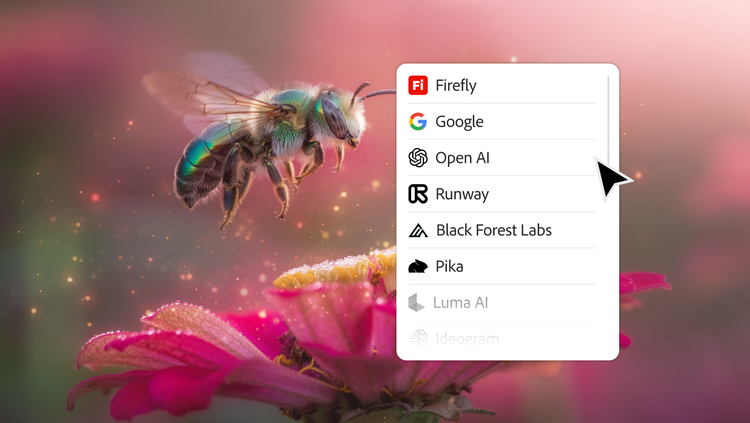
Creative Cloud has long been the home for professional content creation. Today, it is also a comprehensive platform for AI-powered creativity, seamlessly integrating top AI models directly into the tools that teams use every day. Teams can generate images, video, audio, and designs inside Creative Cloud without switching tools or managing separate vendors. For many enterprises, however, the barrier wasn’t access to innovation. It was control.
New enterprise controls.
With new granular controls, enterprise teams can now determine exactly who can access each AI model, ensuring AI usage aligns with internal policy. Creative teams can confidently use AI models, knowing their organization has approved them for use. Adobe and its partner models do not train on customer content, providing additional assurance around data protection.
What this means for IT leaders.
If you are responsible for governance, security, and compliance, you now have precise control without added complexity. You can empower your creative team to use top AI models, with controls that let you decide who can use each model. You can centrally configure role-based access by users and groups and manage access by AI model, all within the Adobe Admin Console. There are no separate tools, vendors, or logins to manage. As new models are introduced, you can maintain oversight while giving teams access to the latest innovation.
What this means for creative leaders.
Creative leaders are under constant pressure to deliver more content, at higher quality, across more channels. With top AI models integrated directly into Creative Cloud, you can empower your team to scale ideation and production in a single, connected environment.
Here are a few examples of how teams are using partner models in Creative Cloud.
Adobe Firefly Boards.
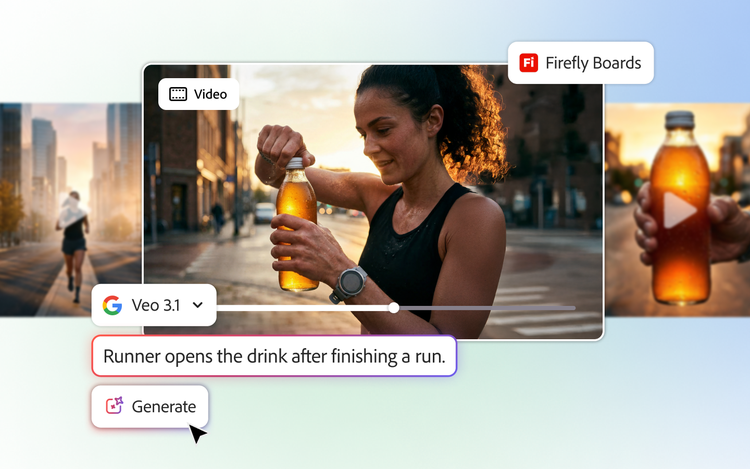
Firefly Boards enables teams to explore ideas collaboratively using top AI models directly on a shared canvas.
- Photoshoot pre-visualization. Use GPT Image to develop mock-ups for locations, lighting setups, props, wardrobe, and talent, aligning stakeholders before production begins and reducing costly reshoots.
- Rapid product prototyping. Leverage Flux Ultra to reuse visual elements, such as fabric, textures, or design styles, to extend product lines, visualize new SKUs, and test creative directions before committing to manufacturing.
- Character and mascot exploration. Use Google Nano Banana to generate and iterate on original characters or brand mascots, refining expressions, styling, and personality traits in minutes instead of weeks.
Production workflows.
AI isn’t confined to ideation. It’s embedded directly into the tools your teams use every day.
- Create high-quality B-roll in Adobe Firefly. Generate environment shots, abstract textures, lighting effects, and transitional visuals for ads, landing pages, and social content using Google Veo — accelerating video production without additional shoots.
- Accelerate image editing in Adobe Photoshop. Use Generative Fill, powered by Google Nano Banana, to quickly add, remove, or transform elements, enabling rapid iteration while staying inside core design workflows.
- Enhance vector creation in Adobe Illustrator. Turn text prompts into editable vector graphics using the Text to Vector Graphic function powered by the GPT Image model, thereby speeding up iconography, pattern, and layout exploration.
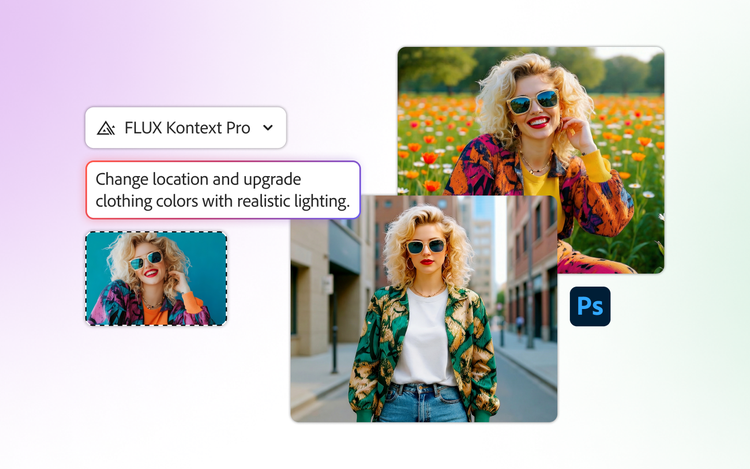
- Generate structured visual variants in Adobe Firefly. Use Flux Kontext to produce cohesive variations that test tone, setting, composition, and hierarchy — ideal for campaign testing and stakeholder reviews.
These are not abstract AI experiments. They are practical, production-ready workflows embedded inside Creative Cloud, designed to help teams move from idea to execution faster.
A real-world example: ProSiebenSat.1 PULS 4.
ProSiebenSat.1 PULS 4, one of Austria’s leading media companies, used Google Veo 3 and Flux Kontext in Firefly Boards to visualize ideas for Farmer Wants a Wife. By integrating AI models directly into its creative workflows, the team achieved 40% faster prototyping for concept development. It accelerated iteration while maintaining control and quality standards.
Scaling AI with trust.
Generative AI is quickly becoming core to how enterprises create and compete. With granular enterprise controls in Creative Cloud, organizations no longer have to choose between speed and safety.
Creative and IT leaders can unlock top AI models across Creative Cloud and ensure they are available to the right people. Innovation thrives when it is trusted, and Adobe is proud to have made trusted AI at scale a reality for enterprises.
Elliot Sedegah is Director of B2B Product Marketing and Strategy for generative AI and Creative Cloud Enterprise at Adobe. He focuses on solutions that help organizations scale on-brand content and accelerate digital transformation. Elliot has played a key role in launching enterprise products and driving adoption across Fortune 500 companies and government organizations.
He holds a bachelor’s degree from the University of Maryland, a master’s degree in engineering management from George Washington University, and an MBA from MIT Sloan.