Today, marketing teams are under pressure to move faster, but the work itself hasn’t gotten simpler. Campaigns still get stuck in production, content goes stale quickly, and testing what works for audiences can take weeks or even months. Meanwhile, customer expectations keep rising with every interaction expected to feel timely, personal, and relevant.
At Adobe Summit 2026, the world’s largest digital experience conference, the popular Sneaks session offers a look at how generative and agentic AI are changing that. Presented by Adobe scientists, engineers, product managers, and designers, these early-stage R&D projects showcase cutting-edge opportunities to reimagine content production, branded experiences and marketing workflows.
This year’s Sneaks introduce exciting new use cases for generative AI and agentic-powered workflows, demonstrating how brands can create personalized, dynamic, and impactful content at scale. Across email, web, video, and design, the move is toward systems that can generate, adapt, and improve as they go — whether that’s turning a single design into a personalized campaign or testing creative before it ever goes live.
Project Concurrent
Marketers often rely on visuals like infographics and charts to bring campaigns to life. But when the underlying data changes, those assets quickly become outdated, requiring teams to rebuild or update them.
Project Concurrent turns static designs into living canvases. Using Adobe Express, marketers can create visuals connected to live data sources, so the content updates itself as information changes, without needing to be rebuilt.
The project also supports more advanced data mapping, allowing marketers to apply formulas and generate dynamic visuals with the help of an AI assistant. Through an open-source plugin in Adobe Express, teams can create compelling visualizations that stay current without constant revision.
https://youtu.be/VCq3a1G4GjI?si=yUQrxf0ZWfNlOs81
Project Face Off
Understanding which digital experiences will drive engagement and conversions is critical, but testing subpar options can negatively affect your bottom line.
Project Face Off simulates A/B testing before anything goes live. It generates audience personas and models how each would interact with different design variants to identify what performs best.
Marketers can prompt specific personas, run tests in seconds, and see not just which version wins, but why — helping mockup and refine designs before they’re built and launched.
https://youtu.be/0MA5ouSlqiY?si=xcp3wx9qkVVGvOnk
Project Page Turner
Delivering experiences that reflect each customer’s needs is critical to building brand loyalty and customer satisfaction, but personalizing every interaction can be difficult to scale.
Project Page Turner generates personalized web pages in real time based on user intent. Visitors can describe what they’re looking for directly on a brand’s site and the page adapts instantly — pulling from Adobe Experience Manager content to assemble a relevant experience.
Each interaction helps inform what content is surfaced next through generative-powered personalization, allowing brands to respond dynamically while staying within brand guidelines and without needing to redesign pages from scratch.
https://youtu.be/Dp52Wi4o8Cc?si=v7mrXhlTKjS20X0x
Project Wise Wire
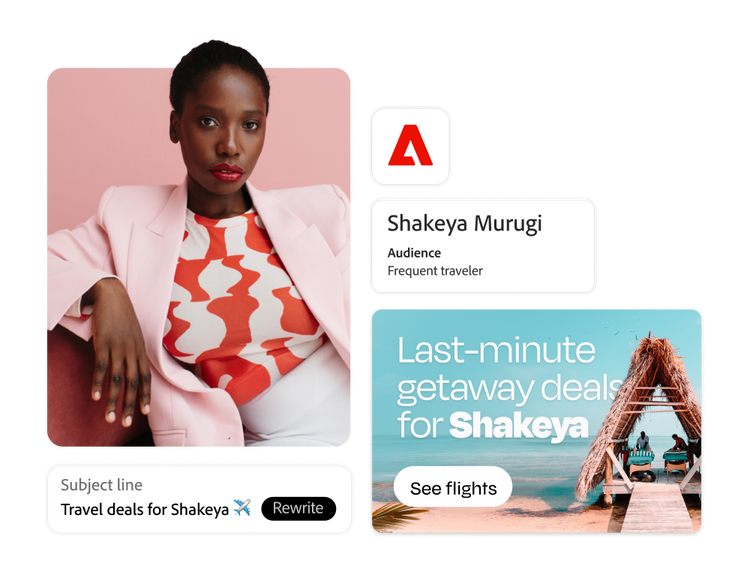
People are inundated every day with emails, messages and ads from brands that are generic and easy to ignore. For marketers, that makes it harder to keep content relevant and personalized at scale.
Project Wise Wire addresses this by turning a static asset into a fully built, personalized email workflow. A marketer can quickly convert a creative asset from Adobe Express into a clean, structured HTML template, ready to be refined and activated in Adobe Journey Optimizer.
From there, a set of agents helps personalize the experience by suggesting more tailored content, updating HTML schema based on audience data, and adapting copy using natural language prompts. Adobe Experience Manager Assets deliver quick iterations on visuals, while Adobe Journey Optimizer helps align messaging and personalization across audiences.
The project also introduces built-in testing and simulation, allowing marketers to preview how different versions of the email will appear across audiences and personas before sending. In minutes, a single image can become a functional, personalized, campaign that’s ready to launch.
https://youtu.be/BUno2fNEi00?si=5ErbrmgTN3hDNBpY
Project Test Kitchen
Creating visually compelling marketing content is often a time-consuming, iterative process for design and marketing teams. Project Test Kitchen supports that process with an AI-powered image generation and editing tool built for exploration. Teams can create moodboards and visual guides from inputs like brand assets, design ideas, or styles, then generate and refine concepts as they go.
The tool allows designers to experiment in a visual interface to explore variations in color, layout, and style while maintaining the core idea, and break designs into reusable elements that can be recombined into new directions. By supporting how teams naturally work, it makes it easier to iterate, collaborate, and move ideas forward.
https://youtu.be/HPjwlZ6knHg?si=pbn1Iy6v6M63EgOr
Project Asset Amplify
Marketers are expected to create content that stays consistent across every channel, but producing tailored assets for social, web, and print often means starting from scratch for each format.
Project Asset Amplify expands a few pieces of content into a full set of campaign assets. Starting with a promotional video or image, it can generate on-brand visuals for different formats and platforms using a simple prompt.
Using large language model design and diffusion-safe backgrounds, the project creates assets that can be used across social media, websites, and print, that can then be refined in tools like Adobe Photoshop or Adobe Express.
https://youtu.be/ez9lIxgWRiE?si=QpxO1Hbtt74TjUIj
Project Tailored Takes
Adapting content for different audiences and markets can quickly become complex, especially when campaigns need to stay consistent across regions and formats.
Project Tailored Takes streamlines video creation and variation using Firefly Foundry, Adobe’s fine-tuned, proprietary generative AI models. Marketers can design storyboards, adapt visuals, and create product variations tailored to different audiences.
The project pulls from brand assets in Adobe Experience Manager and allows teams to adjust product placement, generate localized versions, and edit video in Frame.io — making it easier to produce tailored content across markets.
https://youtu.be/5yWRhRlsuso?si=Lk93hhjnj2oJoiTj
Learn more about Adobe Summit 2026 Sneaks here.
Eric Matisoff is the Analytics & Data Science Evangelist at Adobe with 10 years of digital experience working with data and visualizations. Eric has spent the majority of his time in the industry driving implementation, optimization, analysis, and data integration projects for dozens of Adobe customers on hundreds of digital experiences across high-tech, automotive, consumer products, financial, travel, retail, and healthcare verticals. Eric works with Adobe’s largest accounts to help align their business strategies to the vision Adobe has defined for data ingestion, analysis, and action.