Consumer shopping habits have undergone a structural shift. Where consumers once bounced between web pages to research products and look for deals, a growing share has turned to large language models (LLMs) to do the heavy lifting. By the time shoppers click through to a retailer site, many are ready to purchase. As the busiest shopping season of the year approaches, that shift is turning AI from an emerging source of traffic into one of the most valuable acquisition channels.
Adobe first observed an uptick in AI usage during the 2024 holiday shopping season. Since then, all key metrics have reversed: AI traffic now converts better, drives longer engagement, and delivers more revenue compared to non-AI traffic (such as email, paid search, and social). In this new battleground for consumer attention, retailers are having to engage both shoppers and AI systems that synthesize and surface their products offerings.
Our latest insights are based on direct transactions online, covering over 1 trillion visits to U.S. retail sites, 100 million SKUs and 18 product categories. A companion survey of more than 5,000 U.S. respondents (conducted in September 2026) also provides additional context on how consumers are leveraging AI in their daily lives.
AI traffic to U.S. retail sites remains elevated, performance continues to strengthen.
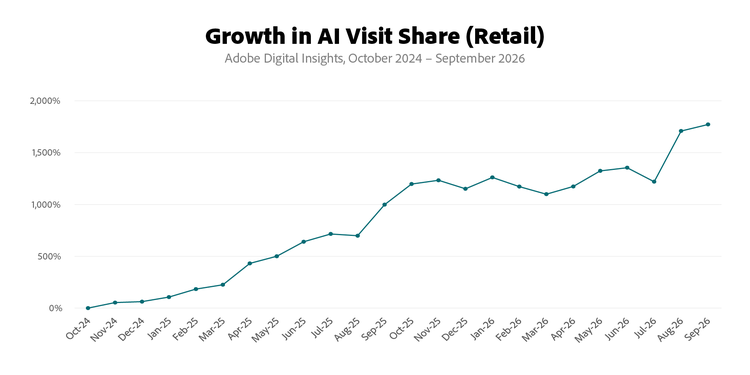
In September 2026, AI traffic to U.S. retail sites (measured by users clicking on a link) grew 71% year-over-year (YoY). Adobe expects continued growth through the holiday shopping season, with AI traffic projected to rise 159% YoY on Thanksgiving, 95% YoY on Black Friday, and 88% YoY on Cyber Monday. AI traffic has now grown substantially every month since October 2024 (when Adobe first began tracking this space), a clear signal of how the channel has become an integral part of how shoppers research and engage.
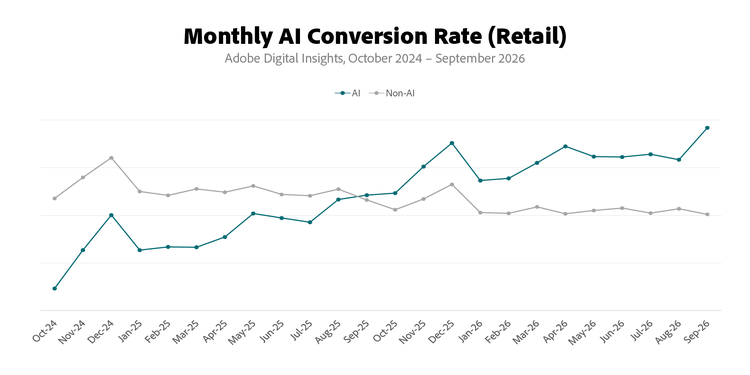
The impact of AI-driven research extends directly into retailer sites. In September, AI traffic converted 90% better (visits that become purchases) than non-AI traffic, the highest level Adobe has observed to date. This is a dramatic shift from just over a year earlier, where in August 2025, AI traffic converted 9% worse. Visitors from AI sources are also more engaged once they land on a retail property, spending 73% more time on site, viewing 25% more pages per visit, and adding products to their carts at a 53% higher rate than non-AI visitors.
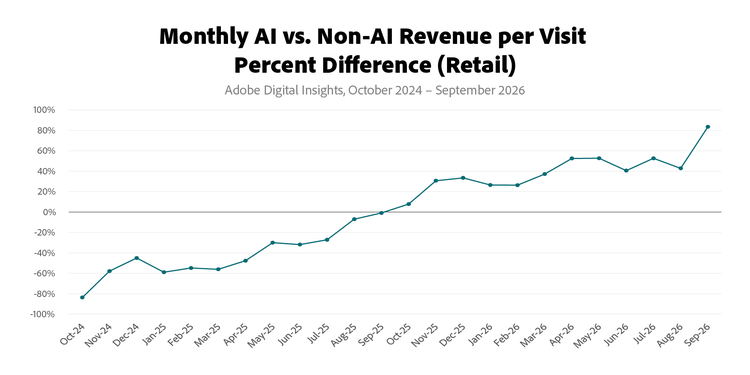
The same trend lines are showing up in actual revenue. In September, AI traffic generated 83% higher revenue per visit than non-AI traffic, the largest gap observed this year. In just 12 months, AI traffic has gone from being worth less than half of a typical visit to nearly twice as much. That premium is expected to continue growing. Adobe forecasts AI’s revenue-per-visit advantage will double this holiday season. As consumers remain price sensitive and seek out the best value, the revenue advantage will accelerate for retailers that can capture the most mindshare on AI surfaces.
Not all content is equally visible to AI.
Capturing the value of AI traffic starts with being visible to AI systems. Adobe’s Citation Readability Score measures how much of a web page's content can be effectively understood and cited by AI. In September, the average U.S. retail homepage scored 63%, meaning more than a third of homepage content is not visible to the AI systems and agents that are sending valuable shoppers to retailers.
Our data also shows that the content AI reads best is content that explains. Electronics leads all retail categories with an overall score of 79%, driven by category pages (79%) and customer service pages (78%) full of setup guides, troubleshooting articles, and detailed specs. Grocery follows at 55%, and General Merchandise homepages score just 40%, where navigation-heavy, promotional layouts give AI less context to work with.
The pages that answer shoppers’ questions, from product details and buying guides to FAQs and return policies, are the ones AI can find, understand, and recommend. During a holiday season when more shoppers will turn to AI before they buy, that content becomes a direct path to the most valuable visitors a brand can get.
What this means for brands this holiday season.
In just over a year, AI-referred shoppers have gone from underperforming the rest of a retailer's traffic to outperforming it on conversion, revenue per visit, and engagement. The gap continues to widen, but brands can only capture that value if AI can find, understand, and recommend them. With consumer adoption accelerating and the holiday season set to bring another surge in AI traffic, the opportunity is only growing. As shoppers turn to this new interface, brands that make their digital content easy for LLMs to find, understand, and cite will be better positioned to stay visible and relevant.