For Maxine Pierce, a Marketing and Business Development Associate who leads bid responses for BDP, a global architecture, engineering, and design firm, pulling together a single submission could require days of work — tracking down relevant case studies from past projects, verifying employee credentials, locating compliance certifications, and cross-referencing contract language.
Over the years, BDP has built a wealth of knowledge across its projects, captured in a wide range of documents. But as that knowledge grew, so did the challenge of finding the right information quickly when it mattered most, especially when preparing competitive bids. With Adobe Acrobat solutions, BDP is now making decades of institutional knowledge captured across its documents easier for employees to access and put to work.
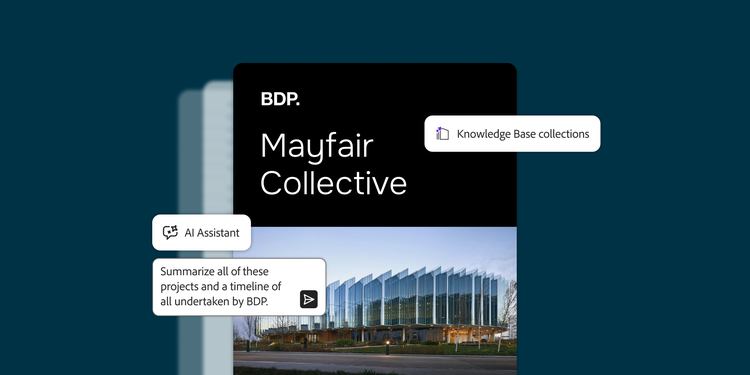
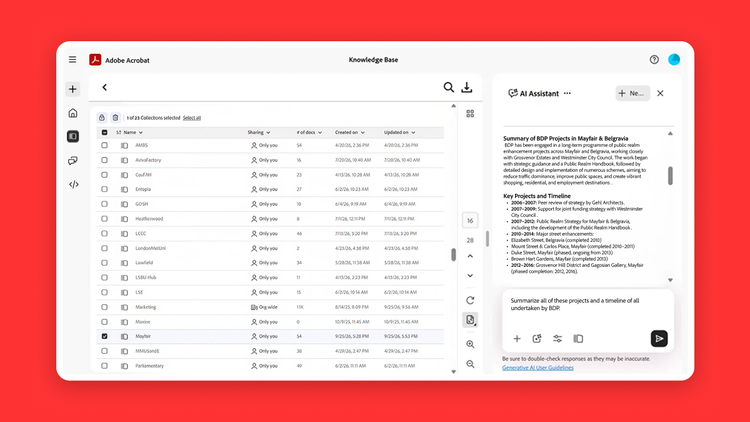
Using Knowledge Base, a new feature in Adobe Acrobat Studio, BDP teams can turn large collections of curated documents into accessible knowledge, finding trusted answers in seconds with citations linking directly to the source — from a sentence or image to a specific table cell. Meanwhile, PDF Spaces provides a shared workspace where teams can draft, review, and refine bid responses, helping ensure their proposals address every requirement in a prospect’s Invitation to Tender (ITT).
From buried document data to trusted knowledge.
Before working with Adobe, BDP built an intranet-based library to centralize its organizational knowledge. Without intelligent discovery capabilities, however, its employees still had to dig through folders and files manually to find what they needed.
With Knowledge Base, the firm gained a trusted source of enterprise knowledge. Rather than manually searching, retrieving, and merging data to extract knowledge from historical documents, the solution connects to BDP’s document repositories and surfaces relevant bid content, case studies, and credentials on demand, in seconds, with every answer cited to the specific sentence in the source document, not just the file name or page number.
By bringing Knowledge Base and Acrobat AI Assistant together within PDF Spaces, team members can summarize tender documents, identify gaps in draft responses, and strengthen their final submissions through AI-assisted review — all in one connected workspace. Employees can ask questions in natural language, specifying the format, word count, and sector focus they need, giving them more flexibility and creativity in how they shape final bid documents.
Once complete, team members use the platform to automatically sense-check BDP’s responses against a prospect’s Invitation to Tender (ITT), helping them fill gaps in their responses, surface relevant case studies they may have overlooked, and ensure every requirement in the tender has been thoroughly addressed.
“Working with Knowledge Base has opened our eyes to blind spots in our bidding process,” says Pierce. “All the knowledge in our organization is just one question away, which means we can show off the full scale of BDP’s capabilities while responding to each prospect’s needs more completely.”
Turning AI insight into connected workflows.
One of the most immediate benefits for BDP was how quickly teams could start working with the Acrobat platform solutions, no lengthy implementation or IT project required. Junior team members draft the firm’s initial bid responses in PDF Spaces, where they are then reviewed and refined by experienced staff, all on the same platform. This collaborative approach drives transparency and trust, strengthening both the quality of submissions and the development of the team.
Once a bid is drafted, teams upload their proposals back into PDF Spaces and ask Acrobat AI Assistant for a final review. This often surfaces what a manual review might miss, such as a tender requirement that slipped through or a strong project credential that got left out.
Integrations between Adobe Acrobat and both Microsoft SharePoint and Microsoft Teams have allowed BDP to curate project-specific knowledge banks for employees across functions. The SharePoint integration makes it easy for teams to find up-to-date source information to inform their decision-making, while the Teams integration allows them to quickly query Knowledge Base directly without toggling between applications.
With trusted, cited intelligence at their fingertips, BDP’s teams spend less time in the archives and more time doing the work that drew them to architecture and design in the first place: solving complex problems for clients.
Building trust in AI workflows.
Bid processes were just the beginning for BDP. As its teams saw how AI could help them to better work with their company’s collective knowledge, adoption began to extend beyond bid management. Today, teams from HR to engineering are embracing AI assistance in their own document work.
This transformation is especially striking when one considers that BDP’s leadership was once wary of trusting AI agents with security, governance, and traceability at stake.
In a bid, for instance, it’s not enough for AI to provide teams with an accurate answer; that answer must also reflect the firm’s own experience. Every claim BDP makes must trace back to its own project history, a bar that rules out general-purpose AI tools without enterprise-grade citation and source attribution. As importantly, the firm must trust that the information its teams create and share each day is grounded and governed.
“We’ve built a reputation for pushing boundaries while staying true to our purpose of designing with people in mind and making a positive impact. Using AI without guardrails would conflict with that mission,” explains Alistair Kell, COO, BDP.
Working with Adobe’s trusted solutions has helped BDP achieve this combination of proven results and peace of mind around accuracy and governance. In turn, this trust has shifted how AI is viewed across the firm, so much so that its teams now work closely with Adobe to shape the Acrobat platform roadmap, including AI-powered capabilities built for design-oriented businesses.
BDP’s journey with the Acrobat platform has validated what its leadership once questioned — that AI can enhance the way a design firm works without compromising the standards of accuracy, attribution, and creative integrity the firm was built on. What started as an experiment in its bid process has become a blueprint for how BDP’s teams across the enterprise access, understand, and act on the knowledge their organization has built over six decades.
“The best AI solutions are like Fisher-Price toys,” says Kell. “Not in the sense that they’re rudimentary, but rather that they’re simple, robust, and trustworthy. Our relationship with Adobe is strong because of the trust we’ve built over months of testing, discussing, and refining how we use AI in our connected document workflows.”
Tired of feeling like your bids and proposals are stuck in last year’s files? Unlock trusted, cited answers across curated document collections with Adobe Acrobat Studio.