Powering the future of travel and hospitality with AI-driven customer experience.
In travel and hospitality, experience is the product, and its value is increasingly shaped by how travelers discover, validate, and engage with brands long before they ever reach a booking engine. More than seamless transactions or competitive pricing, today, travelers expect journeys that feel curated, responsive, and trustworthy from their first moment of inspiration to the moment they return home.
To understand how travel brands are navigating these shifting dynamics, Adobe commissioned Incisiv to survey 565 travel and hospitality leaders across nine global markets, with 65% representing enterprises with over US$1 billion in annual revenue and 58% at vice president or above levels. The findings highlight where progress is being made, where foundational gaps persist, and how AI is reshaping the future of connected traveler experiences.
The travel journey is fluid, but continuity remains fragile.
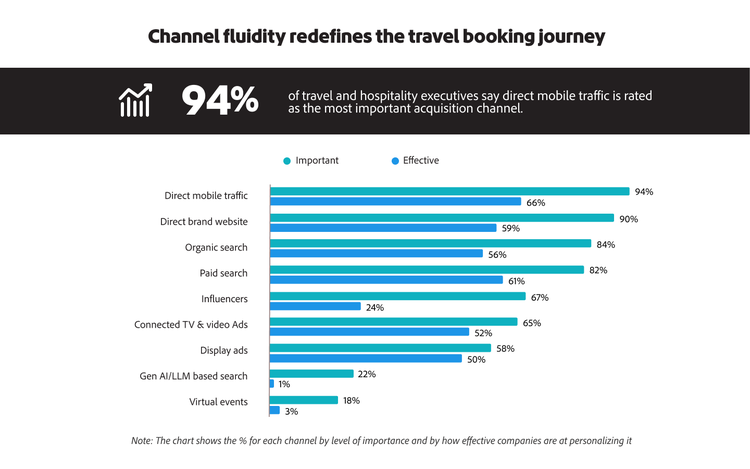
Travelers rarely move through a single device or channel when planning a trip. Discovery often begins on mobile, shifts across platforms for comparison, and frequently ends on desktop for more complex bookings, such as cruises or multi-leg itineraries. Mobile remains critical, as direct mobile traffic is now rated as the most important acquisition channel by 94% of travel and hospitality executives, yet it is rarely where journeys conclude.
This cross-device behavior raises expectations for consistency. Saved itineraries, relevant recommendations, and contextual prompts should follow travelers as they move between screens. Brands that design for this continuity, rather than optimizing each channel in isolation, are better positioned to reduce friction and build booking confidence.
Social validation now defines trust.
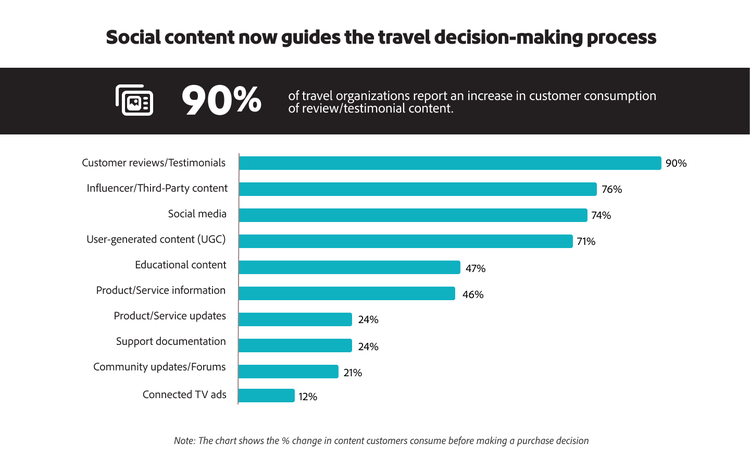
Trust in travel has shifted decisively toward community voices. Travel organizations report that 90% have seen an increase in customer consumption of review and testimonial content, while nearly 9 in 10 travelers consult reviews before booking. At the same time, roughly three-quarters are consuming more influencer or third-party content than in the past.
These behaviors are reshaping how destinations are discovered and decisions are made. Short-form, authentic content shared by real travelers now influences itinerary planning as much as traditional brand messaging. Leading brands are responding by investing in review management, amplifying user-generated content, and partnering with authentic creators.
AI-powered discovery is elevating the research phase.
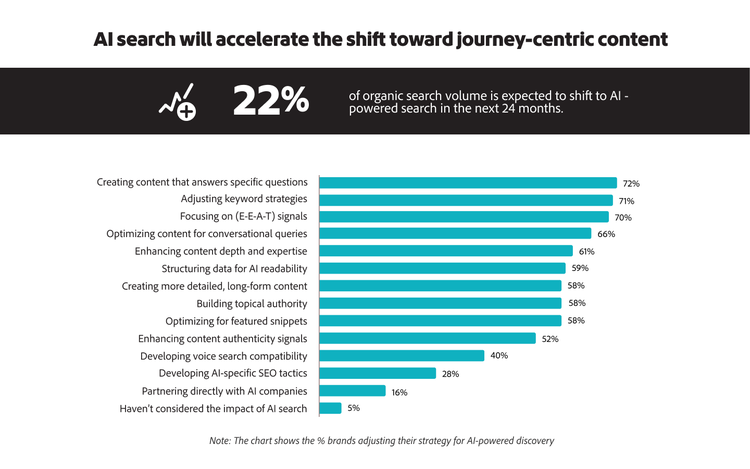
Search behavior in travel is undergoing a structural shift. Leaders expect 22% of organic search volume to move to AI-powered discovery within the next 24 months, as travelers increasingly rely on conversational queries rather than traditional keyword searches.
This evolution is expanding the importance of the research stage of a journey. Travelers want curated and authoritative content that helps them explore and validate options, not just booking pages. Brands that restructure content around experience, expertise, authoritativeness, and trustworthiness (E-E-A-T) are positioning themselves to stay visible as AI-driven discovery becomes a dominant gateway to the travel funnel.
Fragmented data is the hidden barrier to personalization.
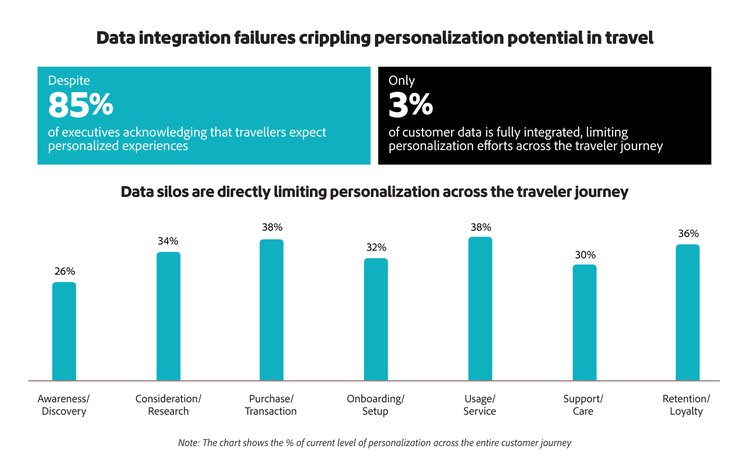
Personalized experiences are no longer a differentiator, they are an expectation. Most travel and hospitality leaders recognize this, with 85% acknowledging that travelers expect tailored interactions. Yet nearly all customer data remains fragmented or siloed, making this expectation difficult to meet.
Today, only 3% of brands report having fully integrated customer data, limiting their ability to recognize the same traveler across platforms or act on real-time behavioral signals. The impact is felt at critical moments: loyalty members having to repeat information, irrelevant offers interrupting research, and service interactions that lack context. Brands that prioritize consolidating traveler profiles gain a foundational advantage in delivering relevance across the full lifecycle.
Marketing as a revenue engine.
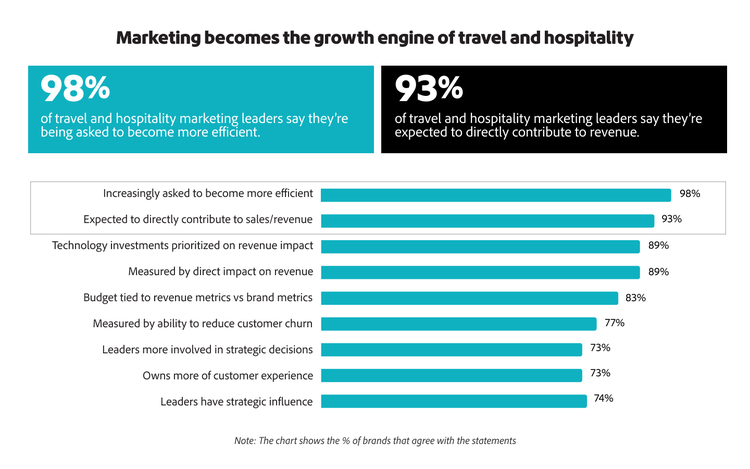
The marketing mandate across the travel and hospitality space has evolved, with 98% of leaders reporting pressure to become more efficient and 93% saying they are now expected to directly contribute to revenue.
This shift is redefining how success is measured, from awareness to bookings, occupancy lift, and guest lifetime value. AI-powered analytics are enabling teams to quantify incrementality, distinguish first-time from repeat bookings, and optimize spend with far greater precision. Marketing teams that embrace this performance mindset are emerging as strategic growth drivers rather than cost centers.
Generative AI and agentic AI are reshaping content and service economics.
Generative AI is changing how travel content is produced and scaled. While only 9% of brands are currently scaling generative AI for content operations, those that have been able to scale it reported tangible gains, including higher content output and lower cost per piece.
The adoption of agentic AI is also accelerating, with more than two-thirds of travel and hospitality organizations actively exploring or implementing these capabilities. As of now, these companies have an early focus on AI-powered customer support agents that manage traveler queries, reduce wait times, and deliver multilingual service at scale.
However, governance remains an open risk, with just 8% of brands reporting formal AI frameworks in place. The solution is not simply more automation, but better orchestration by embedding quality controls, traveler feedback loops, and cross-functional accountability into AI workflows so that efficiency gains can translate into sustained competitive advantage.
The road ahead for travel and hospitality leaders.
To close the gap between changing traveler expectations and operational reality, leaders should focus on three priorities:
- Elevate traveler trust through peer-driven engagement by proactively managing reviews, amplifying user-generated content, and building authentic influencer partnerships.
- Unify customer data to enable journey-centric personalization by investing in integrated platforms that support cross-device continuity and predictive engagement.
- Operationalize AI with accountability by scaling generative AI and agentic AI with embedded quality controls, governance, and feedback loops.
The future of travel and hospitality will be defined by how intelligently brands connect trust, omnichannel engagement, and AI-powered experiences across every moment of the traveler journey.
Read the full report to see how leaders in the travel and hospitality space are redefining customer experience in an AI-driven world.
Julie is an entrepreneurial executive with over 25 years of experience defining strategy, creating categories, accelerating, and achieving hyper-growth objectives backed by data-driven insights for Fortune 500 brands in both travel and retail/CPG. In 2013, she pioneered one of the first micro services architecture, creating a headless approach on how services are delivered to customers. This improved both topline growth and operational efficiency, delivering speed to market focused on automation. She was onboarded in 2016 as a global executive advisor to travel, hospitality, and dining brands, informing C-level executives, senior leadership, and their board of directors with thought leadership, inspiring and supporting brands on their digital transformation around the world for Adobe.